


A month ago we said we'd sit with Claude Fable 5 for a while and come back with a considered take once the launch noise died down. Turns out the noise didn't die down, the model did. Fable 5 launched 9 June 2026, got pulled globally by a US export-control order roughly 72 hours later, sat dark for 18 days, and only came back online on 1 July. You can't review a model you had for three days, and anyone publishing a confident capability verdict right now is reviewing a press release. What the month actually produced is a different, more useful story: what it looks like when a frontier model vanishes out from under its customers overnight.
Here's the properly dated version, because the loose version going around ("it was down for most of a month") undersells how clean this actually was.
9 June 2026: Anthropic launches Claude Fable 5 (the general, safer-tier model) alongside Claude Mythos 5 (a more restricted tier), available across the API, web, and AWS. Normal launch, normal excitement.
12 June 2026, around 5:21pm ET: Anthropic receives a US government export-control directive citing national security and jailbreak concerns. The company suspends access to both models worldwide, not just for US users, everyone, everywhere. That's about 72 hours of availability before the switch flipped. Worth being precise here: this hit the two newest, most capable releases specifically, not Anthropic's established Claude line-up. If your production workload was already running on an earlier Claude model, it kept working through all of this.

12 June to 1 July 2026: dark. Not degraded, not rate-limited, just gone. 18 days, with no confirmed full return in between, whatever partial-availability rumours were floating around at the time.
30 June 2026: the Commerce Department lifts the export controls, and Anthropic posts that Fable 5 "will be available again globally tomorrow," after what it describes as "a series of productive conversations with the US government," confirming it's redeploying with a new set of classifiers.

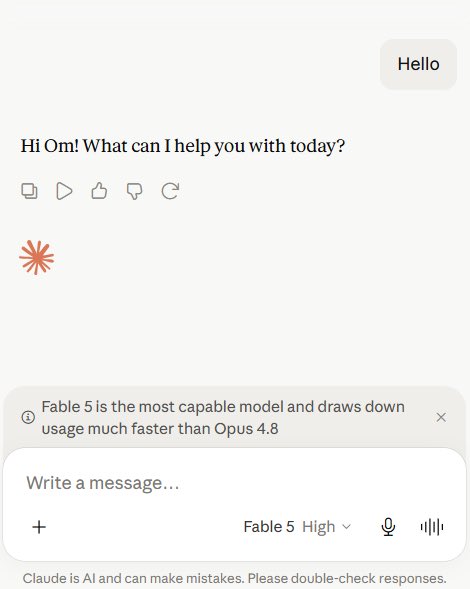
1 July 2026: it's back. The US-time restoration landed as the early hours of 2 July in GMT, which is when multiple users, including @aiera_tech, @deepakThamizhK and @omjain23, posted independently within minutes of each other confirming access had returned, with usage capped at roughly 50% of normal weekly limits until 7 July, shifting to a credit-based system after that.

Three days on, eighteen days off, back on. That's the shape of it. Not staggered, not partial, not a slow drip of regional restores. One switch, flipped twice, 18 days apart.
Now the uncomfortable bit. Back in June we told you we'd run Fable 5 against real Webcoda client workloads (government content migrations, the grinding, high-volume work that actually tells you whether a model's worth double the price) and report back honestly. That test never happened. The discount window Anthropic offered closed on 22 June, while the model was still suspended. We couldn't run a real-workload test on a model we couldn't open. It came back this week with a brief 50%-limits window, and a half-run test on a rate-limited model would've told you less than nothing anyway. So we're not fabricating a benchmark to save face, and we're not making a fresh promise to test it "soon" either. We've already burned that line once on this exact model.
What actually matters here isn't whether Fable 5 is good
It's this: a frontier AI model, from a serious, well-capitalised vendor, got switched off nationally by government order with zero notice to customers, and stayed off for weeks. Not a rumour, not a hypothetical risk consultants like to gesture at in slide decks. It happened, it's documented, and it happened to one of the two or three biggest labs in the world.
If your product, your client-facing tooling, or your internal workflow is hard-wired to a single model from a single vendor, that risk is no longer theoretical. It's a line item. What do you actually do the day your model vendor gets a letter like the one Anthropic got on 12 June? If the honest answer is "panic, then improvise," that's worth fixing before it's your problem and not Anthropic's.
Practically, that means three unglamorous things. Don't hard-code your product to one model's API if you can help it, an abstraction layer that lets you swap providers costs a bit of engineering time up front and saves you a very bad Wednesday later. Know your fallback path before you need it, which model, which vendor, roughly what it'll cost, and whether your prompts'll even work there without a rewrite. And actually read the availability terms in your vendor contract, because most don't have an SLA at all for "your government orders us to switch you off." That's not an oversight, it's a gap nobody's filled yet because nobody's had to.
Here's where that advice needs a genuine caveat, not a soft one. Multi-vendor abstraction insures you against Anthropic-specific problems, an outage, a price hike, a company going under. It does not insure you against what actually happened here, which was a government deciding a whole category of frontier capability needed restricting. If the concern is "this class of model is dangerous enough to export-control," a comparably capable release from OpenAI or Google sits inside the same regulatory blast radius, not a diversified one. Swapping vendors is real protection against company risk. It is not protection against policy risk aimed at the frontier tier generally, and pretending otherwise would be selling you the wrong insurance. The actual hedge for that second risk looks different: don't build your core, can't-lose-it workflow on a model that launched last week, let anything genuinely new prove out for a stretch before it's load-bearing, and watch the regulatory conversation the way you'd watch any other input cost. Both hedges are worth having. They are not the same hedge, and the article would be selling you short to pretend they were.
Now, the obvious pushback, and it's fair: this was a one-off geopolitical event. Export-control orders against a specific model over jailbreak concerns aren't a monthly occurrence, and generalising a durable risk from a single incident is thin evidence. There's a sharper version too: businesses already run entirely on AWS or Azure with no real contingency plan for a regional outage, so why's a single AI vendor suddenly the risk worth an article? Both points land. But they don't cancel out, they compound. AWS outages are usually measured in hours and almost never government-ordered; this one ran for weeks and was ordered deliberately, by a national government, on national security grounds, a category of risk cloud infrastructure genuinely doesn't carry the same way. And the fact most businesses already tolerate undiversified cloud risk isn't proof model risk is fine too, it's proof risk tolerance across the AI stack has been set by convenience rather than anyone actually pricing the downside. Worth saying plainly, this advice also happens to line up with the kind of resilience work an agency like ours gets paid to do. Weigh that in, don't dismiss the point because of it. The event's real, the pattern's n=1, and the sensible response is neither panic nor a shrug, it's building the fallback path you'd want regardless of whether this ever happens again.
Usual disclosure: we use Claude every day at Webcoda, and this site's tooling is built on it. Factor that in.
Anthropic just released Claude Mythos to the public. Except they didn't.
Everyone spent six months waiting for Claude Mythos, and prediction markets priced its launch at 93%. What Anthropic actually shipped is Claude Fable...
Read full article
The US government just pulled Claude Mythos offline globally. Three days after Anthropic launched it.
Five days ago we published three predictions about Claude Fable 5. One has already resolved wrong: a US government export control directive pulled...
Read full articleThe next real test of any of this is simple: whether it happens again, to Fable 5 or to something else entirely. We're not putting a date on that. We're just going to make sure our own fallback path is drawn up before we need it, which is the whole point of writing this down in the first place.