

Sony Music Publishing and Warner Chappell sued Anthropic on 28 August. With a public IPO prospectus reportedly due later this month, you'd expect copyright to be near the top of the company's worries.
CNBC reports that the AI backlash, including public opposition to data centres, will feature among the filing's risks too. That's reporting from people familiar with the matter. We haven't seen the public document yet, or how it weighs one risk against another.
The infrastructure risk interests me because Anthropic can negotiate a settlement and keep selling access to Claude. It can't serve more customers from a data centre that's waiting for permission to connect to the grid. A bigger budget doesn't necessarily get the power switched on any sooner.
I use Claude every day at Webcoda, and this site's tooling runs on it. I'd like the service to keep getting better. That also makes me interested in what could stop it growing, beyond the lawsuits that tend to get the headlines.

The backlash that has a postcode
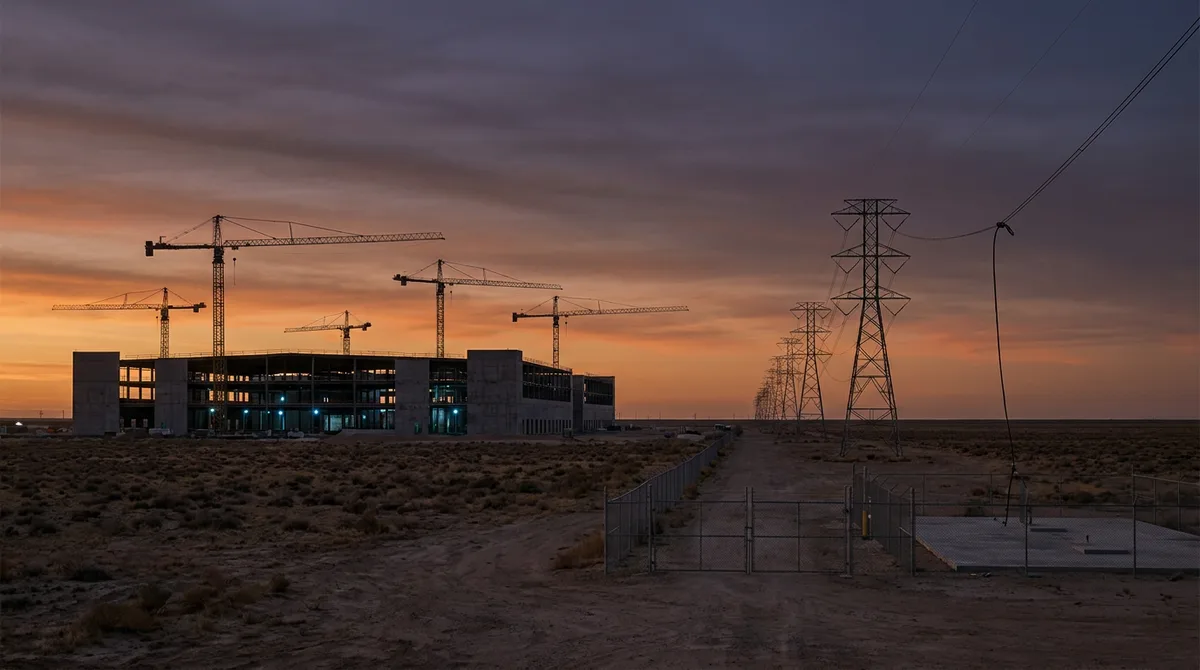
In November 2025, Anthropic announced $50 billion of US data centre investment with Fluidstack. It named Texas and New York, with more sites to follow. Ten months later, both states have put restrictions on the industry's expansion.
New York moved first. In July, Governor Kathy Hochul signed Executive Order 62, pausing discretionary permits for new or expanded data centres of 50 MW or more while the state prepares an environmental assessment. That process could take up to a year.
TeraWulf's Lake Mariner campus hosts the Fluidstack build in New York. Its response matters: the company says the site is already operational and its expansion supporting Fluidstack and Google is fully permitted. A statewide pause doesn't mean every building has stopped.

Three weeks later, Governor Greg Abbott ordered an audit of data centres advancing through ERCOT's grid connection process in Texas. The queue held about 474 GW of requests, more than five times the grid's record peak demand, roughly 90% of it data centres. Five more Texases, all wanting a socket at once. They're requests, though, not a forecast that all that demand will arrive.
Anthropic has been identified in reporting as the tenant at Rockdale and as a potential tenant at a proposed campus in Bastrop County. I can't show you that either project is caught by the audit. The narrower point is enough: the first two states Anthropic chose for its announced expansion are now reassessing how much of this infrastructure they'll allow, and on what terms.
Memphis shows how complicated that can get even when the buildings are already there. An SEC-filed description of Anthropic's compute agreement puts the full monthly fee at $1.25 billion for access to capacity across Colossus and Colossus II. The NAACP publicly criticised Anthropic's use of the first site in May.
There's also a federal pollution lawsuit against xAI over turbines powering Colossus II. That suit is against xAI, not Anthropic, and doesn't establish that Anthropic's service has been interrupted. But Anthropic is buying capacity from a supplier whose power arrangements face sustained local opposition.
The point isn't that Anthropic chose badly. It's that it chose, and those places have politics.
Gallup gives some sense of how difficult those politics have become. In its March survey, 71% of US adults said they'd oppose a data centre in their area, compared with 53% for a nuclear power plant. More people objected to having a data centre nearby than a nuclear plant. That's a difficult starting point for an industry that needs communities to accept a lot more construction.
I wouldn't read that as proof any particular project will fail. I'd read it as a reason to be sceptical when a capacity announcement comes with a confident delivery date and little about how the power will get there.
The backlash that has a docket
The Sony and Warner complaint alleges large-scale downloading of pirated books and the scraping of licensed lyric services Musixmatch and LyricFind. It names Dario Amodei and co-founder Benjamin Mann personally and seeks up to $150,000 per work for wilful infringement.
Anthropic told Reuters: "This is the third lawsuit from the same lawyers, recycling allegations from cases already before the courts." It says training is fair use.
That response is narrower than it sounds. The same firm brought the two Concord cases, but BMG and Round Hill have also sued with different lawyers. Sony and Warner's case brings the music total to five. There's no reason to assume those claims will disappear, or that they'll all end on terms Anthropic likes.
The useful comparison is a case that did settle. In Bartz, Judge William Alsup ruled in June 2025 that training on lawfully acquired books was fair use. The dispute over acquiring pirated books survived. Anthropic agreed to pay $1.5 billion in a settlement that received final approval in July 2026.
That distinction is easy to lose in a headline. The ruling wasn't permission to pirate books, and the settlement didn't buy protection against all future claims or claims about model outputs.
What a settlement can buy
The figures here are US dollars. Bloomberg reported that Anthropic's annualised revenue run rate passed $65 billion at the end of July. At that rate, the $1.5 billion Bartz settlement amounts to about eight days of revenue.
It's an uncomfortable comparison if you make your living producing the work these systems train on. A sum that sounds enormous can look much smaller beside the business built around it.
There are limits to the arithmetic. Annualised revenue isn't profit or cash in the bank. This uses a later run rate to put the settlement in perspective; it doesn't tell us how easily Anthropic could pay it. And one settlement with authors doesn't cap the exposure in five music suits. Future cases could cost far more or seek restrictions on what the company can do.
Still, compare that settled bill with the Colossus agreement: at the full monthly rate, $15 billion a year for compute across the two facilities. Ten times the Bartz settlement, every year.
That's why I'd take the data centre risks seriously. A settlement resolves a defined dispute on agreed terms. Those can go beyond payment: Bartz also requires the destruction of pirated books. But the company knows what it has to do. An unsigned permit or an unavailable grid connection leaves it waiting for capacity it was counting on. It can try another supplier, but that supplier needs power and permission too.
There's a limit to what this tells us about the IPO. We don't know how Anthropic will describe the risks in the public filing. We also don't know whether its existing contracts protect it from particular delays. Those details could change the comparison considerably.
But the ability to secure enough working compute is a condition of growth. It deserves attention alongside the question of who gets paid for the training material.
That second question matters to me too. I've run websites for twenty years, and ClaudeBot turns up in this site's logs. I don't find it reassuring to think of disputes over content as an expense a much larger business can absorb. Understanding why a risk might rank lower for Anthropic doesn't make it less consequential for the people on the other side.
If you're deciding what to let crawlers access on your own site, we've covered those choices separately.
The AI Crawling Decision: Strategic Choices for Australian Website Owners
Whether you want AI systems discovering your business or prefer strategic content control, understanding AI crawling is essential. Learn how to...
Read full articleWhat I'll look for in the prospectus
Reuters reported on 4 September that the public prospectus is now expected in late September, with IPO marketing starting in mid-October at the earliest. The timetable has already moved. When the filing appears, I'll look for what Anthropic says about capacity that isn't yet connected, contracts that depend on permits, and what happens if a supplier can't deliver.
I'll read the litigation disclosures alongside those commitments. Does the filing put a range on potential costs? Does it describe claims that could restrict operations? How much uncertainty is left in each?
I want to know which commitments it can rely on and which still depend on someone else saying yes.
I don't know what the filing will reveal. If it shows ample secured capacity and serious unresolved litigation exposure, I'll have to revise this view. For now, the question I'd bring to it is simple: how much of Anthropic's promised growth already has somewhere to run?
---
Sources
- Reuters, via MarketScreener. "Anthropic IPO launch shifts toward mid-October, sources say." 04/09/2026. https://www.marketscreener.com/news/anthropic-i...
- MarketScreener/Reuters. "Anthropic plans to publicly unveil IPO prospectus after Labor Day, the Information reports." 27/08/2026. https://www.marketscreener.com/news/anthropic-p...
- CNBC. "Anthropic IPO filing will show AI backlash as a risk factor, sources say." 21/08/2026. https://www.cnbc.com/2026/08/21/-anthropic-ipo-...
- Bloomberg. "Anthropic's Annualized Revenue Tops $65 Billion Before IPO." 17/08/2026. https://www.bloomberg.com/news/articles/2026-08...
- Anthropic. "Anthropic invests $50 billion in American AI infrastructure." 12/11/2025. https://www.anthropic.com/news/anthropic-invest...
- CNBC. "Riot Platforms strikes deal with Anthropic as bitcoin miners shift focus to AI infrastructure." 11/08/2026. https://www.cnbc.com/2026/08/11/riot-platforms-...
- KXAN. "AI giant Anthropic in talks to lease massive Bastrop County data center, sources said." August 2026. https://www.kxan.com/news/local/ai-giant-anthro...
- Governor Kathy Hochul. Executive Order No. 62. 14/07/2026. https://www.governor.ny.gov/executive-order/no-...
- The Block. "TeraWulf falls 7% after New York orders one-year pause on new data center permits." 15/07/2026. https://www.theblock.co/news/business/2026-07-1...
- Office of the Texas Governor. "Governor Abbott Directs Comprehensive Data Center Audit." 03/08/2026. https://gov.texas.gov/news/post/governor-abbott...
- NAACP. "NAACP Sues xAI for Illegal Pollution from Data Center Power Plant." 14/04/2026. https://naacp.org/articles/naacp-sues-xai-illeg...
- AfroTech. "NAACP Continues Fight Against xAI After Memphis Data Center Deal With Anthropic." 08/05/2026. https://afrotech.com/naacp-xai-lawsuit-anthropi...
- Gallup (Jeffrey M. Jones). "Americans Oppose Local Data Centers." 13/05/2026. https://news.gallup.com/poll/709772/americans-o...
- Music Business Worldwide. "Now Sony Music Publishing and Warner Chappell sue Anthropic in multi-billion dollar lawsuit." 29/08/2026. https://www.musicbusinessworldwide.com/now-sony...
- Reuters (Blake Brittain), via The Spokesman-Review. "Sony, Warner Music sue Anthropic over songs used in AI training." 31/08/2026. https://www.spokesman.com/stories/2026/aug/31/s...
- Rolling Stone. BMG Rights Management v Anthropic. March 2026. https://www.rollingstone.com/music/music-news/b...
- Variety. "Round Hill Music Sues Suno and Anthropic for Copyright Infringement." 17/08/2026. https://variety.com/2026/biz/news/round-hill-mu...
- Authors Guild. "Bartz v. Anthropic Settlement: What Authors Need to Know." Accessed 02/09/2026. https://authorsguild.org/advocacy/artificial-in...
- Authors Guild. "Court Grants Final Approval of $1.5 Billion Anthropic Copyright Settlement." 21/07/2026. https://authorsguild.org/news/court-grants-fina...
- SpaceX. SEC-filed description of the Anthropic compute services agreement, covering Colossus and Colossus II. Accessed 07/09/2026. https://www.sec.gov/Archives/edgar/data/1181412...
- Sony Music Publishing and Warner Chappell. Complaint against Anthropic, Dario Amodei and Benjamin Mann. 28/08/2026. https://www.musicbusinessworldwide.com/files/20...
- Axios. Reporting on Anthropic revenue run rate, citing Bloomberg. 17/08/2026. https://www.axios.com/2026/08/17/anthropic-reve...