

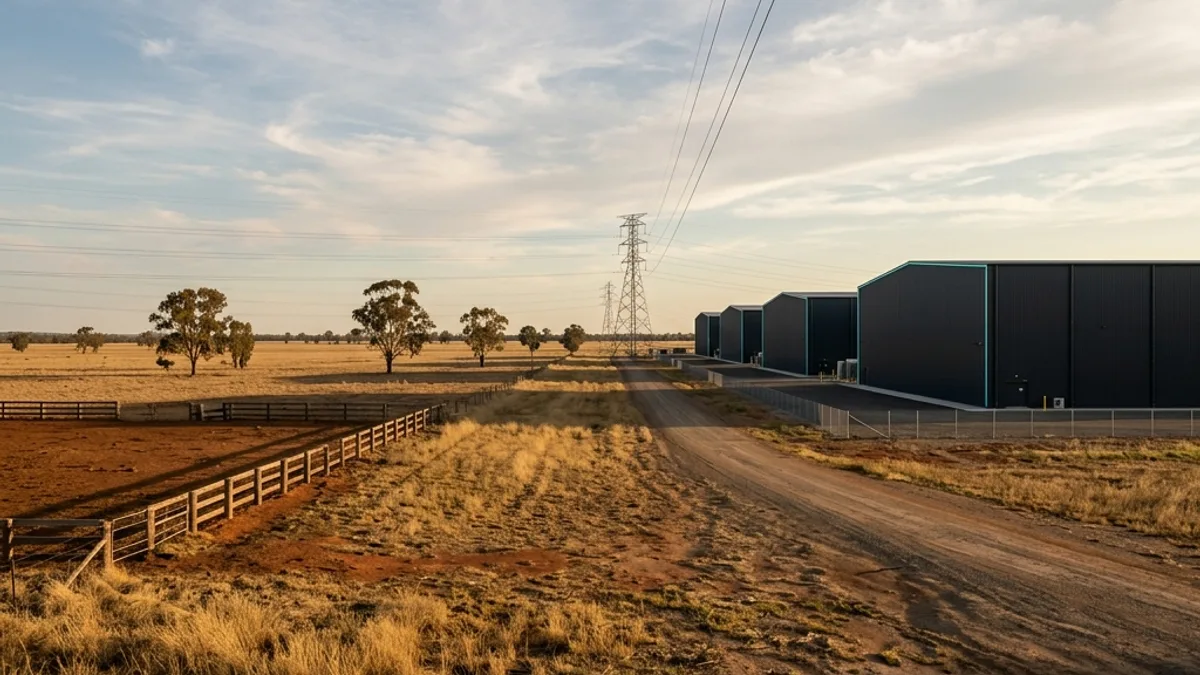
A data centre that doesn't exist yet would eat about 47 gigawatt hours of electricity a day. Queensland, all of it, uses around 170.
The ABC ran that comparison on 14 September, two days before anyone outside the deal knew Anthropic was involved. Then on Wednesday 16 September, Premier David Crisafulli stood up in parliament and said Anthropic had signed a long-term lease for capacity at the Western Downs Digital Park, a A$32 billion project proposed for 725 hectares of farmland near Kogan, out past Dalby. Largest data centre ever proposed in Australia. Anthropic's first in this country.
Here's the part that got lost in a day of headlines. The council hasn't approved it. The Foreign Investment Review Board hasn't approved it. Western Downs Mayor Andrew Smith told the ABC it's not yet a done deal. The development application landed on his council's desk on 17 August, a month before the Premier announced a tenant for it.
And Anthropic itself said nothing at all. No post on its newsroom, nothing from its account or Dario Amodei's, and Reuters reported it couldn't reach the company for comment. The largest data centre proposal in the country was announced entirely by a state premier, then reported by journalists. That's unusual, and I'll come back to it.
Usual disclosure: we use Claude every day at Webcoda, and this site's tooling is built on it. Factor that in.
What was actually signed, and what the A$32 billion is
The money is not Anthropic's. This matters more than anything else in the story and most of the coverage blurred it.
Zerra DC, the data centre arm of Singapore-based AGP Sustainable Real Assets, is the developer. The project company is Western Downs Digital Park Pty Ltd. They carry the A$32 billion capital cost of building the campus. Anthropic has signed a lease for capacity in the first stage, which makes it an anchor tenant, not an investor.
What Anthropic pays, how much of stage one it has taken, and how long the lease runs are all undisclosed. Nobody has published a number for Anthropic's own commitment, because nobody outside the deal has one.
You can watch that confusion happen in real time. The AFR called it a $30 billion data centre project. The Australian called it "a potential $31bn deal". News24 Australia, which got the widest reach of any post I found, called it a "$30 billion contract with the Queensland government", which is wrong twice over, since it's a lease with a private Singaporean developer rather than a contract with the state. The ABC said $32 billion. The planning application puts private investment at $31.9 billion.

Four mastheads, three numbers, one day. The AFR's wording is the one to copy, because it says lease.
The spread isn't sloppiness, or not only sloppiness. The planning documents carry two different numbers for two different things. A$31.9 billion is total private investment across the full build-out. About A$14.5 billion excluding GST, nearer A$16 billion with it, is the construction cost in the DA's own economic assessment. Convert either into US dollars and you get US$22 billion and US$10.4 billion, which is how the same project ends up quoted four ways in one news cycle.
So when you see a figure for this, ask what it's measuring. Total investment at full build-out? Construction cost? Estimated lease value? "Potential" deal size, which is a phrase that can mean almost anything? They're different questions with different answers, and the one number nobody has published is the only one that tells you what Anthropic is actually committing.
The number, and the three things attached to it
At full rollout, four to six years away, the finished campus is designed to draw about 47 GWh a day. Queensland's current average daily consumption is roughly 170 GWh, and the ABC's reading of that on 14 September was that the site could increase the state's daily electricity use by about 25 per cent. Do the division yourself and 47 into 170 lands nearer 28, but that's the ratio rather than the increase, and a quarter is the honest order of magnitude either way.
Every one of those qualifiers is load-bearing. Full rollout means all four halls, not stage one. Four to six years means the comparison is to a grid that will have changed by then. And 170 GWh is what Queensland uses today, not what it'll use in 2032. Strip any of those out and you've got a scarier sentence and a less true one.
There's a fourth qualifier that almost every version of this story dropped, including the ones with the biggest reach. The quarter isn't Anthropic's. The 47 GWh figure is the whole campus, all four halls, and the lease documentation covers the first hall with an option to grow. Stage one is about 360 MW of IT load, a quarter of the site's computing capacity, and Anthropic hasn't disclosed how much of even that it has committed to. So the correct sentence is that Australia's largest proposed data centre would use about a quarter of Queensland's electricity when it's finished, and Anthropic has signed for the first slice of it. Anything tighter than that is a guess dressed up as reporting.
The household version of this, roughly 1.5 million average Australian homes, is the same number said differently. It isn't a second fact. I've seen both stacked in the same paragraph as though they were independent, and they aren't.
Then there's the capacity figure, which turns up in the wild as both 2.16 and 1.44 GW. Neither is a typo. The planning documents, as read by Brisbane Development, put IT capacity at 1.44 GW across four halls of about 360 MW each, with total facility demand of roughly 2.16 GVA. The smaller number is the computing load inside the halls. The bigger one is everything the site pulls, cooling and conversion losses included, and it's quoted as apparent power rather than real power, which is a distinction electrical engineers care about and headline writers don't. If you see both, nobody has made a mistake.
It's inference, not training, and that changes the argument
Anthropic's capacity here is for inference. Serving Claude's answers to people who asked Claude something. Not training runs.
That distinction matters more than it sounds, and it doesn't cut the way you'd expect.
Training power is a capital cost. You spend an enormous amount of electricity building a model, you finish, and the bill stops. Inference power is a running cost. It scales with how many people use the thing, how often, and how much thinking you let it do per question. It doesn't stop after launch. It goes up.
Which brings me to the argument that's been circulating since Wednesday, in two versions. The sloppy version says Dario Amodei called for slowing down AI last week and then signed a 2.16 GW data centre, so he's a hypocrite. That version confuses training with serving. Slowing frontier model development and serving more Claude requests aren't in tension at all. They're different budgets.
The careful version is Mark Kretschmann's, and it's the one worth engaging with.

His actual claim is "Nobody in the AI race is actually slowing down. They are racing to secure every available gigawatt." Strip the Amodei framing off that and he's right, and the correction I just made doesn't rescue anybody. A company can genuinely mean it about pacing capability research while competing ferociously for physical capacity, because the capacity race is about who can serve customers, and losing that one is an ordinary commercial death rather than a safety problem. Both things hold at once. The people arguing about model capabilities and the people signing power agreements are not having the same argument, and the second one is the argument with concrete in it.
Who still has to say yes
This is the bit I'd want if I were briefing someone on Monday.
Western Downs Regional Council. The DA was lodged on 17 August 2026 and it's impact assessable, which in Queensland means public notification and a submission period, and anyone who makes a properly lodged submission picks up appeal rights in the Planning and Environment Court. It's been referred to the State Assessment and Referral Agency and to Powerlink. This is not a rubber stamp, and the council can ask for more information before it starts.
FIRB. Two hooks here, and they're separate. The land is agricultural, and for investors from Singapore the screening threshold on agricultural land starts at A$15 million cumulative and isn't indexed, so it's a low bar. The other hook is the interesting one. Data storage and processing is one of the sectors named in the Security of Critical Infrastructure Act, and the "critical data storage or processing asset" class is written to catch data centres. But the test isn't size. It's who the customer is: the asset has to be handling data for a government body, or for the entity responsible for another critical infrastructure asset. A hall answering Claude questions for the public doesn't automatically qualify. A hall that picks up Commonwealth or state workloads does, and "data sovereignty" was the Premier's own phrase for what this buys. Acquiring an interest in a business like that is acquiring an interest in a national security business, and that's a mandatory notification with no dollar threshold at all.
The rules that don't exist yet. At National Cabinet on 26 August, first ministers agreed the Commonwealth would develop mandatory national standards for large data centres covering energy, water and land, with legislation targeted for early 2027. Same year as first capacity. Anyone who's watched a compliance regime land mid-build knows how that goes.
The energy carve-out. That same meeting is where the federal preference for new data centres to run on additional renewables got softened. Queensland and the Northern Territory won flexibility to use existing coal and gas, Queensland arguing its publicly owned generation. It's the most under-reported detail in the whole story, and it sets up a tension the first stage will have to resolve in public.
Yes, every big project is conditional at announcement, and dressing routine process up as jeopardy would be cheap. But the combination here isn't routine: an impact-assessable application lodged a month before the tenant was announced, a 2027 target, national rules arriving mid-build, and a state energy settlement that cuts against the federal one. The "done deal" phrasing is the mayor's, not mine.
The objection that deserves better than "locals are worried"
Liza Balmain grows cotton and grain on the Darling Downs and speaks for Save Our Darling Downs. Her line to the ABC was this: "As we've seen with coal seam gas, it can fracture communities."
Read that carefully. She said *can*, not will. And she isn't predicting an environmental outcome, she's predicting a social one, which is a much more specific claim than it sounds. Everyone on the Downs knows exactly what CSG did out there: who signed agreements and who didn't, what happened at the fence line between neighbours who disagreed, and how long that took to settle down. Some of it hasn't. A Queensland Parliament e-petition against the proposal has passed 1,300 signatures, raising power demand, water, traffic, fire risk, workforce accommodation and loss of farmland.
Two honest counterweights, though.
The water objection is weaker than it looks. The cooling is primarily closed-loop and air-cooled, no evaporative towers, with operational demand in the planning documents at about 16.5 kilolitres a day and supply from tanks, recycled water and an on-site dam rather than the town supply. If you're going to run the "data centres drink the river dry" line, not here, not on these documents.
And on the grid, Ben Beattie, who writes on Australian energy as @EnergyWrapAU, made the sharpest technical point I saw all week: Western Downs is Dalby and Chinchilla country, a region with high dispatchable generation and therefore high network capacity, very stable electrically, with gas pipeline infrastructure running right past Dalby. His estimate for the connection works, which the developer pays for, was a local substation and transmission stub in the $10 to $20 million range. He reckons they'd spend more on their backup generators. If he's right, the grid-strain story is thinner than the quarter-of-the-state number makes it sound, and the real argument is about what generation gets built to feed it.
Which is where Quentin Dempster put it in four words.

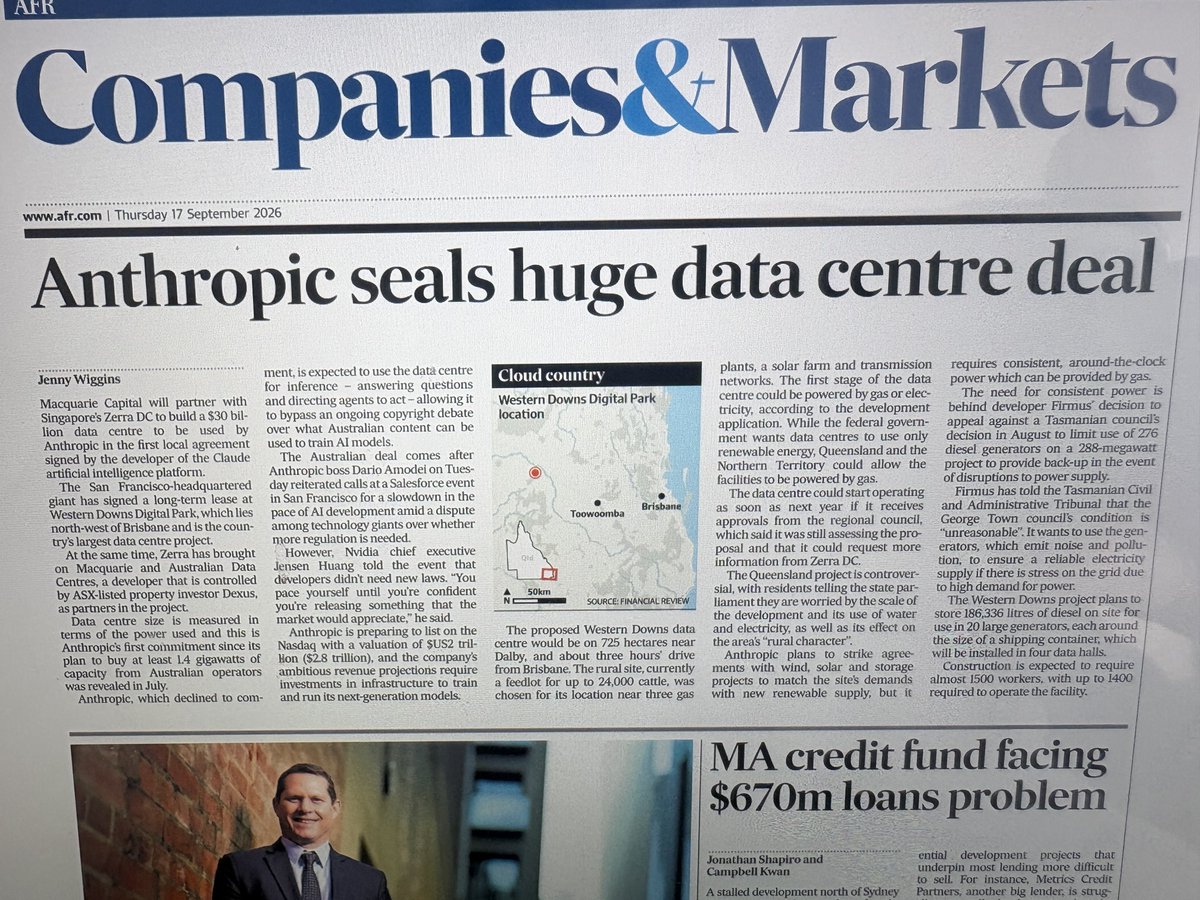
(He's got the site near Toowoomba. It's a good 120 km further west than that. "Cooking with gas" is still the best line anyone's written about this.)
I can't resolve that argument and I'm not going to pretend to. Crisafulli says the deal will "put more energy into Queensland's grid and drive down power prices". Andreas Helwig at the University of Southern Queensland says "getting this wrong will impact grid stability and cost to consumers". Tim Buckley at Climate Energy Finance says we've "got to make sure they're not powered by industries of last century". Littleproud says a load this size can't run on renewables alone.
The Climate Council went further and put numbers against it. Its chief executive Amanda McKenzie says modelling has the project pushing wholesale power prices in Queensland up by at least 13%, and the site producing around 6.6 million tonnes of climate pollution a year if it runs at Queensland's current grid emissions factor, which she put as "like putting more than two million extra cars on the roads". That last figure carries a condition worth keeping attached to it, because it assumes the site draws from today's generation mix rather than the new wind, solar and storage the developer says it intends to contract. If the renewable power purchase agreements land, the number comes down. If the coal and gas carve-out is what actually feeds it, the number is roughly what she says.
Which is the mechanical question I'd want answered, and haven't seen asked: by what route does adding the single largest electricity load in the state lower the price everyone else pays? There might be a good answer involving new generation built under long-term contracts that wouldn't otherwise get financed. The Premier hasn't made it, and the Climate Council has modelling pointing the other way. I'd like to see someone show the working.
Eleven days ago
On 7 September I argued on this site that public opposition to data centres could matter more to Anthropic than the copyright lawsuits, because a company can settle a lawsuit and keep selling access to Claude, but it can't serve customers from a building that's waiting for permission. Nine days later it signed in Queensland, and a named farmers' group was already objecting before the ink dried. I don't claim any foresight there, the trend was plain to anyone reading American planning news. When the prospectus appears, the thing I'll look for is the same: how much of the promised capacity has somewhere to run, and how much still depends on a council meeting.
Why data centre opposition could matter more to Anthropic's IPO than copyright lawsuits
Anthropic can settle a copyright dispute. Getting more compute connected to a grid is harder. Its reported IPO risks expose the difference.
Read full articleWhat it changes if you buy technology in Australia
Something real did shift on Wednesday, conditional on all of the above.
If you've been told that sovereign AI capacity in Australia isn't available at scale, that answer now has an expiry date on it. OpenAI has an offtake arrangement with NextDC at Eastern Creek in Sydney. Anthropic has a lease at Kogan. Both are conditional, both are years from full capacity, and neither one helps you this financial year. But "the inference runs offshore" stops being a permanent fact and becomes a timeline, and if you're writing a five-year technology strategy for a government client, that's worth knowing now rather than in 2028.
If you're near a proposed site, the planning process is genuinely open. Impact assessable means a public notification period and submissions on the record, and submissions carry appeal rights. That's a more useful hour than complaining about it afterwards.
And if your interest is the copyright fight, note that this facility sits outside it. Inference capacity isn't training capacity, so the argument about who gets paid for training material doesn't touch these halls. We've covered where that fight is actually being fought.
Cloudflare's AI training block also blocks Googlebot. That isn't a bug, and on Tuesday it becomes the default.
Cloudflare's new AI crawler defaults land on Tuesday. Blocking Training can block Googlebot with it, and that's documented design rather than a fault.
Read full articleKey Takeaways
- The A$32 billion belongs to Zerra DC and its project company, not to Anthropic. Anthropic leased the first of four halls and hasn't said what it's paying, for how long, or how much of that hall it has taken.
- The 47 GWh a day figure is the whole campus at full rollout, four to six years out, against what Queensland uses today. It is not Anthropic's load. The 1.5 million households line is the same number restated.
- The Climate Council's modelling has wholesale prices up at least 13% and 6.6 Mt of emissions a year, on the assumption the site runs on today's grid mix rather than the new renewables the developer says it will contract.
- 2.16 and 1.44 GW are both correct. One is whole-site demand, the other is IT load in the halls.
- Three approvals are outstanding: an impact-assessable council DA lodged 17 August 2026, FIRB, and a national standards regime that gets legislated in early 2027.
- It's inference capacity, not training capacity, so the power bill grows with adoption rather than stopping when a model ships.
The easy part is over
The thing I keep turning over is the silence. A A$32 billion announcement, and the company at the centre of it published nothing, said nothing and couldn't be reached. The Premier announced it, the Prime Minister responded by talking about regulating it, and the tenant stayed quiet.
Maybe that's just a company that doesn't announce leases. Maybe it's a company that has read the room on data centre politics and would rather a state government carried this one. I don't know, and I'd rather say so than guess.
What I do know is that the announcement was the easy part. The decisions that actually determine whether anything gets built out at Kogan sit with a regional council, a foreign investment regulator, a federal standards regime nobody has drafted yet, and a few hundred people who farm next door and now have a submission period.
---
Sources
- ABC News. "AI giant Anthropic signs agreement for $32b Queensland data centre." 16/09/2026. https://www.abc.net.au/news/2026-09-16/queensla...
- ABC News. "Australia's largest proposed data centre could draw a quarter of Queensland's energy use." 14/09/2026. https://www.abc.net.au/news/2026-09-14/western-...
- ABC News. "International developer plans Australia's largest data centre in regional Queensland." 24/08/2026. https://www.abc.net.au/news/2026-08-24/plans-fo...
- ABC News. "Internal emails expose scale of Anthropic's Australian AI plans." 26/08/2026. https://www.abc.net.au/news/2026-08-26/claude-m...
- Reuters, via Dawn. "Anthropic signs deal for Australia data centre, govt says." 16/09/2026. https://www.dawn.com/news/2030352/anthropic-sig...
- Brisbane Development. "Anthropic Joins $32 Billion Western Downs Digital Park West of Brisbane." September 2026. https://brisbanedevelopment.com.au/anthropic-ze...
- Farm Weekly. "AI giant secures foothold in regional Australia with $32b data centre plan." 16/09/2026. https://www.farmweekly.com.au/story/9352206/ant...
- The Conversation. "Australia's backdown on data centres allows them to use energy from coal and gas. Here's what that means." August 2026. https://theconversation.com/australias-backdown...
- Anthropic. "Australia and Anthropic sign AI safety MOU." 2026. https://www.anthropic.com/news/australia-MOU
- Senator the Hon Tim Ayres, Minister for Industry and Innovation. "New agreement on AI collaboration with Anthropic." 2026. https://www.minister.industry.gov.au/t-ayres/me...
- Department of Industry, Science and Resources. "Memorandum of understanding between the Australian Government and Anthropic on collaboration on AI opportunities." 2026. https://industry.gov.au/publications/memorandum...
- Cyber and Infrastructure Security Centre. SOCI Act 2018, data storage and processing sector. Accessed 17/09/2026. https://www.cisc.gov.au/information-for-your-in...
- Security of Critical Infrastructure Act 2018 (Cth), s 12F, meaning of critical data storage or processing asset. https://www.austlii.edu.au/cgi-bin/viewdoc/au/l...
- MinterEllison. "Critical infrastructure changes expand the FIRB rules." https://www.minterellison.com/articles/critical...
- Foreign Investment Review Board. Monetary thresholds applicable from 1 January 2026. https://foreigninvestment.gov.au/sites/foreigni...
- InnovationAus. "OpenAI unveils 'for Australia' initiative with $7bn data centre deal." 2026. https://www.innovationaus.com/openai-unveils-fo...
- Australian Financial Review (@FinancialReview). Post on Anthropic's long-term lease. 16/09/2026. https://x.com/FinancialReview/status/2100079880...
- Mark Kretschmann (@mark_k). Post on Anthropic's Australian agreement and the race for capacity. 16/09/2026. https://x.com/mark_k/status/2100235552918262060
- Quentin Dempster (@QuentinDempster). Post on the Queensland data centre and its energy mix. 16/09/2026. https://x.com/QuentinDempster/status/2100360510...
- Ben Beattie (@EnergyWrapAU). Post on Western Downs network capacity and grid connection costs. 16/09/2026. https://x.com/EnergyWrapAU/status/2100167698659...
- The Australian (@australian). Post reporting a "potential $31bn deal". 16/09/2026. https://x.com/australian/status/210013286107674...
- News24 Australia (@News24Aust). Post reporting a "$30 billion contract with the Queensland government". 16/09/2026. https://x.com/News24Aust/status/210012838161460...
- Converge Digest. "Anthropic and Zerra DC: 2.16 GW Australian data centre." September 2026. https://convergedigest.com/anthropic-zerra-dc-a...
- Cyber Daily. "Anthropic's $32bn Qld data centre could cause emissions equal to 2m cars, Climate Council warns." 16/09/2026. https://www.cyberdaily.au/digital-transformatio...
- Mirage News. "Qld Data Centre Gamble to Hike Power Costs, Emissions." 16/09/2026. https://www.miragenews.com/qld-data-centre-gamb...
- w.media. "Zerra plans 1.44GW, AUD 14.5bn data centre campus in Queensland." 2026. https://w.media/zerra-plans-1-44gw-aud-14-5bn-d...
- iTnews. "Anthropic signs first Australian data centre agreement." 16/09/2026. https://www.itnews.com.au/news/anthropic-signs-...