

I've been building websites for over 20 years, and I've never seen a tech announcement that made me spit out my coffee quite like this one.
Apple. The company that insists on designing its own chips, its own software, its own lightning cables (remember those?). The company whose entire brand is built on controlling every pixel of the user experience. That Apple just announced it's outsourcing the brain of Siri to Google.
Let that sink in. It's like Coca-Cola announcing they'll be using Pepsi's secret formula. Or Ferrari slapping a Honda engine in their next supercar. (I spent about ten minutes trying to think of a more absurd analogy. I couldn't.)
The Announcement That Shook Silicon Valley
On 12 January 2026, Apple and Google dropped a bombshell that sent shockwaves through the tech industry. The two companies have entered a "multi-year collaboration" where Google's Gemini models will power the next generation of Siri and Apple Intelligence features. (CNBC, January 2026)
Let's break down what we actually know:
The deal structure: Apple will use Google's Gemini models and cloud technology as the foundation for future "Apple Foundation Models." These will power everything from a revamped Siri to deeper Apple Intelligence integrations across iOS, iPadOS, and macOS.
The price tag: While neither company confirmed the exact terms, Bloomberg reported in November that Apple would pay Google roughly $1 billion annually for access to Gemini. (TechCrunch, January 2026)
The technical upgrade: Apple is moving from a 150 billion parameter model to Google's 1.2 trillion parameter beast. That's an eight-fold increase in AI capability. (WebProNews, January 2026)
The timeline: The new AI-powered Siri is expected to arrive with iOS 26.4, likely in March or April 2026.
Here's how the official announcement landed:

The market reacted immediately. Google's parent company Alphabet briefly crossed $4 trillion in market capitalisation on the news, becoming only the fourth company ever to reach that milestone. (CNBC, January 2026)
Why Apple Blinked
If you've been following Apple's AI struggles, this announcement shouldn't come as a complete shock. But it's still remarkable to see the company that built its empire on vertical integration surrender such a critical piece of its technology stack.
The backstory here matters.
Apple's AI efforts have been, to put it politely, a bit of a mess. The company launched Apple Intelligence in 2024 with promises of revolutionary features. What users got instead was a notification summary feature that kept rewriting news headlines incorrectly. (They had to disable it for news apps after The New York Times and BBC complained about AI-generated misinformation being attributed to their publications.) (CNBC, December 2025)
The flagship feature, a major Siri upgrade, was supposed to launch in 2024. Then it got pushed to 2025. Then it got pushed again to "sometime in 2026." Bloomberg reported that Apple executives privately called the delays "ugly" and "embarrassing." (Bloomberg, March 2025)
Meanwhile, Google had a breakout year. Gemini 3, released in December 2025, has been turning heads across the industry. Gemini 3 Flash scored 90.4% on PhD-level reasoning benchmarks (GPQA Diamond), while the Deep Think reasoning mode achieved an even higher 93.8%. (Google Blog, December 2025)
And here's the kicker that probably kept Tim Cook up at night: last week, Google's market capitalisation surpassed Apple's for the first time since 2019. After seven years of Apple dominance, Google is now the more valuable company. (CNBC, January 2026)
The writing was on the wall. Apple needed help.
Analyst Ming-Chi Kuo, who has an uncanny track record of predicting Apple's moves, offers some interesting context. According to Kuo, this deal is a "short-term solution designed to lower the pressure on Siri" while Apple develops its own AI infrastructure. Apple is reportedly mass-producing custom AI server chips in the second half of 2026, with dedicated data centres planned for 2027. (MacRumors, January 2026)
Translation: Apple's buying time. They're renting Google's brain while they build their own.
The Privacy Paradox Nobody's Talking About
Here's where things get uncomfortable.
Apple has spent the last decade positioning itself as the privacy-first tech company. "What happens on your iPhone stays on your iPhone." Remember those billboards? The entire company identity is built on the promise that Apple won't monetise your data like those other guys. (You know, like Google.)
And now Apple is handing the keys to Siri over to... Google?
I've had three clients phone me since the announcement, all asking some version of the same question: "Wait, is my data going to Google now?"
Apple insists the answer is no. According to their statement, Gemini will operate through Apple's "Private Cloud Compute" infrastructure. The idea is that while Google provides the "silicon brainpower," the actual processing happens within Apple's secure environment. Your personal messages, your health data, your calendar, none of it should touch Google's servers directly. (TechCrunch, January 2026)
Should. That's doing a lot of heavy lifting in that sentence.
Critics aren't convinced. And the antitrust context makes this even messier.
In August 2024, a federal judge ruled that Google had violated the Sherman Act by maintaining an illegal monopoly in search. The judge specifically targeted the multi-billion dollar deals that made Google the default search engine on Safari. Google paid Apple roughly $20 billion a year for that privilege. (Department of Justice, August 2024)
So we've got a confirmed monopolist now powering the AI assistant on 2.35 billion Apple devices. Some people aren't thrilled about that.
Elon Musk weighed in (because of course he did), calling the deal "an unreasonable concentration of power for Google, given that they also have Android and Chrome." (Benzinga, January 2026)
Now, Musk has his own dog in this fight. His xAI company is currently suing Apple and OpenAI over their ChatGPT partnership. So take his concerns with a grain of salt. But he's not entirely wrong about the concentration issue. Google now powers AI features on both Android and iOS. That's essentially every smartphone on the planet.
What Happens to OpenAI?
This is the question everyone's asking, and Apple's answer is frustratingly vague.
Apple says its existing partnership with OpenAI "remains unchanged." ChatGPT integration in Siri and Apple Intelligence Writing Tools stays in place. No changes planned. (CNBC, January 2026)
But here's the reality check: Apple now has two competing AI backends, and one of them is clearly the foundation while the other is... what, exactly?
The way analysts are describing it: ChatGPT is becoming the "consultant" you can optionally call in for complex queries. Gemini is becoming the "brain" that powers everything by default. (H2S Media, January 2026)

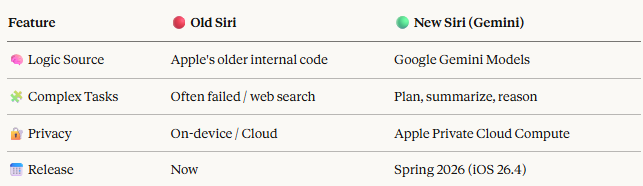
I'm sceptical that Apple maintains both partnerships long-term. The complexity of coordinating two different AI systems, with different capabilities, different APIs, different pricing models... that's a maintenance nightmare. My guess? OpenAI's role quietly shrinks over the next 18 months as Gemini takes over more and more functionality.
ChatGPT's 'Code Red' Moment: Three Years After Disrupting Google, the Tables Have Turned
In December 2022, ChatGPT triggered Google's 'code red.' Now OpenAI has declared its own as Anthropic leads enterprise AI. Here's how the tables...
Read full articleThe timing here is brutal for OpenAI. Just last month, Sam Altman sent an internal memo declaring a "code red" at the company. ChatGPT's growth has slowed dramatically, Anthropic has overtaken them in enterprise market share, and now they've lost their foothold in the Apple ecosystem to Google.
Three years ago, ChatGPT triggered Google's code red. Now the tables have turned completely.
The Real Story: AI Agents Are Coming for Your Website
Alright, let's talk about what this actually means for the rest of us. Not for Apple shareholders or Google executives, but for the businesses and website owners reading this.
With Gemini powering Siri across 2.35 billion Apple devices, we're about to see a massive acceleration in what the industry calls "agentic commerce." (MacRumors, January 2025)
Here's what that means in plain English: AI assistants are going to start doing things on behalf of users. Not just answering questions, but actually browsing websites, comparing products, and completing transactions.
Google has been laying the groundwork for this. Just last week, they announced the Universal Commerce Protocol (UCP), an open standard for AI agents to interact with e-commerce websites. It's co-developed with Shopify, Etsy, Wayfair, Target, and Walmart. Backed by Visa, Mastercard, American Express, and Stripe. (Google Blog, January 2026)
This isn't some distant future scenario. It's happening now.
Morgan Stanley predicts that nearly half of online shoppers will use AI shopping agents by 2030, capturing 10-20% of e-commerce market share ($190-385 billion in spending). (Modern Retail, January 2026)
A recent study found that 73% of consumers are already using AI in their shopping journey. While only 13% have completed a purchase after being referred by an AI assistant, 70% are at least "somewhat comfortable" with an AI agent making purchases on their behalf. (Riskified Global Study, October 2025)
The implication for website owners is profound. If Siri powered by Gemini can browse your website, understand your products, and complete purchases, then your website needs to be readable by AI. Not just by humans. Not just by traditional search engines. By AI agents that are making decisions on behalf of customers.
What This Means for Website Owners
I've spent the last two days thinking about the practical implications of this announcement. Here's what I'm telling clients:
Your Site Architecture Just Became Critical
AI agents don't browse websites the way humans do. They don't scroll, they don't click around, they don't admire your fancy animations. They parse your structured data, read your schema markup, and extract the information they need.
If your website doesn't have proper schema.org markup, you're invisible to the next generation of AI-powered assistants. Product schema. Service schema. FAQ schema. Review schema. All of it matters more than ever.

Schema.org Implementation Guide: Making Your Website AI-Readable
Most Australian business websites look professional to human visitors, but search engines and AI systems can't actually figure out what you do....
Read full articleAccessibility Is Now a Competitive Advantage
Here's something most people haven't connected yet: AI agents and accessibility tools share the same requirements. Both need clean, semantic HTML. Both need properly labelled form fields. Both need logical heading structures and descriptive alt text.
A website that's accessible to users with disabilities is also accessible to AI agents. The businesses that have been investing in WCAG compliance for the last few years are about to discover they've also been investing in AI-readiness.
Content Quality Matters More Than Keywords
When Siri, powered by Gemini, answers a question about your industry, where is it pulling that information from? The AI models are trained on the entire internet, but they're increasingly using real-time retrieval to find current information.
This means the old SEO playbook of stuffing keywords into mediocre content is dead. AI agents want to find authoritative, comprehensive, up-to-date information. They want to cite sources that are credible.
Zero-Click Commerce Is Coming
The industry is calling it "zero-click commerce." A user asks Siri to order more coffee pods, and Siri handles the entire transaction without the user ever visiting a website. Product discovery, price comparison, checkout, all handled by the AI agent.

The Zero-Click Internet: Prediction is the New Search
The era of 'searching' is ending. Predictive AI is ushering in the zero-click internet, where information finds you before you ask. Here's how...
Read full articleThis is terrifying for businesses that rely on website traffic for revenue. But it's an opportunity for businesses that optimise for AI discovery. If Siri recommends your product, you don't need the user to visit your website. The sale happens anyway.
Not sure if your website is ready for AI agents? Test your site's structured data, semantic markup, and AI crawler compatibility:
Test Your Site's AI Readiness
See exactly how AI agents view your website with our free analysis tool.
The Bottom Line
Honestly? I don't know if I'm overreacting or underreacting to this announcement.
In 20 years of building websites, I've watched plenty of "revolutionary" tech announcements fizzle into nothing. But this one feels different.
The combination of Google's AI capabilities with Apple's distribution reach creates something we haven't seen before: a genuinely capable AI assistant in the pockets of 2.35 billion people. That's not a future scenario. That's happening in three months.
What keeps me up at night isn't the privacy concerns or the antitrust implications. It's simpler than that. If Siri can actually do things now, if it can browse and buy and book on behalf of users, then the websites I build need to work for AI agents, not just human visitors.
I've started auditing every client site for AI readability. Schema markup, semantic HTML, clean data structures. The basics we should have been doing anyway, but now with urgency.
Maybe I'm overreacting. But I'd rather prepare for a future that doesn't arrive than be caught flat-footed when it does
---
Sources
- CNBC. "Apple picks Google's Gemini to run AI-powered Siri coming this year." January 2026. https://www.cnbc.com/2026/01/12/apple-google-ai...
- TechCrunch. "Google's Gemini to power Apple's AI features like Siri." January 2026. https://techcrunch.com/2026/01/12/googles-gemin...
- WebProNews. "Apple and Google Ink $1B Deal to Bring Gemini AI to Siri in 2026." January 2026. https://www.webpronews.com/apple-and-google-ink...
- Google Blog. "Joint statement from Google and Apple." January 2026. https://blog.google/company-news/inside-google/...
- CNBC. "Alphabet hits $4 trillion market capitalization." January 2026. https://www.cnbc.com/2026/01/12/alphabet-4-tril...
- CNBC. "Alphabet's market cap surpasses Apple's for first time since 2019." January 2026. https://www.cnbc.com/2026/01/07/alphabets-marke...
- CNBC. "Apple punted on AI this year. Next year will be critical." December 2025. https://www.cnbc.com/2025/12/17/apple-ai-delay-...
- Bloomberg. "Apple's Siri Chief Calls AI Delays 'Ugly' and 'Embarrassing,' Promises Fixes." March 2025. https://www.bloomberg.com/news/articles/2025-03...
- Google Blog. "Gemini 3: Introducing the latest Gemini AI model from Google." December 2025. https://blog.google/products/gemini/gemini-3/
- MacRumors. "Kuo: Apple's AI Deal With Google Is Temporary and Buys It Time." January 2026. https://www.macrumors.com/2026/01/13/apple-goog...
- Apple Insider. "Ming-Chi Kuo: Apple will get serious about AI server chips in 2026." January 2026. https://appleinsider.com/articles/26/01/13/ming...
- Department of Justice. "Department of Justice Prevails in Landmark Antitrust Case Against Google." August 2024. https://www.justice.gov/opa/pr/department-justi...
- Benzinga. "Elon Musk Slams Google, Apple Deal: 'Unreasonable Concentration Of Power'." January 2026. https://www.benzinga.com/markets/tech/26/01/498...
- MacRumors. "Apple Now Has More Than 2.35 Billion Active Devices Worldwide." January 2025. https://www.macrumors.com/2025/01/30/apple-acti...
- Google Blog. "New tech and tools for retailers to succeed in an agentic shopping era." January 2026. https://blog.google/products/ads-commerce/agent...
- Modern Retail. "Why the AI shopping agent wars will heat up in 2026." January 2026. https://www.modernretail.co/technology/why-the-...
- Riskified. "Global Study: 73% of Shoppers Using AI in Shopping Journey." October 2025. https://www.riskified.com/press/global-study-73...
- H2S Media. "Apple Picks Google Gemini AI at $1B/Year to Power New Siri." January 2026. https://www.how2shout.com/news/apple-google-gem...
- 9to5Mac. "Unsurprisingly, Elon Musk reacts poorly to Apple's new Gemini deal." January 2026. https://9to5mac.com/2026/01/12/elon-musk-reacts...
---