

I'll be honest: I wasn't expecting to wake up on 18 February and find myself questioning whether there's any reason to reach for Opus anymore. But here we are.
Sometime overnight on 17 February 2026, Anthropic quietly dropped Claude Sonnet 4.6. No countdown, no live stream, no competing Super Bowl ads. Just a blog post, a model card, and the sudden realisation that the "budget" Claude had just matched the flagship on nearly every benchmark that matters. Twelve days after Opus 4.6. Two frontier-class models from one company in less than a fortnight.
I spent the morning going through the benchmarks properly, because the headline numbers alone don't tell the full story. What I found was more interesting, and more uncomfortable for Anthropic's own pricing logic, than I expected.
What Happened: The Two-Week Blitz
If you missed it, here's the quick version. On 5 February 2026, Anthropic dropped Opus 4.6 within roughly 20 minutes of OpenAI releasing GPT-5.3-Codex. I wrote about that whole chaotic episode in detail (The 20-Minute AI War: Opus 4.6 vs GPT-5.3-Codex), but the short version is: two companies raced to get their press releases out first, and the AI community spent the day arguing about benchmarks instead of getting work done.
Opus 4.6 came with some genuine headline features: a 1 million token context window in beta, Agent Teams for parallelising complex tasks across multiple Claude Code instances, Microsoft 365 integration, and solid improvements to coding and reasoning (Anthropic, February 2026). It was, by any reasonable measure, Anthropic's best model yet.

The 20-Minute AI War: What Happened When Anthropic and OpenAI Released Models Simultaneously
On 5 February, Anthropic dropped Opus 4.6 and OpenAI fired back with GPT-5.3-Codex within 20 minutes. Here's who won, who lost, and what it means for...
Read full articleThen, 12 days later, they did it again. Sonnet 4.6 arrived on 17 February, and it's not the incremental bump you might expect from a mid-tier release. It's a proper upgrade. The kind that makes you reconsider which Claude you're actually paying for.
Sonnet 4.6: The Model Most People Will Actually Use
Here's the thing about Sonnet models: they're what most developers actually run day-to-day. Opus is the prestige option you reach for when something really matters. Sonnet is what's running in your background tasks, your code reviews, your first drafts. So when Sonnet gets dramatically better, it affects a lot more workflows than an Opus upgrade does.
Sonnet 4.6 is now the default model for Free and Pro plan users on claude.ai (Anthropic, February 2026). That alone tells you Anthropic considers this a serious upgrade. You don't make something your free-tier default unless you're confident it holds up.
The developer preference numbers from Anthropic's own Claude Code testing are striking. In head-to-head evaluations, 70% of developers preferred Sonnet 4.6 over Sonnet 4.5. More telling: 59% preferred Sonnet 4.6 over Opus 4.5, the model that was Anthropic's frontier as recently as November 2025. The "budget" option is now beating a model that was state-of-the-art three months ago.
What's actually new under the hood: a 1 million token context window (beta, matching Opus 4.6), adaptive thinking and extended thinking modes, context compaction in beta (it automatically summarises older context as you approach the limit, so you don't hit walls mid-conversation), and improved web search tools that can now write and execute code to filter results rather than just returning raw pages (Anthropic, February 2026). The API model ID is claude-sonnet-4-6, and it's live on Amazon Bedrock, Google Vertex AI, and Microsoft Foundry from day one.
Coding: Where Sonnet 4.6 Punches Above Its Weight
Let's get into the numbers where they matter most for developers.
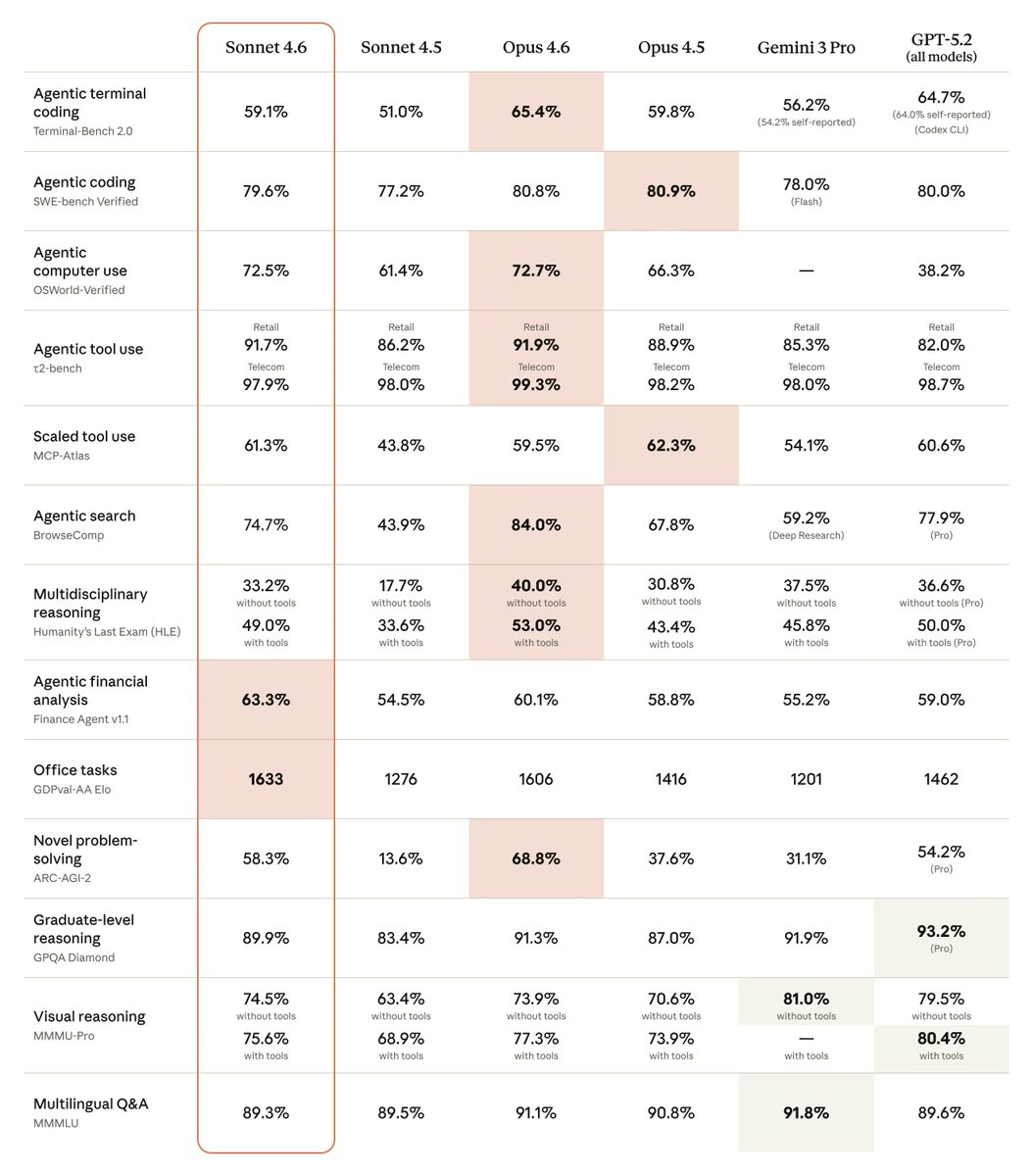
On SWE-bench Verified, the standard benchmark for real-world software engineering tasks, Sonnet 4.6 scores 79.6%. Opus 4.6 scores 80.8%. That's a 1.2 percentage point gap. On a benchmark where the difference between 79% and 80% is essentially noise in practice, that's effectively a tie (Anthropic, February 2026).
The agentic terminal coding improvement is worth calling out separately. Sonnet 4.6 is 8.1 percentage points better at agentic terminal coding than Sonnet 4.5. That's not incremental, that's a step change. For developers running Claude Code on long-horizon tasks, multi-file edits, or autonomous debugging sessions, this is the number that probably matters most in practice.
What developers are reporting beyond the benchmarks: Sonnet 4.6 is less prone to overengineering. It follows instructions more literally without adding unrequested complexity. It reads existing code context before modifying files rather than just inserting new code. It hallucinates less about successfully completing tasks it hasn't finished. Frontend development in particular has come up repeatedly in early reactions as an area where the improvement is obvious.


Povilas Korop tested it across 7 Laravel projects and documented the comparison on video. The speed and code quality are close to Opus. Not identical, but close enough to make the cost difference hard to justify for standard tasks.
Computer Use: The Human-Level Milestone
This is where Sonnet 4.6's improvement is most dramatic.
OSWorld is the benchmark that measures how well an AI can operate a real computer: navigating UIs, filling forms, using applications, completing multi-step tasks across different software. It's a genuinely hard benchmark because it requires the kind of contextual awareness and error recovery that distinguishes capable computer use from just clicking the obvious thing.
Sonnet 4.5 scored 61.4% on OSWorld. Sonnet 4.6 scores 72.5% (Anthropic, February 2026). That's an 11.1 percentage point jump in a single model generation. Opus 4.6, for comparison, scores 72.7%. Two-tenths of a percentage point separates them.
For context on why that 72.5% number matters: GPT-5.2 scores 38.2% on OSWorld. Sonnet 4.6 is nearly double the score of OpenAI's previous model on the same benchmark. Anthropic also reports meaningful improvements in prompt injection resistance, which is relevant if you're deploying computer use agents in production environments where you can't control every page the model encounters.
Automation that was genuinely unreliable with Sonnet 4.5 is now practical with Sonnet 4.6. That has real implications for anyone building agentic workflows.
The Benchmarks That Actually Matter
Here's the full picture:
| Benchmark | Sonnet 4.6 | Opus 4.6 | Notes |
|---|---|---|---|
| SWE-bench Verified | 79.6% | 80.8% | 1.2 point gap |
| OSWorld-Verified | 72.5% | 72.7% | 0.2 point gap |
| GDPval-AA Elo | 1633 | 1606 | Sonnet wins by 27 points |
| Finance Agent v1.1 | 63.3% | 60.1% | Sonnet wins by 3.2 points |
| ARC AGI 2 | ~58% | ~75% | Opus leads significantly |
Two results in that table deserve more attention than they're getting. On GDPval-AA, which measures general office task performance, Sonnet 4.6 scores 1633 Elo versus Opus 4.6's 1606. Sonnet beats Opus on office work. On Finance Agent v1.1, Sonnet 4.6 scores 63.3% versus Opus 4.6's 60.1%. Sonnet beats Opus on financial analysis tasks too.

The one place where Opus genuinely pulls away is ARC AGI 2, the benchmark designed to test novel reasoning that resists pattern matching. Opus 4.6 is around 75% there; Sonnet 4.6 is around 58%. If you're working on problems that require that kind of deep, novel problem-solving, Opus is still the right call. But that's a narrower category than "everything I do that's hard."
The Pricing Elephant in the Room
Let me just say what the numbers are implying: for most everyday use cases, Opus 4.6 is now a tough sell.
Sonnet 4.6: $3 per million input tokens, $15 per million output tokens. Unchanged from Sonnet 4.5.
Opus 4.6: $5 per million input tokens, $25 per million output tokens.
That's a 1.67x premium on both input and output for Opus. And what does that premium buy you, exactly? Not better coding performance (the gap is 1.2 percentage points on SWE-bench). Not better computer use (0.2 percentage points on OSWorld). Not better office task performance (Sonnet actually wins here). Not better financial analysis (Sonnet wins here too).
What it buys you is Agent Teams (still Opus-exclusive), significantly better performance on deep reasoning benchmarks like ARC AGI 2, and presumably maximum accuracy on genuinely complex, novel problems where the extra headroom matters.

That's a fair summary: Opus is the expert brain for the hardest problems. Sonnet is the workhorse that handles almost everything else, faster and cheaper. The question each team has to answer honestly is: what fraction of your actual tasks require that expert brain?
For most of my work, I'd put it at maybe 20-30%. The rest is code review, drafting, analysis, automation, and similar tasks where Sonnet 4.6 now performs essentially identically to Opus at 60% of the cost.
What Developers Are Actually Saying
The reaction in the community has been mostly positive, with some interesting nuances.

Wes Roth's take captures what a lot of developers seem to be feeling: this is a model built for doing, not just talking. The reliability improvements in coding, combined with the computer use gains, make it feel less like a chatbot and more like an agent you can actually trust with autonomous tasks. That's a meaningful shift.
The concern that keeps coming up, particularly on r/claudexplorers, is about personality. Some users are describing Sonnet 4.6 as sounding "distant and hollow" in conversational use, with a "weird clinical tone" that earlier Claude models didn't have. There are complaints about "nannybot safety responses" on benign queries. I've seen similar complaints about Opus 4.6, actually. Whether this is intentional, a side effect of training for instruction-following precision, or just adjustment period, I don't know. But it's real enough that multiple people have flagged it independently, which suggests it's not just one person having a bad day with the model.

There's also a broader reaction to what this release signals. Software stocks dropped on the news, with investors reading the improved agentic coding capability as a threat to developer headcount. I think that's an overreaction, for the same reasons it's always been an overreaction. But the market's anxiety isn't entirely irrational: a model that can genuinely autonomously fix bugs, navigate UIs, and handle end-to-end tasks does change what a developer can do in a day. It doesn't replace the developer. It changes what the job looks like.
One more community reaction worth noting, from the sceptic camp: "Don't trust the benchmarks blindly. Trust your own tests." That's good advice. Benchmark scores are useful signal but they're not your specific codebase, your specific prompts, or your specific use case. The Fano logic puzzle failures some users reported with Opus 4.6 are a reminder that frontier models still have strange failure modes.
When to Use Opus 4.6, When to Use Sonnet 4.6
Here's how I'd think about the decision:
Stick with Opus 4.6 if you're:
- Using Agent Teams (it's Opus-exclusive, and it's a genuine differentiator for complex parallel tasks)
- Working on novel deep reasoning problems, research tasks, or anything where creative problem-solving matters over instruction-following precision
- Doing complex codebase refactoring where you need the highest possible accuracy on architectural decisions
- Running multi-agent coordination workflows where Opus serves as the planning layer
Use Sonnet 4.6 for:
- Daily coding, debugging, and code review (the benchmark gap doesn't justify the cost premium)
- Financial analysis (Sonnet actually leads on Finance Agent v1.1)
- Office and knowledge work tasks (Sonnet wins on GDPval-AA)
- Computer use automation (effectively tied, at a much lower per-token cost)
- High-volume production workloads where cost efficiency matters
- Frontend development specifically (multiple developers have flagged this as a standout area)
- Any free-tier or Pro plan usage (it's now the default, and you're not losing much vs Opus)


The "infrastructure, not iteration" framing is apt. For agentic workflows at scale, Sonnet 4.6's combination of near-Opus performance with Sonnet pricing isn't just a nice-to-have. It's what makes certain production deployments economically viable that weren't before.
What This Tells Us About Where AI Is Heading
Twelve days between two frontier-class releases from one company. That cadence is wild, even by 2026 standards.
What Anthropic has effectively done is demonstrate a pattern that I think we'll see play out repeatedly: frontier capabilities arrive first in premium tiers, then trickle down to mid-tier models within months. The gap between Sonnet 4.6 and Opus 4.6 is smaller than the gap between Sonnet 4.5 and Opus 4.5 was. The next Sonnet will probably close it further. That's not a weakness in Anthropic's strategy. That's the product being delivered as promised: better models at the same price points, iteratively.
The competitive picture is worth keeping in mind too. GPT-5.3-Codex prices at $1.25 input / $10 output, which undercuts Sonnet 4.6 significantly on input (OpenAI, February 2026). OpenAI's model leads on Terminal-Bench 2.0 agentic coding. So Sonnet 4.6 isn't the only option in this price range. But on computer use, office tasks, and financial analysis, it's got a real lead over the OpenAI alternative. DeepSeek V4 is also expected imminently, which will add another competitive dimension on the cost side.
The real winner in all of this is straightforward: it's developers and businesses who get more capable AI at the same or lower cost every few months. I'm not complaining.
Key Takeaways
The Event:
- Anthropic released Claude Opus 4.6 on 5 February 2026 and Sonnet 4.6 on 17 February 2026, just 12 days apart
- Sonnet 4.6 closes the gap to Opus on nearly every major benchmark, and beats it on some
Sonnet 4.6 Highlights:
- SWE-bench Verified: 79.6% (vs Opus 80.8%, gap of 1.2 points)
- OSWorld: 72.5% (vs Opus 72.7%, gap of 0.2 points, nearly double GPT-5.2's 38.2%)
- Beats Opus on office tasks (GDPval-AA Elo: 1633 vs 1606) and financial analysis (63.3% vs 60.1%)
- 70% developer preference over Sonnet 4.5 in Claude Code testing
- Priced at $3/$15 per million tokens (unchanged from Sonnet 4.5)
- Now the default model for Free and Pro plan users
For Developers:
- Sonnet 4.6 is the new default for most daily development work
- Opus 4.6 is worth the 1.67x premium for Agent Teams, deep reasoning, and novel problem-solving
- The price-performance sweet spot has shifted dramatically toward the mid-tier
For Businesses:
- Tasks that previously required Opus-level pricing now work reliably at Sonnet pricing
- Financial analysis and office task improvements matter for enterprise workflows
- Computer use automation at 72.5% OSWorld is genuinely viable for production deployments
- High-volume workloads benefit significantly from Sonnet's cost efficiency
---
Sources
- Anthropic. "Introducing Claude Sonnet 4.6". 17 February 2026. https://www.anthropic.com/news/claude-sonnet-4-6
- Anthropic. "Introducing Claude Opus 4.6". 5 February 2026. https://www.anthropic.com/news/claude-opus-4-6
- Anthropic. "Claude Models Overview". February 2026. https://platform.claude.com/docs/en/about-claud...
- Anthropic. "Claude Pricing". February 2026. https://claude.com/pricing
- Anthropic. "Claude Sonnet 4.6 System Card". February 2026. https://anthropic.com/claude-sonnet-4-6-system-...
- OpenAI. "Introducing GPT-5.3-Codex". 5 February 2026. https://openai.com/index/introducing-gpt-5-3-co...
- TechCrunch. "OpenAI launches new agentic coding model only minutes after Anthropic drops its own". 5 February 2026. https://techcrunch.com/2026/02/05/openai-launch...
- Wes Roth (@WesRoth). "Anthropic isn't just releasing models, they are releasing employees..." 18 February 2026. https://x.com/WesRoth/status/2024068877572030786
- Edgaras (@edgarasben). "Looks like: Opus 4.6 still the expert brain..." 18 February 2026. https://x.com/edgarasben/status/202406669274205...
- Nishant Lamichhane (@19nishant). "Claude Sonnet 4.6 dropped and Wall Street panicked..." 18 February 2026. https://x.com/19nishant/status/2024065428411035771
- Povilas Korop (@PovilasKorop). "I Tested New Sonnet 4.6 vs Opus 4.6: Speed, Token Usage, Code Quality". 18 February 2026. https://x.com/PovilasKorop/status/2024049005362...
- Chandika Jayasundara (@chandika). "MAX users shouldn't waste time on Sonnet for everything..." 18 February 2026. https://x.com/chandika/status/2024061195402309793
- AVA-IRIS (@AvaXIris). "Claude Sonnet 4.6 just escalated the agent race..." 18 February 2026. https://x.com/AvaXIris/status/2024064825924702551
- r/claudexplorers. Community reactions to Claude Sonnet 4.6. February 2026. https://reddit.com/r/claudexplorers
- Anthropic. "Claude Sonnet 4.6 System Card". February 2026. https://anthropic.com/claude-sonnet-4-6-system-...
---