

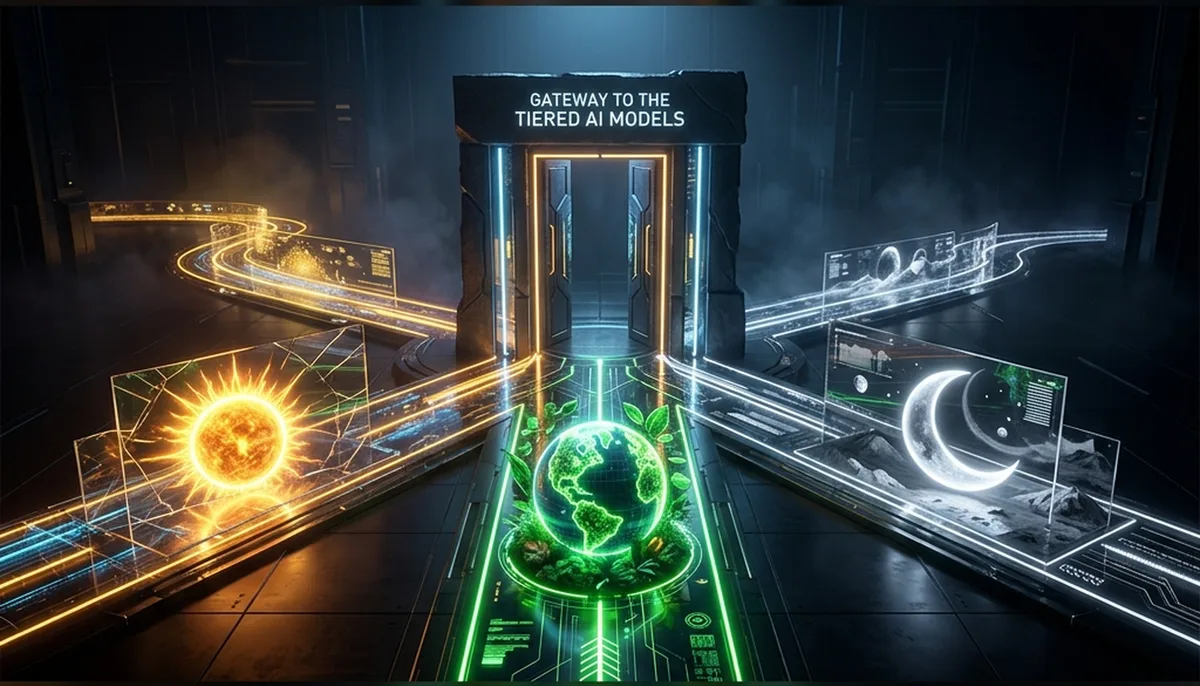
GPT-5.6 has three tiers, three prices, and in the first 48 hours of general availability, a lot of people wasted money picking the wrong one. Here's how not to be one of them.
On 9 July 2026, OpenAI took the whole GPT-5.6 family, Sol, Terra and Luna, general, after a few weeks spent previewing it to a short list of government-approved companies, which I wrote about at the time. Here's how OpenAI announced it: "GPT-5.6 is available starting today across ChatGPT, Codex, and the OpenAI API. The rollout is starting globally now and will continue gradually toward full availability over the next 24 hours." That's not marketing gloss, that's the actual sentence, and I want to flag the word "gradually" because it matters more than most people reading the headline will clock.
So here's what changed, and what didn't. What changed: you're no longer locked out because you're not on a government-approved list of twenty companies. What didn't change: this still isn't instantly available to every user on every plan the second the announcement went live. It's a phased rollout, plan-gated, over roughly a day. I'll come back to that, because it's the first thing worth being honest about rather than sweeping under the "generally available" banner.
What I actually want to give you here isn't a verdict on whether GPT-5.6 is good. It clearly is, in places. What I want to give you is the thing nobody selling you an AI subscription bothers to write: which of the three tiers is actually worth your money for the job you're trying to do, and where the marketing gets ahead of the reality. I've spent the last week poking at all three, reading the system documentation, and talking to a couple of clients who jumped on this the day it opened. Here's what I've got.
The three tiers, properly explained
Let's start with the bit that should be simple and somehow isn't, because OpenAI named these things Sol, Terra and Luna instead of "Big", "Medium" and "Small", and half the confusion in the first 48 hours came from people assuming the fancier name meant the fancier model. It does, for what it's worth, but check the table below before you assume anything.
| Tier | Best for | Input price (per 1M tokens) | Output price (per 1M tokens) | Context window |
|---|---|---|---|---|
| Sol | Deep reasoning, complex coding, long-running agentic tasks | $5 | $30 | 1.05M |
| Terra | Balanced, everyday work, roughly GPT-5.5 capability at half the cost | $2.50 | $15 | 1.05M |
| Luna | High-volume, low-complexity, speed and cost over depth | $1 | $6 | 1.05M |
All three share the same 1.05 million token context window and a 128,000 token maximum output, which is worth knowing because it means the context ceiling isn't the thing separating them. What separates them is depth of reasoning and how much compute OpenAI is willing to throw at your query before it answers.
Sol is the one to reach for when the job is genuinely hard. Large codebases where a wrong assumption three files away breaks something you won't notice for a week. Agentic tasks that run unattended over hours, where persistence and not going off the rails matters more than raw speed. Anything where a mistake is expensive, legal drafting review, a security audit, a migration plan for a production system. There's also a Sol Pro variant aimed at enterprise, with an "Ultra mode" for multi-agent coordination, though I'd treat "Ultra mode" the same way I treated the "Sol Ultra" claims in the gated-preview coverage: real, but thinly documented outside enterprise sales material, so don't build your business case on a feature you haven't actually seen work.
Terra is the one most small and mid-sized businesses should actually be running day to day. It's pitched as matching the outgoing GPT-5.5's ability at roughly half the price, and from what I've tested that holds up for the kind of work most people are doing: drafting, summarising, customer correspondence, general coding that doesn't need a research agent chewing on it for four hours. If your team's current habit is defaulting to the flagship model for everything because it's the one everyone's heard of, Terra is very likely the tier that saves you real money without you noticing a quality drop.
Luna is the unglamorous one, and it's the one I think gets underrated because "cheapest" sounds like "worst" to people who haven't used it. Luna is for volume. Tagging incoming support tickets. Routing emails. Short, structured, repetitive tasks where you're running thousands of calls a day and the marginal cost per call actually shows up on your invoice. At $1 input and $6 output per million tokens, Luna is roughly a fifth the cost of Sol on the output side. If you're running a high-volume, low-complexity workload on Sol out of habit, you are, plainly, wasting money.
The heuristic I've settled on, and the one I'm giving clients this week: ask how expensive a wrong answer is, not how important the task feels. A support-ticket triage system that occasionally misfires costs you a few minutes of human review. A production code migration that occasionally misfires costs you a very bad Tuesday. Match the tier to the cost of being wrong, not to how impressive the task sounds in a meeting.
What the early reaction actually looks like
The enthusiasm out of OpenAI's own channels in the first few days was, unsurprisingly, enormous. Real-world use cases got a lot of airtime, farmers running agricultural planning queries, mathematicians using Sol for proof-checking work. That's genuine and worth acknowledging rather than dismissing as pure marketing theatre. Some of it clearly is impressive.
But the friction was real too, and I'd rather tell you about it than pretend the rollout was smooth. Rate limits reset and got hammered within hours as people rushed to test the new tiers, which is normal for any major model launch but still meant a chunk of early testers hit walls mid-session.

Tier confusion was rampant, plenty of people expected to just tap a dropdown in ChatGPT and pick Terra or Luna directly, only to find those two are mostly reachable through the API, Codex, or ChatGPT Work rather than sitting as a selectable option in a standard consumer chat, and if you're on a Free or Go plan in Work or Codex, Terra is the only one of the three you'll see at all. And the plan-gating on Sol caught people out. You need Plus, Pro, Business or Enterprise, and you need to bump the effort setting up to actually get Sol's deeper reasoning rather than a lighter pass that looks similar but isn't.
Which brings me to the thing I flagged at the top and want to address directly rather than let slide. OpenAI's phrase "generally available" is carrying more weight than it should. For a solo user on a free ChatGPT account, the honest, practical answer to "can I use GPT-5.6 Sol today" is still closer to "not really, not on your current plan" than it is to "yes, obviously." The gate didn't vanish. It moved from "twenty companies with government sign-off" to "whoever's paying for the right subscription tier." That's a meaningfully bigger gate. It's still a gate. One developer put the underlying point better than I have here:

And here's the second honest complication, the one I'd be doing you a disservice to skip. A three-tier pricing ladder assumes you can judge, in advance, how complex your task actually is. In practice a lot of people can't, reliably, and that's not a knock on anyone's judgement, it's just how uncertain a "how hard is this job really" call is before you've started the job. I've had clients ask me flat out which tier to use for a project brief that turned out to need Sol-level reasoning on one section and Luna-level triage on the rest. The three-tier model solves OpenAI's cost problem more cleanly than it solves your decision-making problem. If you're not sure, my honest advice is to start one tier down from where your instinct says, and step up only when you hit a wall. Overpaying by defaulting everything to Sol is the far more common and far more expensive mistake I'm seeing right now.
The Claude Fable 5 comparison, kept honest
I can't write about a new frontier model launch in July 2026 without someone asking how it stacks up against Anthropic's Fable 5, and the comparisons genuinely have been playing out in public since GPT-5.6 opened up. I want to be careful here, because it would be very easy for this section to read as OpenAI-favourable simply by being the anchor of the article you're reading. It shouldn't, and having gone through the actual reports rather than the highlight reels, it doesn't hold up as a clean win for either side.
Image could not be loaded: /images/articles/gpt-5-6-claude-dual-monitor.jpg
Claude vs GPT-5.6 Capabilities
On complex coding and agentic persistence, the early word has Sol edging ahead in a genuine way, cleaner outputs on some benchmark comparisons, stronger showings on things like physics simulation tasks, and reported gains in Ultra mode for coordinated multi-agent work, though I'll flag Ultra mode again here for the same reason I flagged it earlier: it's thin on independent documentation outside enterprise sales material, so treat that specific claim as unconfirmed rather than settled. The coding and persistence edge is a real advantage worth testing against whatever you're currently running if your business is heavily code-focused.
On the other side, plenty of developers still reach for Claude Fable 5 for anything requiring what people keep calling "taste", the quality of creative and nuanced writing, the judgement calls in ambiguous prose tasks that don't have a clean right answer. That preference showed up repeatedly in the side-by-side testing threads doing the rounds on X this week, including comparison tests referencing benchmarks like BridgeBench and DeepSWE.

What I noticed, and what I think matters more than either company's press release, is how many developers are running both models rather than switching wholesale. That's not indecision. That's people who've worked out these two tools are genuinely good at different things and are declining to pretend otherwise.
To be clear about what this section is and isn't. It's about capability and fit, not price. I know there's a separate, live conversation about how OpenAI's launch affected Anthropic's own pricing decisions around Fable 5, and I'm deliberately not wading into that here, because it's a different question with its own answer, and folding it in would muddy both. If you want the fuller picture on Fable 5 specifically, including the vendor-risk side of that story, I wrote about it separately.

The real Fable 5 lesson isn't the model, it's that it can vanish overnight
You can't review a model you had for three days. Claude Fable 5 was pulled globally for 18 days by a US export-control order, and the real lesson...
Read full articleA practical picking guide
If you just want the short version to hand to whoever's making the call at your business, here it is.
Image could not be loaded: /images/articles/gpt-5-6-decision-flowchart.jpg
GPT-5.6 Tier Decision Matrix
Content generation and drafting, blog posts, marketing copy, internal documentation: Terra. You don't need Sol's depth for this, and Luna will show its seams on anything requiring nuance or a longer arc of reasoning across a document.
Coding, genuinely complex work: Sol, but only when the codebase or task is actually complex. A CRUD app doesn't need it. A migration touching a production database with downstream dependencies does.
High-volume customer support triage, ticket tagging, first-pass email sorting: Luna. This is the textbook use case for the cheapest tier, and if you're currently running this kind of workload through Sol because it's the name everyone knows, you're overpaying by a wide margin for accuracy gains you probably won't notice.
Agentic, long-horizon tasks that run unattended for hours: Sol, with genuine caution. This is exactly the profile where a persistent model earns its higher price, and also exactly the profile where an error compounds the longest before a human notices. Budget for review, not just for the API bill.
One-off, high-stakes decisions, contract review, security assessments, anything with real financial or legal exposure: Sol, and don't be the business that tries to save the price difference on this category. It's the one place I'd tell a client not to shop down a tier.
Where this leaves you
I don't think there's a tidy, satisfying ending here, and I'd rather say that than manufacture one. GPT-5.6's tier system is a genuinely sensible response to a genuine problem, not every task needs the most expensive model, and OpenAI deserves credit for building a pricing structure that actually reflects that. But "generally available" still means "available if your plan and your patience for a 24-hour rollout line up," and picking the right tier still asks you to correctly judge your own task's complexity before you've started it, which is a harder ask than the marketing implies.
My honest read, after a week of actually using all three: for the five categories in the picking guide above, use the tier I named, don't shop down on the high-stakes ones, don't overpay on the high-volume ones. That advice was specific for a reason. It's only for the genuinely ambiguous middle, the task you can't confidently place in any of those five buckets, that I'd say start a tier cheaper than your instinct suggests and let the work tell you when you need to step up. Don't read "start cheap" as a universal rule that overrides the specific guidance a few paragraphs back. It's a tiebreaker for when you're actually unsure, not a licence to shop down on a security audit.

OpenAI built its best model yet. The government decided who gets to use it.
OpenAI previewed GPT-5.6 on 26 June 2026 and gated it to roughly 20 government-approved companies, not the public. OpenAI itself objected. It...
Read full articleSources
- OpenAI. "GPT-5.6: Frontier intelligence that scales with your ambition." OpenAI, 9 July 2026. https://openai.com/index/gpt-5-6/
- OpenAI. "Previewing GPT-5.6 Sol." OpenAI, 26 June 2026. https://openai.com/index/previewing-gpt-5-6-sol/
- OpenAI Help Center. "A preview of GPT-5.6 Sol, Terra, and Luna." https://help.openai.com/en/articles/20001325-a-...
- Simon Willison. "The new GPT-5.6 family: Luna, Terra, Sol." 9 July 2026. https://simonwillison.net/2026/Jul/9/gpt-5-6/
- TechCrunch. "OpenAI launches its new family of models with GPT-5.6." 9 July 2026. https://techcrunch.com/2026/07/09/openai-launch...
- Forbes. "OpenAI Rolls Out Powerful New GPT-5.6 Models, But Limits Users After Government Request." 26 June 2026. https://www.forbes.com/sites/conormurray/2026/0...
- Eclipse Ventures (@EclipseVentures). X post on GPT-5.6 Sol running at 750 tokens/sec on Cerebras. July 2026. https://x.com/EclipseVentures/status/2070607792...