


The FCC approved a million AI data centres in space.Read the order: it licensed their backup radio.
SpaceX Starmind's FCC approval, read line by line: what it licenses, the 2033 deadline, the cooling maths it skipped, and the SKA's brushed-off objection.
At 3:09am on Thursday, Sydney time, the chair of the US Federal Communications Commission posted under an all-caps heading and a flag emoji. "Today, in a historic first, the FCC approved SpaceX's request for 1 million satellites (orbital compute modules)," Brendan Carr wrote. By Thursday it had passed 14,000 likes.


By breakfast the story had settled into one line: a million AI data centres, approved, in orbit. Reuters puts the number of satellites in existence at "only 17,000" (ABC News, via Reuters, 2026), so that's nearly 60 times everything currently up there.
A million, against everything up there now
- 17,000
- satellites in existence, per Reuters
- 1,000,000
- Starmind satellites in the grant
nearly 60 times everything currently up there.
Then I read the order. It's DA 26-1273, signed on 25 November, US time, by Courtney Reinhard, chief of the FCC's Space Bureau (FCC, 2026). In a box near the top, under "Scope of Grant", it says:
DA 26-1273
Scope of Grant
“Authority for radiofrequency communications for backup and emergency telemetry, tracking, & command (TT&C) for a constellation of 1,000,000 NGSO satellites to operate as data centers in space.”
Backup radio. For a million satellites. That's the thing that got licensed.
To be fair, it's the only radio on board, so it's everything the FCC could license. What's narrow is what the FCC agreed to judge.
What the order actually approves
It's a real approval, so let's be fair. SpaceX can't run radio transmitters on its satellites without an FCC licence, and the order says plainly that the Commission licenses space stations "as it generally pertains to the communications between them". No licence, no launch. SpaceX now has one.
What it covers is narrow. Starmind satellites will talk to each other and to Starlink mostly by laser. SpaceX argued in a September letter that those optical links "are not covered by the Commission's jurisdiction" (SpaceX letter to the FCC, 2026), so the radio part is a Ka-band fallback for when the lasers fail, on an "unprotected and non-interference basis". If it interferes with anyone, SpaceX has to stop. The order agrees with SpaceX that it's "unlikely" all one million satellites will need the radio at once.
Then there are the edges:
Asked for, and got
- 500 to 600 km Two of the six shells. Debris plan compliant.
- 600 to 1,002 km The other four. SpaceX has to file a modification with a final debris plan first.
- 1,002 to 2,000 km Asked for on 30 January. Not in the grant.
- Altitude. SpaceX filed on 30 January asking for orbits from 500 to 2,000 km (FCC public notice, 2026). It got 500 to 1,002 km, in six shells.
- Debris. The order finds SpaceX's debris plan compliant only for satellites below 600 km. Two of the six shells sit under that line. Before anything goes into the other four, SpaceX has to file a modification with a final debris plan. Its request to dispose of higher satellites into "heliocentric orbits" (around the sun; I had to read that twice) is deferred.
- Deadlines. The grant voids itself if SpaceX misses these:
| Deadline | Deployed and operating |
|---|---|
| 25 November 2033 | One satellite |
| 25 November 2035 | 10% (100,000) |
| 25 November 2038 | 50% (500,000) |
| 25 November 2040 | All 1,000,000 |
What the grant requires, and when
Seven years to get one working. In fairness, these are the FCC's new standard milestones, which SpaceX accepted after withdrawing a request for none at all. At a Baron Capital talk, Elon Musk said he expects the first of these spacecraft to launch in the third quarter of 2027 (Spaceflight Now, 2026), and Via Satellite reports SpaceX's president told investors launches would begin in 2027. If that happens, 2033 won't trouble anyone.
What the FCC said wasn't its job
The FCC's press release went big. It says the decision "promises to bring the human race closer to a Kardashev II civilization", which it defines as one that can harness the full power of the sun (FCC, 2026). The order's far more modest. The American Astronomical Society argued the system would generate substantial waste heat, and that its "thermal signature" could brighten the infrared sky. The order's reply, at paragraph 17, is one sentence: those concerns "are outside the scope of the ODC's radiofrequency operations."
Paragraph 18 goes further. Comments doubting the feasibility of orbital data centres, flagging "issues with thermal management of ODCs", calling them inefficient compared to ground-based ones, or doubting the economics all "fall outside of the Commission's review ... and are not a basis for denial". In many cases, it says, the comments "seek to substitute the government's judgment regarding the viability of business endeavors for that of the applicant and private enterprise. We decline to do so."
Read that carefully: nowhere does the order say the heat objections are mistaken. Heat isn't radio, so in the Bureau's view it isn't the FCC's call. Legally, I think that's defensible. Practically, it leaves a hole. After the grant the AAS said it's critical for the FCC to consider optical and infrared astronomy "in the absence of another licensing agency that can take these concerns into account" (SpacePolicyOnline, 2026). The society said it was "disheartened and dismayed".
Petitions to deny from Viasat, Amazon's Kuiper and the AAS were all denied. Optical astronomy got no extra conditions beyond SpaceX's promise to coordinate with the US National Science Foundation, though the Bureau says it ran the grant past NASA, NOAA and federal astronomy bodies through the government's spectrum agency first. On the sheer number of satellites, the Bureau "declines to invent a de facto rule".
What the Bureau did with each question
| Put to the Bureau | What the order did |
|---|---|
| Backup and emergency radio for 1,000,000 satellites | GrantedOn an unprotected and non-interference basis. |
| Orbits from 500 to 2,000 km | Got 500 to 1,002 kmIn six shells. |
| The debris plan | Compliant only below 600 kmTwo of the six shells sit under that line. |
Disposal of higher satellites into heliocentric orbits | Deferred |
| Petitions to deny from Viasat, Amazon’s Kuiper and the AAS | Denied |
The SKA Observatory: the constellation itself will reflect radio waves | unpersuadedThe comments provide no technical support. |
| The sheer number of satellites | declines to invent a de facto rule |
| Put to the Bureau | What the order did |
|---|---|
Waste heat, and a thermal signaturethat could brighten the infrared sky | outside the scopeParagraph 17. |
Feasibility, issues with thermal management of ODCs, efficiency and economics | fall outside of the Commission’s reviewParagraph 18: and are not a basis for denial. |
nowhere does the order say the heat objections are mistaken
(One aside that made my week: the order twice cites a pending FCC rulemaking actually titled "Spectrum Abundance for Weird Space Stuff". Somebody there has a sense of humour.)
The heat problem, for people who build websites
On the ground, a data centre gets rid of heat by moving air or water past hot things. Fans, chillers, cooling towers. In orbit there's no air. The only way out for heat is to glow it away as infrared, from a radiator. Peter Howson put it neatly in The Conversation: "like a Thermos flask, space keeps things hot" (The Conversation, 2026).
SpaceX sells it the other way. When it filed, Musk talked up "the natural cooling of the vacuum" (SatNews, 2026), and its Starmind page still says "Heat radiates freely into the vacuum of space" (SpaceX, 2026). It radiates. Freely is the bit I'd argue with: you pay in square metres of radiator that you launch, unfold and keep out of the sun as best you can.
How much radiator does a Starmind satellite get? SpaceX told the FCC on 16 September that its satellites will have a radiator under 200 m², solar arrays under 1,500 m² and a mass under 4,000 kg. How much heat? Via Satellite reports that SpaceX describes the satellites "with a compute payload of 175 kW on average, and up to 250 kW" (Via Satellite, 2026). SpaceX's Michael Nicholls told a conference in October each one "might be something like a 250 kilowatt satellite, or roughly a rack of compute in space", per Spaceflight Now. Back in July, Notebookcheck reported SpaceX's Starmind page listing 120 kW average, 150 kW peak and 110 m² of radiator (Notebookcheck, 2026). Both have grown since: the peak by two-thirds, and the radiator envelope SpaceX gave the FCC in September is up to 200 m². The page's text, as I read it on 26 November, doesn't show these numbers any more.
Now my maths, which is mine alone and back-of-envelope. Assumptions in one line: a flat panel radiating from both sides, emissivity 0.9, and no heat soaked up from the sun or Earth (which flatters the result).
| Radiator temperature | Heat shed per m² | Area for 250 kW | Area for 1 MW |
|---|---|---|---|
| 27°C | about 827 W | about 300 m² | about 1,210 m² |
| 52°C | about 1,140 W | about 220 m² | about 880 m² |
| 77°C | about 1,530 W | about 165 m² | about 650 m² |
I checked it against a published figure. Starcloud's white paper gets 770 W per m² for a two-sided plate at 20°C, which matches mine once you allow for its coating, and then loses about 18% of that to sunlight and Earth (Starcloud, 2024). So my numbers are, if anything, kind.
Put SpaceX's figures through that. At the 175 kW average, the full 200 m² it told the FCC about needs the radiators to average only about 31°C, or roughly 42°C once you add Starcloud's sunlight and Earth load. At the 250 kW peak, it's about 60°C before that penalty. Both assume the 200 m² is panel size with both faces radiating; if SpaceX counted both faces in that figure, the peak case is nearer 120°C. At a room-ish 27°C, 250 kW needs about 300 m², more than SpaceX's envelope and a bit more than a doubles tennis court.
My working, drawn
Five temperatures from the maths above. Step through them: the cooler the radiator, the more of it a satellite needs.
27°C
250 kW peak needs about 300 m²
Over the envelope
More than SpaceX’s envelope, and a bit more than a doubles tennis court
.
- Heat shed per m²
- about 827 W
- Area for 1 MW
- about 1,210 m²
All five points
- 27°C: 250 kW peak needs about 300 m². Over the envelope. More than SpaceX’s envelope, and
a bit more than a doubles tennis court
. - about 31°C: 175 kW average needs the full 200 m². Fills the envelope. Or
roughly 42°C once you add Starcloud’s sunlight and Earth load
. - 52°C: 250 kW peak needs about 220 m². Over the envelope.
- about 60°C: 250 kW peak needs the full 200 m². Fills the envelope. That is
before that penalty
. If SpaceX counted both faces in its figure,the peak case is nearer 120°C
. - 77°C: 250 kW peak needs about 165 m². Inside the envelope.
a flat panel radiating from both sides, emissivity 0.9, and no heat soaked up from the sun or Earth. The line joins the four points stated for the 250 kW peak.
One satellite against the whole station
ISS external cooling system
Six radiators, with ammonia supplied at around 3°C.
One Starmind satellite
2.5 to 3.6 times the whole station’s cooling rating, from less than half the panel area.
the comparison shows how much warmer Starmind has to run, not that it can’t
For scale, the International Space Station's external cooling system is rated at 70 kW, shed through six radiators of about 23.3 m by 3.4 m each, roughly 475 m² of panel (NASA, 2006). The ISS runs its radiators cold, with ammonia supplied at around 3°C. One Starmind satellite at 175 to 250 kW is 2.5 to 3.6 times the whole station's cooling rating, from less than half the panel area. At the 250 kW peak, that's at least eight times the ISS's heat per square metre of radiator. Most of that gap is temperature, though: a panel at 60°C sheds two to four times what one near freezing does. So the comparison shows how much warmer Starmind has to run, not that it can't.
And warm isn't exotic. GPU racks on the ground already run on warm liquid coolant, so a radiator in the 40s to 60s is a sensible design, not a red flag. The hard part is the size. Nobody has flown, unfolded and kept pointed 200 m² of radiator per satellite, let alone a million of them, as far as I can find. That's the engineering bet.
The AAS's worry is a different one, spelled out in its reply comments back in March: "It is physically impossible to make hot objects like satellites faint in thermal infrared wavelengths" (AAS reply comments, 2026). Whatever temperature the radiators run at, every one of those kilowatts has to leave as infrared. Getting the radiator design right doesn't make that go away. It's the waste heat itself the astronomers object to.
The Australian telescope the FCC was "unpersuaded" by
On 5 March the SKA Observatory filed comments. The order summarises its argument as being that the constellation "itself will reflect radio waves and cause interference into other radiofrequency services". The Bureau's answer: "We are also unpersuaded", because the comments "are not specific to SpaceX's proposed radiofrequency operations and provide no technical support".
I haven't been able to get hold of SKAO's filing, so I can't say which telescope or frequencies worried it. SKA-Mid is in South Africa. SKA-Low is at Inyarrimanha Ilgari Bundara, the CSIRO Murchison Radio-astronomy Observatory, on Wajarri Yamaji Country in Western Australia: 131,072 Christmas-tree-shaped antennas listening between 50 and 350 MHz (CSIRO, 2026). Australia's been doing radio astronomy in paddocks since well beforeThe Dishmade Parkes famous, and as Curtin's release on the study below puts it, the SKA "needs radio silence to succeed."
"No technical support" is a hard line to read next to work published last year. Curtin University and ICRAR researchers Dylan Grigg, Steven Tingay and Marcin Sokolowski analysed about 76 million sky images from an SKA-Low prototype station. In some datasets, up to about 30% of images showed Starlink interference (Curtin University, 2025). They also detected "the reflections of terrestrial FM radio off different models of Starlink satellites" at 99.70 MHz, right inside SKA-Low's range (Grigg et al., 2025).
The FCC has a fair reply. The study is about Starlink, not Starmind, and mostly about Starlink's own unintended emissions, with the FM reflections as a side finding. The order brushed off both kinds of claim, reflection and "other unintentional emissions", for lack of technical support specific to Starmind. Tingay himself was careful: "It is important to note that Starlink is not violating current regulations, so is doing nothing wrong." That's the problem in a sentence. As far as I can tell, the rules don't cover reflection, and Starmind satellites, with up to 1,500 m² of solar array each, haven't been measured because they don't exist yet. Whether they reflect more than a Starlink is a question for a radio astronomer, not me. I'd just like someone to ask before there are a million of them.
The best case for Starmind
I've been hard on the idea, so here's SpaceX's case as strongly as I can put it. The orbits are chosen for power. SpaceX's September letter says Starmind will use "dawn-dusk or dusk-dawn" sun-synchronous orbits, which ride the line between day and night and stay in sunlight almost constantly. SpaceX told the FCC that "by directly harnessing near-constant solar power with little operating or maintenance costs" its satellites would be cheaper and more energy-efficient than data centres on the ground, per Reuters. No land to buy, no water licence, no grid connection queue. SpaceX owns its rockets, and Google's Project Suncatcher paper treats about US$200 per kg to orbit as the point where launch "could cease to be the limiting cost factor" (Google, 2025). And SpaceX has done the impossible-sounding constellation before: Starlink has nearly 11,200 spacecraft in orbit, per Spaceflight Now. Musk replied to Carr on X, as Spaceflight Now reported: "Much appreciated. This will be a great asset to America and the world."
That's a serious case, and Starlink is the reason to take Starmind seriously. My answer is the size of the jump. Google's researchers estimate a Starlink V2 Mini's arrays at about 28 kW, noting that "exact specifications have not been publicly released by SpaceX." SpaceX describes 175 to 250 kW each, with the heat to match. That's a different kind of spacecraft.
There's also a fair objection to my headline: every satellite licence is a radio licence, so "it licensed their backup radio" sounds like a gotcha. Partly true. But for Starlink the radio is the product. Here it's a fallback, and the product, a data centre in orbit, is exactly what the order says it didn't review. A headline saying the FCC "approved data centres in space" reads like a verdict on whether they'll work. The order goes out of its way not to give one. Astrophysicist Adam Becker gave AP his own verdict: "a fantasy", and "It's not going to happen" (AP, via ABC News, 2026). I'm not that sure. Nobody is, yet.
What it means if you buy compute or run a website
Why bother? Because power for AI is the bottleneck on the ground. In September we covered the A$32 billion campus planned near Dalby, Queensland, with Anthropic as anchor tenant.
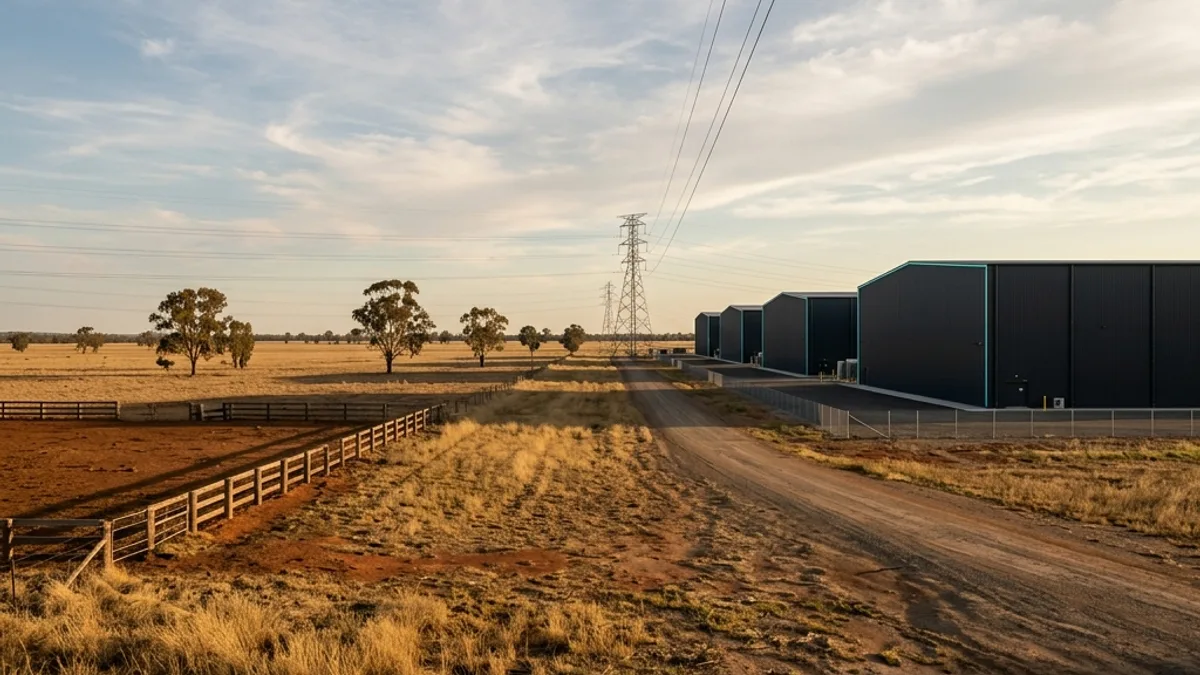
Its planning documents put IT load at about 1.44 GW across four halls of roughly 360 MW each. Run that against SpaceX's 175 kW average (my arithmetic) and one of those halls is about 2,000 Starmind satellites, and the whole campus about 8,200. The full million would be around 175 GW. Compute and power are the real story here, and Starmind is a symptom of it.
For anyone buying hosting or AI tokens in Australia, though, I don't see it changing your bill this decade. The order only requires one satellite by 2033, and Musk told a Baron Capital event SpaceX would "start off slow", reaching significant volume "probably in '28", per Spaceflight Now. I'd be surprised if any of that reaches what you pay before 2030. Your next price change will come from data centres on the ground, electricity prices and the AI companies themselves. Plan around those.
Where I've landed
The FCC did approve something real this week, and SpaceX can now start building. But what it approved is the radio licence a constellation needs, four of six shells still waiting on a debris plan, and an explicit refusal to judge whether the thing works. The physics test hasn't started.
"Space is cold" sounds like it should make the cooling easy. I did the sums instead, and they say SpaceX's numbers can close with warm radiators of a size nobody has flown yet. That might be fine. Or it might be where the whole idea stalls. I'm a web developer doing thermodynamics on a Thursday, and if my numbers are off I'd honestly like to hear it. We're all reading the same order and guessing at the same physics.
Key Takeaways
The FCC's Space Bureau granted SpaceX "backup and emergency" radio for 1,000,000 Starmind satellites on 25 November, US time. Real, but narrow.
Debris is cleared only below 600 km, so four of six shells need another filing. One satellite must be working by 25 November 2033, or the grant is void.
The order puts heat, feasibility, efficiency and economics outside its review, without calling those objections wrong.
My maths on SpaceX's figures: under 200 m² of radiator handles the 175 kW average at roughly 30°C to 45°C and the 250 kW peak at about 60°C. Warm is normal for GPU cooling; a radiator that size in orbit is the untested part.
The FCC was "unpersuaded" by the SKA Observatory, though Curtin and ICRAR have already caught FM radio bouncing off Starlink in SKA-Low prototype data.
Cooling in orbit isn't free. It costs radiator area, and radiator area costs launches.
Frequently asked questions
Did the FCC approve a million data centres in space?
Partly. On 25 November 2026, US time (26 November in Sydney), the FCC's Space Bureau granted SpaceX authority for backup and emergency radio communications for a constellation of 1,000,000 satellites meant to operate as data centres. That licence is what lets SpaceX deploy, so it's a real approval. But the order says objections about heat, feasibility, efficiency and economics fall outside its review. It clears SpaceX's debris plan only for satellites below 600 km, so four of the six orbital shells need another filing, and SpaceX must have one satellite working by 25 November 2033 or the authorisation is void.
When will the first Starmind satellite launch?
SpaceX hasn't given a firm date in the filings we've read. Spaceflight Now reports Elon Musk told a Baron Capital talk he expects the first of these spacecraft to launch in the third quarter of 2027. The FCC's deadlines are later: one satellite deployed and operating by 25 November 2033, 10% of the constellation by 2035, half by 2038 and all one million by 2040, or the authorisation becomes null and void.
How do you cool a computer in space?
With radiators. In orbit there's no air or water to carry heat away, so it has to be radiated off as infrared. Liquid loops move heat from the chips to large panels that shed it into space. Our own back-of-envelope figure, for a two-sided panel with emissivity 0.9 and ignoring sunlight, is about 827 watts per square metre at 27°C. At that temperature a 250 kW Starmind satellite would need about 300 m² of radiator. SpaceX told the FCC its radiators will be under 200 m², which works if they run warm: roughly 30°C to 45°C at the 175 kW average and about 60°C at the peak. That's normal for liquid-cooled GPUs; the untested part is flying radiators that big.
Will Starmind affect Australian astronomy?
Nobody knows yet. The SKA Observatory, which is building the SKA-Low telescope in Western Australia and SKA-Mid in South Africa, filed comments arguing the satellites themselves could reflect radio waves into other services. The FCC said it was 'unpersuaded' and that the comments gave no technical support. A 2025 Curtin University and ICRAR study did detect FM radio reflecting off Starlink satellites in data from an SKA-Low prototype station. Starmind satellites haven't flown, and the FCC didn't assess infrared effects, which it said were outside its scope.
Sources
- FCC Space Bureau. "Memorandum Opinion and Order and Authorization, DA 26-1273, Space Exploration Holdings LLC (Starmind)." 25/11/2026. https://docs.fcc.gov/public/attachments/DA-26-1273A1.pdf (opens in a new tab)
- FCC. "FCC Authorizes 1 Million Satellites for Data Centers in Space" (news release). 25/11/2026. https://docs.fcc.gov/public/attachments/DOC-427572A1.pdf (opens in a new tab)
- FCC Space Bureau. "Space Bureau Accepts for Filing SpaceX's Application for Orbital Data Centers", Public Notice DA 26-113. 04/02/2026. https://docs.fcc.gov/public/attachments/DA-26-113A1.txt (opens in a new tab)
- Madeleine Chang, SpaceX. Letter to Marlene H. Dortch, Secretary, FCC (response to information request), ICFS SAT-LOA-20260108-00016. 16/09/2026. https://api-prod.fcc.gov/icfs-attachment/exp/api/v1/a81df57a93db4f10ac9c39bfa8373c08 (opens in a new tab)
- Brendan Carr, X post. 25/11/2026. https://x.com/BrendanCarrFCC/status/2125623026918002860 (opens in a new tab)
- Reuters, via ABC News. "Trump administration backs Musk's plan for space-based data centres." 26/11/2026. https://www.abc.net.au/news/2026-11-26/musk-spacex-datacentres-fcc/107428024 (opens in a new tab)
- Rachel Jewett, Via Satellite. Report on the FCC's approval of Starmind. 25/11/2026. https://www.satellitetoday.com/connectivity/2026/11/25/fcc-approves-spacexs-1-million-satellite-orbital-data-center-constellation/ (opens in a new tab)
- Will Robinson-Smith, Spaceflight Now. Report on the FCC's approval of Starmind. 26/11/2026. https://spaceflightnow.com/2026/11/26/fcc-green-lights-spacexs-plan-to-launch-1-million-starmind-data-center-satellites/ (opens in a new tab)
- Daniel Zlatev, Notebookcheck. Report on SpaceX's AI1 satellite cooling specifications. 11/07/2026 (modified 05/10/2026). https://www.notebookcheck.net/SpaceX-lists-AI1-satellite-cooling-specs-for-Starmind-data-center-in-space.1340218.0.html (opens in a new tab)
- Marcia Smith, SpacePolicyOnline. Report on the FCC's approval of Starmind. 25/11/2026. https://spacepolicyonline.com/news/fcc-approves-elon-musks-one-million-orbital-data-centers/ (opens in a new tab)
- American Astronomical Society. "Reply Comments of the American Astronomical Society", ICFS SAT-LOA-20260108-00016. 23/03/2026. https://pub-92a1d770e9be416e8558d475b4b5b847.r2.dev/afb0661e-408a-4b87-b72e-87c20f38b0cd.pdf (opens in a new tab)
- Wyatte Grantham-Philips, Associated Press, via ABC News (US). "FCC says SpaceX can deploy 1 million satellites for data centers in space. Scientists are skeptical." 25/11/2026. https://abcnews.com/US/wireStory/fcc-spacex-deploy-1-million-satellites-data-centers-138455857 (opens in a new tab)
- Peter Howson, The Conversation. On AI's environmental footprint in orbit. 18/07/2026. https://theconversation.com/why-ais-environmental-footprint-wont-disappear-into-orbit-287310 (opens in a new tab)
- Boeing IDS, hosted by NASA. "Active Thermal Control System (ATCS) Overview." 2006. https://www.nasa.gov/wp-content/uploads/2021/02/473486main_iss_atcs_overview.pdf (opens in a new tab)
- Feilden, Oltean and Johnston, Starcloud (formerly Lumen Orbit). "Why we should train AI in space", White Paper v1.03. September 2024. https://starcloudinc.github.io/wp.pdf (opens in a new tab)
- Agüera y Arcas et al., Google. "Towards a future space-based, highly scalable AI infrastructure system design." arXiv:2511.19468, 22/11/2025 (v2 17/06/2026). https://arxiv.org/abs/2511.19468 (opens in a new tab)
- SatNews. Report on SpaceX's FCC application for an orbital data centre system. 31/01/2026. https://satnews.com/2026/01/31/spacex-files-fcc-application-for-million-satellite-orbital-data-center/ (opens in a new tab)
- CSIRO. "SKA" (Inyarrimanha Ilgari Bundara, the Murchison Radio-astronomy Observatory). Updated 24/09/2026. https://www.csiro.au/en/about/facilities-collections/international-facilities/ska (opens in a new tab)
- Dylan Grigg, Steven Tingay and Marcin Sokolowski. "The Growing Impact of Unintended Starlink Broadband Emission on Radio Astronomy in the SKA-Low Frequency Range." Astronomy & Astrophysics 699, A307, July 2025. arXiv:2506.02831. https://arxiv.org/abs/2506.02831 (opens in a new tab)
- Sam Jeremic, Curtin University. Media release on Starlink interference in SKA-Low prototype data. 23/07/2025. https://www.curtin.edu.au/news/media-release/interference-to-astronomy-the-unintended-consequence-of-faster-internet/ (opens in a new tab)
- SKA Observatory. "First SKA-Low telescope antennas deployed in Australia." 07/03/2024. https://www.skao.int/en/news/524/first-ska-low-antennas-deployed (opens in a new tab)
- SpaceX. "Starmind" (SpaceX AI page). Read 26/11/2026. https://www.spacex.com/spacexai/starmind (opens in a new tab)