

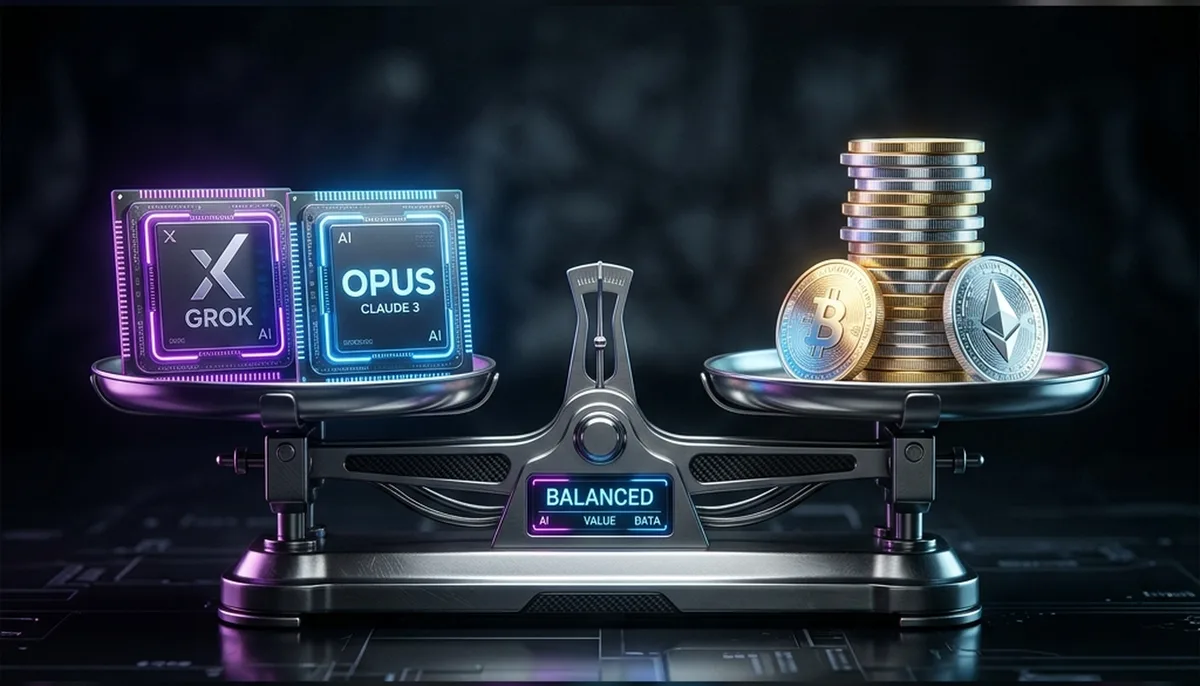
Elon Musk described xAI's new model like this: "an Opus-class model, but faster, more token-efficient and lower cost." Quick note before anything else: xAI merged with SpaceX earlier this year and now operates under the SpaceXAI name, so if you've been out of the loop and are wondering why the byline's changed, that's why. Here's the post that started this, in full:

That's the whole claim, in his own words, and I've read it three times to make sure I wasn't softening it in my own head before writing this. He's not saying Grok 4.5 is "impressive" or "a big step forward." He's naming a specific competitor's flagship (Anthropic's Claude Opus) and claiming parity on quality plus wins on speed, efficiency and price.
That's unusually precise for a launch quote, and precise claims are worth checking rather than waving off. I've spent twenty-odd years building on top of whatever the current best model happens to be, and "basically as good, but cheaper" is the sentence that gets you into trouble if you don't verify it before rebuilding a client's workflow around it. So let's check it, piece by piece.
The maths that's genuinely checkable
Grok 4.5 launched on 8 July 2026, with wider rollout the following day, priced at $2 per million input tokens and $6 per million output tokens. Claude Opus 4.8's standard published rate is $5 per million input and $25 per million output. Run the numbers and Grok 4.5 comes in at roughly 2.5 times cheaper on input and about 4.2 times cheaper on output. Against GPT-5.6 Sol's $5/$30 (the pricing I used in this week's other article), it's a similar story: 2.5x cheaper on input, 5x cheaper on output.
That part of the claim holds up, and it's not close, as a rate comparison. If you're paying for API access at real volume, and your workload leans output-heavy (agentic tasks that generate a lot of code or text tend to), the per-token difference isn't marketing spin, it's arithmetic. Output tokens are where the bill actually hurts on the agentic work I've been building for clients this year, so that number got my attention.
But I want to be precise about what I've actually verified here, because I'm about to spend a whole section telling you not to trust xAI's self-reported quality numbers, and it'd be inconsistent of me to wave through xAI's self-reported efficiency numbers in the same breath. Musk's quote bundles "more token-efficient" into the same sentence as "lower cost", and those are two different claims. A lower price per token only becomes a lower price per finished task if Grok 4.5 needs roughly the same number of tokens as Opus 4.8 to do the work. If it needs more tokens, more retries, or longer reasoning chains to get there, the real-world saving shrinks, and could vanish entirely. I haven't seen independent cost-per-task testing yet, so treat the rate comparison above as genuinely verified, and treat "therefore it's cheaper in practice" as the same category of unproven claim I'm about to apply real scepticism to in the next section.
One wrinkle worth naming precisely, because precision cuts both ways: some reporting on Musk's own internal comment has him comparing Grok 4.5 to Opus 4.7, not the current Opus 4.8, when talking about raw capability. That's a generation behind the model he's inviting the comparison against in the headline quote. Small detail. Still worth flagging, because a claim built on "Opus-class" should probably specify which Opus.
The part nobody outside xAI can check yet
Here's where I have to slow down, because this is exactly the pattern I flagged with GLM 5.2 two weeks ago and with GPT-5.6's own preview figures the week after that. xAI says Grok 4.5 "exceeds comparable leading models" on real engineering tasks. That's xAI's own benchmark, run by xAI, on xAI's chosen tasks, published in xAI's own announcement. I don't doubt the team ran the tests they say they ran. I do doubt anyone should treat a lab's self-reported numbers about its own model as settled fact, and that's not a Musk-specific doubt. I said the same about Zhipu's numbers for GLM 5.2, and I'm not developing selective amnesia just because this quote is punchier.
I've written before about exactly this pattern with GLM 5.2, where strong self-reported benchmarks turned out to be real but not quite as dominant once independent testers got their hands on it.
GLM 5.2 is the model nobody can switch off
The same month Washington switched off Claude Fable 5 and gated GPT-5.6, a Beijing lab shipped GLM 5.2 under an MIT licence at a sixth of the price....
Read full articleUntil someone outside xAI runs Grok 4.5 against Opus 4.8 on shared, neutral tasks, "Opus-class quality" is a claim, not a result. Plausible, given xAI's track record with Grok 4, but unproven.
The limits worth being specific about
Two things worth naming plainly, because a claim this specific deserves caveats with the same specificity. First, Grok 4.5 isn't available in the EU yet, in any xAI product or via the API console, with EU availability expected sometime mid-July. If you're building for European users, or you've got compliance obligations that touch the EU, this isn't ready for you today regardless of what the pricing table says. Second, at the time I'm writing this, I haven't seen independent, apples-to-apples testing against Opus 4.8 on shared tasks. Give that a few weeks. It'll come, and it'll either back the claim or quietly undercut it.
The obvious objection, and why I'm not skipping it
The strongest pushback here is straightforward: Musk says hyperbolic things about his own products constantly, and giving one quote this much scrutiny risks making it more important than it is, or worse, reads as either an xAI puff piece if the numbers land well or an anti-Musk pile-on if they don't. Fair point. One developer made almost exactly this argument, and I think it's the sharpest sceptical take going around:
[tweet:https://x.com/nashnovaAI/status/2075460635077542194] But the alternative, ignoring specific claims because they came from someone with a track record of overstatement, just trains hype-prone founders that nobody's actually checking. I held GLM 5.2 to this standard. I held GPT-5.6's launch numbers to it the week before. The rule doesn't change because the accent, or the billionaire, changes. Specific claim, specific scrutiny, same ruler every time.
So where does that leave Grok 4.5. Cheaper than Opus 4.8 per token, provably, by a wide margin, though whether that holds per finished task is still xAI's word to take or leave. Faster and more token-efficient, plausible on the numbers xAI has shown, not yet independently confirmed. Opus-class on quality? Not proven, not disproven, worth retesting once someone outside xAI runs the comparison properly. That's not a verdict. It's where the evidence actually sits today, and I'd rather give you that than a tidier answer I can't back up.
Sources
- xAI (SpaceXAI). "Introducing Grok 4.5." 8 July 2026. https://x.ai/news/grok-4-5
- Elon Musk (@elonmusk). X post: "...It is an Opus-class model, but faster, more token-efficient and lower cost." 8 July 2026. https://x.com/elonmusk/status/2074740539874775163
- TechCrunch. "SpaceXAI releases Grok 4.5, which Elon describes as an 'Opus-class model'." 8 July 2026. https://techcrunch.com/2026/07/08/spacexai-rele...
- Axios. "Scoop: SpaceXAI launches new model, Grok 4.5." 8 July 2026. https://www.axios.com/2026/07/08/spacexai-grok-...
- Anthropic. "Introducing Claude Opus 4.8." 2026. https://www.anthropic.com/news/claude-opus-4-8
- Anthropic. Claude Platform pricing documentation, Opus 4.8 standard rate ($5/$25 per million tokens). Accessed July 2026. https://platform.claude.com/docs/en/about-claud...