


In May 2024, Sam Altman told an audience that advertising in AI felt "uniquely unsettling" to him. He called it a "last resort" business model. He warned it was easy to imagine a "dystopian future where ChatGPT tells you which product to buy." Nine months later, on January 16, 2026, OpenAI announced it's doing exactly that.
The whiplash is jarring. But when you follow the money, the reversal makes uncomfortable sense.
What's Actually Happening
Starting in the coming weeks, OpenAI will begin testing advertisements in ChatGPT for users on the Free and Go tiers in the United States. The ads will appear at the bottom of ChatGPT's responses when there's a "relevant sponsored product or service based on the current conversation."
According to OpenAI's announcement authored by Fidji Simo, their CEO of Applications, the ads will be clearly labelled and separated from the organic answer. Users can dismiss any ad and provide feedback on why. You'll also be able to see an explanation for why you're seeing a particular ad.
Here's what the tier breakdown looks like:
| Tier | Monthly Cost | Ads? |
|---|---|---|
| Free | $0 | Yes |
| Go | $8 | Yes |
| Plus | $20 | No |
| Pro | $200 | No |
| Enterprise | Custom | No |
Some topics are protected. OpenAI says ads won't appear near health, mental health, or political content. Users under 18 (or those OpenAI predicts might be minors) won't see ads at all.
The initial rollout is US-only, targeting logged-in adult users. Australian users don't have a timeline yet, though expansion seems inevitable if the US test succeeds.
The Money Story
OpenAI's reversal didn't happen in a vacuum. The numbers tell a stark story.
The company lost approximately $8 billion in 2025, according to multiple reports cited by Wikipedia and financial analysts. Their annualised revenue hit $12-13 billion by mid-2025, but that's nowhere near enough to cover their ambitions. OpenAI has committed over $1 trillion to AI infrastructure through various deals, including a $500 billion "Stargate" joint venture with Oracle, SoftBank, and MGX, plus a $250 billion Azure commitment announced in October 2025.
The subscription model that built ChatGPT's brand can't fund this scale. Here's the fundamental problem: of ChatGPT's roughly 800 million monthly active users, only about 5% (around 20-35 million people) actually pay for subscriptions. That's a conversion rate that would make any consumer tech executive nervous, especially one burning through billions in compute costs.
OpenAI doesn't expect to reach cash flow positive operations until 2029. By 2030, they're projecting 2.6 billion users, but still expect only about 8.5% to be paying subscribers. The math simply doesn't work without additional revenue streams.
The Financial Times reportedly described OpenAI as an "era-defining money furnace," and it's hard to argue with that characterisation. When you're spending $17 billion in 2026, $35 billion in 2027, and $45 billion in 2028 (according to Ground News projections), subscriptions alone won't cut it.
Advertising represents a proven, scalable revenue model that doesn't require achieving AGI to generate returns. OpenAI expects "low billions" from ads in 2026 alone.
The Trust Question
Here's where things get uncomfortable. The value proposition of ChatGPT has always been that it's a helpful, objective assistant. You ask questions, it gives you answers based on the best information available. Introducing advertising fundamentally changes that relationship.
Sam Altman seems aware of this tension. In his announcement post on X, he wrote: "We will not accept money to influence the answer ChatGPT gives you, and we keep your conversations private from advertisers."
OpenAI has articulated five principles for their advertising approach:
- Mission alignment: Advertising supports making AI accessible
- Answer independence: Ads don't influence responses
- Conversation privacy: User data isn't sold to advertisers
- Choice and control: Users can disable personalisation
- Long-term value: They're not optimising for engagement over trust
The sceptics aren't convinced. Miranda Bogen from the Center for Democracy and Technology warned: "Even if AI platforms don't share data directly with advertisers, business models based on targeted advertising put really dangerous incentives in place when it comes to user privacy. AI companies should be extremely careful not to repeat the many mistakes that have been made, and harms that have resulted from, the adoption of personalised ads on social media."
StartupHub.ai published a particularly harsh analysis titled "OpenAI's ChatGPT Ads Are Here and the Trust Claims Are Thin." Their central argument? The bias is already baked in. OpenAI has signed extensive licensing deals with major content companies, and the surfacing of results is "drastically biased toward these partners." They argue the principle of "answer independence" is already compromised by commercial content deals that dictate the model's knowledge base.
There's also the question of ChatGPT's memory feature. The Information reported that OpenAI is exploring whether ChatGPT's memory function could personalise ads using personal details from conversations, such as where you live, your pet's name, or your stated preferences. This is precisely the scenario Altman once called "dystopian."
The Altman Reversal Timeline
The arc of Altman's position on advertising is worth examining:
May 2024: "Ads plus AI is sort of uniquely unsettling to me. I kind of think of ads as a last resort for us for a business model." He expressed concern that AI-driven product recommendations could be corrupting.
October 2024: Altman reiterated in various interviews that he "hated ads" and considered them incompatible with OpenAI's mission.
November 2025: A notable shift. On a podcast, Altman acknowledged that OpenAI would likely "try ads at some point," though he said he didn't believe it would be the company's biggest revenue opportunity.
January 2026: The official announcement. Altman's tone has changed completely: "It is clear to us that a lot of people want to use a lot of AI and don't want to pay, so we are hopeful a business model like this can work."
He even offered Instagram ads as a positive example: "An example of ads I like are on Instagram, where I've found stuff I like that I otherwise never would have. We will try to make ads ever more useful to users."

The comparison to Instagram is telling, and not in the way Altman might hope. Zach Rynes, a prominent crypto commentator, responded on X: "Instagram ads are so good because Facebook harvests an immense amount of personal information from users and sells it to advertisers, they have zero regard for user privacy. This is what you're trying to recreate with ChatGPT? It's in direct odds with your principles on privacy."
Test Your Site's AI Readiness
See exactly how AI agents view your website with our free analysis tool.
What This Means for You
If you're a Free tier ChatGPT user, you'll start seeing ads in the coming weeks (if you're in the US). The ads will appear at the bottom of responses when deemed "relevant" to your conversation. You can disable personalisation in settings, but you can't turn off ads entirely without upgrading.
If you're paying for ChatGPT Go ($8/month), you'll also see ads. This new tier launched globally in August 2025 and offers longer memory and more image generation than Free, but OpenAI has positioned it below the ad-free threshold.
If you want an ad-free experience, you'll need to pay $20/month for Plus or $200/month for Pro. Enterprise customers also remain ad-free.
For Australian users, there's no immediate change. The testing is US-only for now. But if you're using ChatGPT for business purposes and privacy matters to you, this development should inform your thinking about which tier you're on, and potentially whether you should be evaluating alternatives.
Anthropic's Claude, for instance, currently has no advertising and has positioned itself as more privacy-focused. Whether they'll maintain that position as their own compute costs scale is an open question.
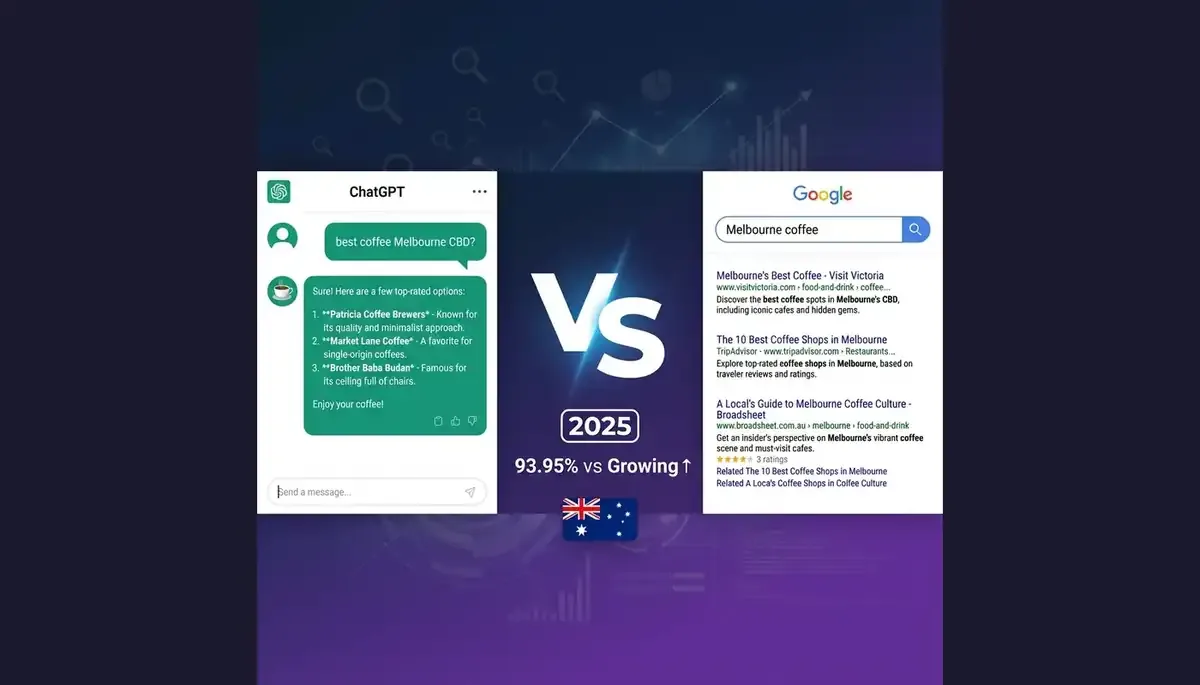
ChatGPT Search vs Google: Guide for Australian Businesses
ChatGPT Search launched October 2024. Google holds 93.95% Australian market share. Success requires optimising for both platforms while competitors...
Read full articleThe Bigger Picture
OpenAI's move follows a well-worn path in consumer technology. Free services acquire users, then monetise through advertising, then face perpetual pressure to extract more value from those ads. Google Search started with modest, clearly-labelled ads. YouTube promised creators it would never run pre-roll ads. Netflix said it would never have an ad tier.
Pedro Domingos, a prominent AI researcher, quipped on X: "OpenAI has finally achieved AGI (Ad-Generated Income)." The post got over 9,000 likes.
David Burkett posted a screenshot of Altman's previous anti-ads statements with the caption "This you?" It received nearly 8,000 likes.
But there's also a pragmatic camp. Daniel Priestley, an entrepreneur, noted: "ChatGPT is experimenting with advertising in their free subscription... When ChatGPT launches ads, I'm going to seize the day." He's already thinking about early-mover advantages in ChatGPT advertising, much like the early days of Google Ads when quality leads cost pennies.
Industry analysts are watching closely. Jackson Blackledge suggested an "agency idea" focused on ranking brands in LLM responses and running ChatGPT ads. The advertising industry senses opportunity.
The question isn't whether AI platforms will have advertising. It's whether they can implement it without eroding the trust that made them valuable in the first place.
The Real Test Is Execution
OpenAI's promises sound reasonable on paper. Ads clearly separated from answers. No influence on responses. Privacy from advertisers. Opt-out personalisation.
But we've heard similar promises before. The history of digital advertising is a history of scope creep. What starts as "just a small banner" becomes increasingly aggressive optimisation for engagement and revenue. The quarterly pressure to grow ad revenue is relentless, and it tends to win.
The social media advertising cautionary tale looms large. What started as connecting people became an attention economy that prioritised engagement over wellbeing, with documented harms to mental health, political discourse, and information quality.
AI systems are, in many ways, more intimate than social media. People share their health concerns with ChatGPT. They ask for relationship advice. They discuss their anxieties. The potential for advertising to corrupt these interactions is significant.
OpenAI insists they'll prioritise user trust over revenue. But they also said ads were a "last resort," and here we are. The gap between stated principles and financial reality has a way of closing in advertising's favour.
For now, the 800 million ChatGPT users are the test subjects. The coming months will reveal whether OpenAI can thread the needle between monetisation and trust, or whether this marks the beginning of the same trajectory we've seen from every other "don't be evil" tech company that discovered the irresistible gravity of advertising revenue.
Users will vote with their feet. Or their wallets. Either way, the experiment has begun.
---
Sources
- OpenAI: Our Approach to Advertising and Expanding Access (January 16, 2026)
- TechCrunch: ChatGPT Users Are About to Get Hit with Targeted Ads (January 16, 2026)
- The Decoder: OpenAI Will Soon Test Ads in ChatGPT Despite CEO Sam Altman Once Calling the Idea Dystopian (January 2026)
- StartupHub.ai: OpenAI's ChatGPT Ads Are Here and the Trust Claims Are Thin (January 2026)
- The Register: ChatGPT Will Get Ads (January 17, 2026)
- PC Gamer: OpenAI CEO Sam Altman Once Called It a Last Resort but ChatGPT Is About to Get Stuffed with Ads (January 2026)
- Benzinga: OpenAI to Test Ads in ChatGPT Free, Go Tiers (January 2026)
- BBC News: OpenAI ChatGPT Ads Announcement (January 2026)
- The Guardian: OpenAI Testing Ads in ChatGPT (January 17, 2026)
- Sam Altman X/Twitter Post (January 16, 2026)