

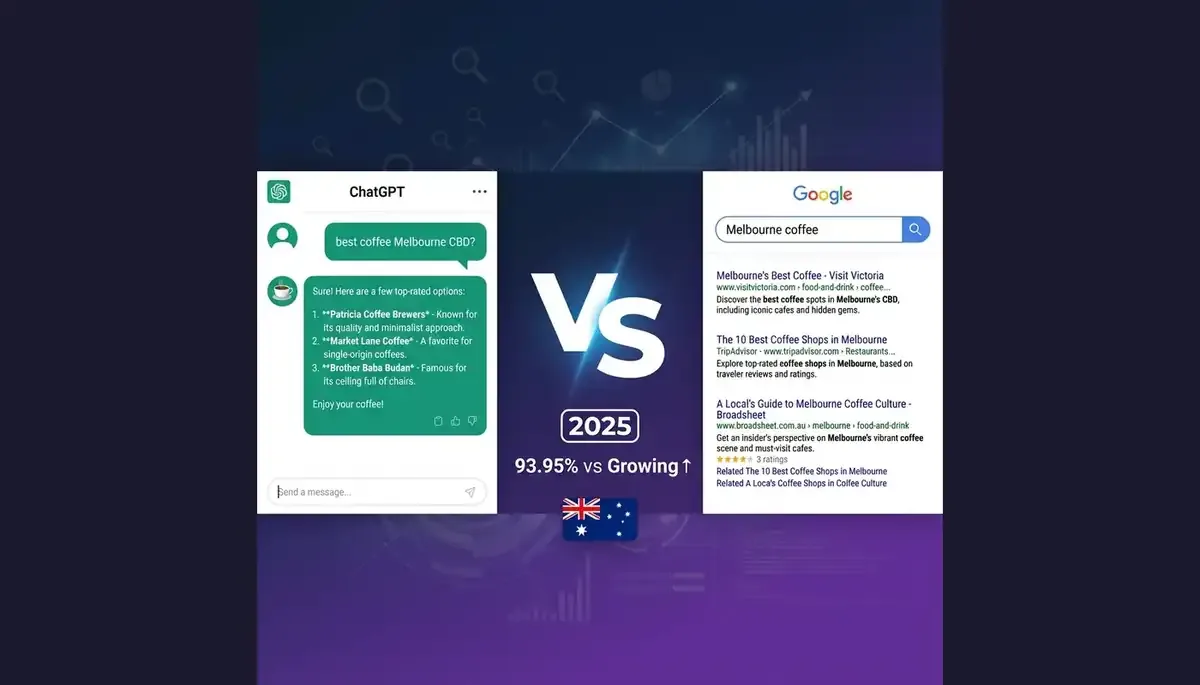
On a Thursday morning in late October 2024, OpenAI quietly flipped a switch that changed how millions of people find information. ChatGPT Search went live to paying subscribers on 31 October 2024, and free users got access in December.
The numbers tell an interesting story. By June 2025, ChatGPT reached 800 million weekly users. That's not just people asking it to write poetry. These are potential customers who might bypass Google entirely when looking for products, services, or information.
But here's the reality check Australian business owners need to hear: Google still processes approximately 373 times more searches than ChatGPT. In Australia specifically, Google holds 93.95% of the search market, and on mobile it's even more dominant at 98.56%.
So why should you care about ChatGPT Search when Google is still king?
Because 40% of Australian SMEs have already adopted AI technologies as of Q4 2024, and that number jumps 5% every quarter. Your competitors are experimenting. Your customers are trying new tools. And the Australian Competition and Consumer Commission (ACCC) confirmed in December 2024 that despite Google's dominance, technological changes are forcing businesses to adapt.
How ChatGPT Search Actually Works (The Technical Reality)
Let's cut through the hype and look at what's actually happening when someone uses ChatGPT Search versus Google.
Google's Approach: The Link Factory
Google crawls your website with Googlebot, indexes your content, and serves up a ranked list of links when someone searches. It's been doing this since 2004, processing more than 5 trillion searches in 2024 alone.
You search "best coffee Melbourne CBD" and get 10 blue links, maybe a map, possibly some AI-generated overview text at the top. You click through three or four sites, compare prices, read reviews, then decide.
ChatGPT Search: The Conversation Partner
ChatGPT Search works differently. It's built on a fine-tuned version of GPT-4o, OpenAI's most powerful language model, enhanced using techniques borrowed from their o1-preview model.
When you ask "best coffee Melbourne CBD," ChatGPT analyses around 12 results from third-party search providers (primarily Microsoft Bing), synthesises the information, and gives you a conversational answer with citations embedded.
You can then ask follow-up questions like "which one has outdoor seating?" or "do any open before 7am?" without starting a new search. The conversation continues naturally.
The Key Difference That Matters for Your Business
Google shows you where information lives. ChatGPT tells you what the information says.
For users, that's convenient. For businesses, it's complicated.
When ChatGPT answers a query, it cites sources with a "Sources" button that opens a sidebar with full citations. But here's the catch: in three-quarters of Google AI Mode sessions (a similar feature), users never left the AI pane. And 88% of users' first interactions were with the AI-generated text, not the original sources.
Your website might be cited, but clicks could drop. Traffic might look different. Traditional metrics like "page views" might stop telling the full story.
What This Means for Australian Businesses (The Practical Impact)
Let's talk about what's actually happening in the Australian market right now.
The Current State: Google Isn't Going Anywhere
The ACCC was clear in December 2024: Google's dominance hasn't been disrupted. When they say "nearly 94% market share," they're being conservative. The actual number is 93.95% overall, and 98.56% on mobile devices.
Your customers are still googling. That's not changing tomorrow, or next month, or probably even next year.
But here's what is changing: 49% of Australians used Generative AI in 2024, up from 38% in 2023. That's a 29% increase in 12 months.
And when people use AI tools, 16.45% also use traditional search engines. More interesting: 99% of AI platform users continue using traditional search.
So it's not either/or. It's both.
Regional Variations Across Australia
AI adoption isn't uniform. Queensland and Western Australia lead at 29% business adoption, while New South Wales sits at 28% (up from 26% the previous quarter).
If you're a Sydney-based business competing against Brisbane companies, they might already be optimising for AI search while you're still focusing solely on Google.
The ROI Reality Check
Here's the good news: 48% of Australian businesses report positive ROI within the first year of AI implementation.
The total Australian business spend on AI hit an estimated $3.5 billion in 2024, growing 20% from the previous year. That's not speculation. That's actual money companies are investing because they're seeing returns.
Top outcomes for SMEs? Faster access to accurate data for decision-making (22%) and stronger security and fraud detection (18%). These aren't feel-good metrics. They're business improvements with measurable impact.
The Flight Centre Case Study
Flight Centre, one of Australia's largest travel agencies, provides a concrete example. They used structured testing to optimise their content for AI-powered search, resulting in a 26% increase in traffic.
That's not a small e-commerce site. That's a major Australian business seeing measurable results from taking AI search seriously.
The Privacy Question (What Your Customers Are Asking)
Let's address the elephant in the room: data privacy.
What Google Collects
Google collects 22 different types of user data, including:
- Location information
- Search and browsing history
- App usage and interactions
- Purchase history
- User-generated content
- Personally identifiable information (PII)
This data feeds back into search algorithms, ad targeting, and product improvements. It's how Google makes money.
What ChatGPT Search Collects
ChatGPT collects 10 types of data:
- Chat interactions
- Account information
- User content
- Payment details (for paid subscribers)
- Communication logs
- Technical usage data
The key difference? ChatGPT doesn't primarily make money from ads. It makes money from $20/month subscriptions. As of June 2025, it had 10 million ChatGPT Plus subscribers globally and 3 million paying business users.
Different business model, different privacy approach.
Australian Privacy Law Implications
The Australian Privacy Act applies to both platforms. The Office of the Australian Information Commissioner (OAIC) provides specific guidance on AI systems and personal information handling.
For Australian businesses, this means:
- You need to know which platform your customers prefer
- You need to optimise for both
- You need to comply with privacy regulations regardless of platform
The Australian Government is currently reviewing AI governance frameworks, with particular focus on transparency and accountability. Businesses operating in Australia need to stay current as regulations evolve.
How to Optimise for Both Platforms (The Strategic Framework)
Here's where we get practical. How do you actually prepare your business for this dual-platform reality?
The Core Principle: Quality Content Works Everywhere
Good news: you don't need completely different strategies. Both platforms value the same fundamental thing: helpful, accurate, authoritative content.
But the implementation details differ.
For Google: Traditional SEO Still Matters
Technical Foundations:
- Clean site architecture and fast loading speeds
- Mobile-responsive design (remember: 98.56% of Australian searches are mobile)
- Structured data using Schema.org markup
- Proper heading hierarchy (H1, H2, H3)
- Internal linking structure
Content Requirements:
- E-E-A-T: Experience, Expertise, Authoritativeness, Trust
- Regular content updates showing current information
- Clear answers to user questions (but keep them on-page)
- Local SEO optimisation for Australian searches
Why This Still Works:
Google processes 5 trillion searches in 2024. That's 373 times more than ChatGPT. You can't afford to neglect the platform handling 93.95% of Australian searches.
For ChatGPT Search: Generative Engine Optimisation (GEO)
This is newer territory, but patterns are emerging.
Content Structure:
- Clear, concise answers to common questions
- Conversational language that sounds natural when read aloud
- Explicit source citations and data attribution
- Comprehensive coverage of topics (not just keyword stuffing)
Technical Considerations:
- Ensure your robots.txt allows "GPTBot" and "ChatGPT-User"
- Structured data still helps (ChatGPT analyses around 12 results from search providers)
- Fast loading times (ChatGPT relies on third-party engines like Bing)
- Mobile optimisation (ChatGPT has mobile apps with 400 million users)
The Critical Difference:
ChatGPT synthesises information from multiple sources. You're not trying to rank #1. You're trying to be one of the sources it pulls from and cites. That means comprehensive, authoritative content that clearly explains topics.
The Dual-Platform Content Strategy
Create content that serves both:
1. Comprehensive Resource Pages
Write in-depth guides that answer questions thoroughly. Google rewards depth. ChatGPT uses depth to synthesise answers.
Example: Instead of "5 Tips for Better Coffee," write "Complete Guide to Coffee Equipment for Australian Cafes: Equipment, Suppliers, Regulations, and Setup Costs."
2. Clear Information Architecture
Organise content logically with clear headings. Both Google crawlers and AI analysis benefit from well-structured content.
3. Natural Language Optimisation
Write for humans first. Answer questions the way you'd explain them to a customer in your shop.
Google's algorithms increasingly use natural language processing. ChatGPT is literally a language model. Natural, conversational content helps both.
4. Authority Signals
- Real author names and credentials
- Citations to authoritative sources
- Regular content updates
- Expert insights and first-hand experience
This satisfies Google's E-E-A-T requirements and provides ChatGPT with trustworthy source material.
The 90-Day Implementation Plan
Month 1: Audit & Foundation (Weeks 1-4)
- Audit current website for technical SEO issues
- Check robots.txt allows GPTBot and ChatGPT-User
- Review content for E-E-A-T compliance
- Identify top 10 pages for immediate optimisation
- Cost: $2,000-$5,000 (audit + initial fixes)
Month 2: Content Optimisation (Weeks 5-8)
- Rewrite top pages with dual-platform approach
- Add structured data where missing
- Improve page speed and mobile experience
- Create 3-5 comprehensive resource pages
- Cost: $3,000-$8,000 (content creation + technical work)
Month 3: Monitoring & Refinement (Weeks 9-12)
- Track ChatGPT citation frequency (manual monitoring)
- Monitor Google Search Console metrics
- Analyse traffic sources and user behaviour
- Refine strategy based on data
- Cost: $1,000-$2,000/month (ongoing monitoring)
Total Investment: $6,000-$15,000 for first 3 months, then $1,000-$2,000/month ongoing.
For small businesses (5-25 employees), budget towards the lower end. For medium businesses (50-200 employees), expect mid-range costs. Enterprises should budget at the higher end or more.
The Voice Search Wild Card (What's Coming Next)
Here's something that doesn't get enough attention: 33% of Australians use voice search daily for local queries.
Voice search is inherently conversational. You don't say "Melbourne coffee CBD best." You say "where's the best coffee near Melbourne CBD?"
ChatGPT's conversational interface maps perfectly to voice search behaviour. As voice assistants integrate more AI capabilities, the conversational search approach becomes even more important.
By 2024, there were projected to be 8.4 billion voice assistants globally. That's more than the human population of Earth.
For Australian businesses, this means:
- Optimise for conversational queries
- Answer questions naturally
- Include local context ("near me," city names, Australian terminology)
- Ensure mobile and voice assistant compatibility
Voice search isn't separate from the ChatGPT vs Google question. It's part of the same fundamental shift towards conversational information discovery.
Common Mistakes Australian Businesses Are Making Right Now
Mistake 1: Waiting for "Clear Winners"
42% of Australian businesses aren't planning to adopt AI, and 23% don't know how to use the technology.
By the time there's a "clear winner," your competitors will have years of optimised content and established presence. Flight Centre didn't wait. They experimented and gained 26% more traffic.
Mistake 2: Abandoning Google SEO
Some businesses hear "ChatGPT Search" and think "Google is dead."
No. Google handled 373 times more searches than ChatGPT in 2024. Google isn't going anywhere soon, especially in Australia where it holds 93.95% market share.
Mistake 3: Over-Complicating the Strategy
You don't need separate websites for each platform. You need good content, solid technical foundations, and willingness to adapt as you learn what works.
Mistake 4: Ignoring Mobile
- 6% of Australian mobile searches use Google. But ChatGPT has 400 million mobile users globally and is growing 33% every three months.
Your content must work flawlessly on mobile, regardless of platform.
Mistake 5: Treating This as an SEO Problem
This isn't just SEO. It's a fundamental shift in how people find and consume information.
Your marketing team, content creators, web developers, and business strategists all need to understand this shift. It's not something you outsource to "the SEO person."
What to Do This Week (Practical Next Steps)
For Business Decision-Makers (30 minutes)
1. Test Both Platforms Yourself (15 minutes)
- Google your business name and key products/services
- Ask ChatGPT the same queries (if you have ChatGPT Plus or free search access)
- Note the differences in how your business appears
- Check if you're cited in ChatGPT responses
2. Check Your Current Status (10 minutes)
- Visit your website's robots.txt file (yourdomain.com.au/robots.txt)
- Search for "GPTBot" and "ChatGPT-User"
- If blocked or not listed, you're invisible to ChatGPT Search
3. Assign Someone to Monitor This (5 minutes)
- Designate a team member to track AI search monthly
- Set up monthly review of search visibility across both platforms
- Budget for potential optimisation work in Q1 2026
For Marketing and SEO Teams (2 hours)
1. Comprehensive Audit (60 minutes)
- Run site through Google Search Console
- Check Core Web Vitals and mobile usability
- Review structured data implementation
- Analyse top-performing content for E-E-A-T signals
- Test key pages in ChatGPT Search
2. Content Gap Analysis (30 minutes)
- Identify topics where competitors appear in ChatGPT but you don't
- List questions customers ask that aren't fully answered on your site
- Map existing content to customer journey stages
- Prioritise pages for dual-platform optimisation
3. Quick Win Implementation (30 minutes)
- Update robots.txt to allow GPTBot and ChatGPT-User
- Add Schema.org structured data to top 3 pages
- Ensure author attribution on key content
- Add FAQ schema to common customer questions
For Small Business Owners (45 minutes)
1. DIY Check (20 minutes)
- Google your business and key services
- Use ChatGPT free search to find your business
- Ask friends or customers to do the same
- Document what appears and what doesn't
2. Local SEO Foundation (15 minutes)
- Verify Google Business Profile is complete and accurate
- Ensure consistent NAP (Name, Address, Phone) across all listings
- Add photos and recent updates
- Respond to recent reviews
3. Simple Content Improvement (10 minutes)
- Add an FAQ section to your homepage
- Answer 3-5 common customer questions clearly
- Use natural language, not marketing jargon
- Include your location and Australian context
The Bottom Line: Adapt Now or Play Catch-Up Later
ChatGPT Search isn't killing Google. Not this year, probably not next year.
But something is changing. User behaviour is evolving. 49% of Australians already used Generative AI in 2024, up from 38% in 2023. That's 29% growth in 12 months.
92% of Fortune 100 companies use ChatGPT. 40% of Australian SMEs have adopted AI technologies.
These aren't early adopters anymore. This is mainstream adoption.
The Australian businesses succeeding right now aren't choosing between Google and ChatGPT. They're optimising for both. They're creating comprehensive, authoritative content that works regardless of how customers find it.
Google still handles 93.95% of Australian searches. You can't ignore that. But ChatGPT user base grew 33% in just three months, from 300 million to 400 million users between December 2024 and February 2025.
The window to experiment while it's still early is closing. Flight Centre got a 26% traffic increase by optimising for AI-powered search. Your competitors are testing right now. Some are already seeing results.
You don't need to bet the farm on ChatGPT Search. But you do need to ensure you're visible when potential customers use it.
The search wars aren't about choosing sides. They're about being found, no matter which tool your customers prefer.
What will you do this week to make sure your business isn't invisible to half the people searching for what you offer?
Key Takeaways
Current Reality:
- Google: 93.95% Australian market share, not going anywhere
- ChatGPT: 800M weekly users, growing 33% every 3 months
- 49% of Australians used Generative AI in 2024 (up 29% from 2023)
- 40% of Australian SMEs have adopted AI technologies
What Works:
- Quality, comprehensive content serves both platforms
- Technical SEO foundations (speed, mobile, structure)
- Natural, conversational language
- Clear author attribution and E-E-A-T signals
- Structured data and proper schema markup
What to Avoid:
- Waiting for "clear winners" while competitors optimise
- Abandoning Google SEO prematurely
- Blocking AI crawlers in robots.txt
- Over-complicating the strategy with separate approaches
- Treating this as purely an SEO problem
Investment Required:
- Small Business: $6,000-$10,000 first 3 months
- Medium Business: $10,000-$15,000 first 3 months
- Enterprise: $15,000+ first 3 months
- Ongoing: $1,000-$2,000/month monitoring and refinement
Timeline:
- Month 1: Audit and technical foundations
- Month 2: Content optimisation
- Month 3: Monitoring and refinement
- Ongoing: Monthly reviews and updates
---
Sources
- **CNBC**. "OpenAI launches ChatGPT search, competing with Google and Microsoft". 31 October 2024.
- **InfoQ**. "OpenAI Releases ChatGPT Search Feature". November 2024.
- **DemandSage**. "Latest ChatGPT Users Stats 2025".
- **Backlinko**. "ChatGPT Statistics 2025".
- **Search Engine Land**. "ChatGPT's search surge: 1% market share predicted by 2025". December 2024.
- **Australian Department of Industry, Science and Resources**. "AI adoption in Australian businesses for 2024 Q4".
- **Local Digital**. "AI and Automation Adoption Statistics in Australian Businesses for 2025".
- **Google Australia Blog**. "AI Adoption in Australia: New Survey Reveals Increased Use & Belief in Potential". 2024.
- **Webplanners**. "10 AI SEO Strategies for Australian Businesses to Stay Ahead in 2025".
- **Growth Memo**. "What Our AI Mode User Behavior Study Reveals about the Future of Search". 2024.
- **Red Search**. "Search Engine Usage Statistics (2024)".
- **ACCC**. "Google's dominance in general search yet to be disrupted". December 2024.
- **Karmic Artworks**. "Search Engine Stats 2024: Google Dominates Australia".
- **Online Marketing Gurus**. "Year-End Review of Australian SEO in 2024 & Getting Ready For 2025".
- **Growth.pro**. "129 GEO, AI & SEO Case Studies & Winning Strategies for 2025".
- **Australian Department of Industry, Science and Resources**. "New report shows business needs more guidance on AI adoption".
- **DataCamp**. "Google Search vs ChatGPT Search: Head-to-Head Comparison".
- **SparkToro**. "New Research: Google Search Grew 20%+ in 2024; receives ~373X more searches than ChatGPT".
- **TechTarget**. "ChatGPT search vs. Google: How do they differ?". 2024.
---