

I checked the price of a RAM upgrade for my office workstation last week. The same 64GB DDR5 kit I'd bookmarked back in September for $180 was now showing $900. I refreshed the page three times thinking it was a glitch.
It wasn't.
This isn't some distant tech industry story that only affects enthusiasts building gaming rigs. If your business needs to upgrade computers, replace ageing hardware, or expand your team's workstations in 2026, you're about to feel this. Hard.
Here's the thing that really gets me: this isn't some mysterious supply chain disruption. It isn't a pandemic choking shipping lanes or a factory fire reducing capacity. It's a deliberate choice by memory manufacturers to prioritise AI data centres over you and me. And they're making record profits while doing it.
The Numbers That Made Me Swear Out Loud
Let me lay out what's happened since September 2025, because the scale of this is genuinely staggering.
According to TrendForce DRAMeXchange, DDR5 spot prices have increased 307% since September. That's not a typo. In four months, the wholesale cost of DDR5 memory chips has more than quadrupled.
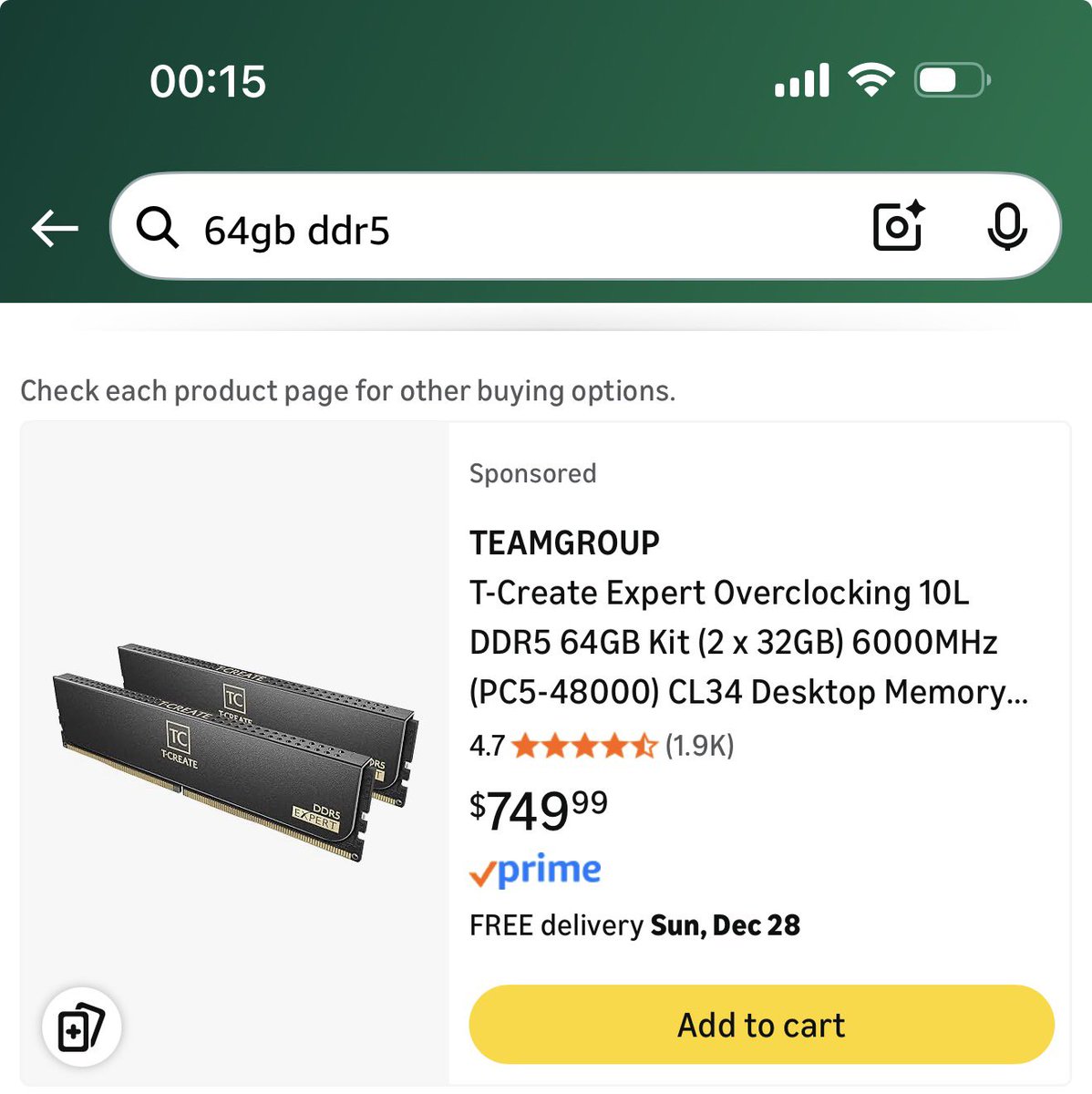
At the retail level, it's just as brutal. A DDR5-5600 64GB kit that cost around $180 in May 2025 now runs approximately $710, representing a 294% increase (PCPartPicker via Resell Calendar). The DDR5-6000 64GB kits have jumped from around $210 to $750, a 257% increase.

If you're thinking "I'll just stick with DDR4," I've got bad news. DDR4 isn't an escape hatch. According to TrendForce, DDR4 1Gx8 chip spot prices are up 158% over the same period, with retail kit prices showing similar or higher increases (WCCFTech). A DDR4-3600 64GB kit that cost $180 now sits at $470. There's nowhere to hide.
Let me give you some specific examples that hit close to home. The Crucial 64GB DDR5 5600MHz kit hit a low of $156.99 back in March 2025. By December 3rd, it peaked at $549.99 (Pangoly Price History). The G.SKILL Trident Z5 Royal 64GB DDR5 6400 went from $209.99 to $959.99 by December 29th.
And here's the kicker that keeps me up at night: TrendForce has revised their Q4 2025 outlook from 8-13% price growth to 18-23% growth, with a likelihood of further upward revision. Q1 2026? Prices are projected to spike again as contract pricing catches up with spot markets.
This is only just getting started.
This Isn't a Supply Crisis. It's a Prioritisation Crisis.
The memory manufacturers would love you to believe this is about supply constraints. It isn't. It's about where they've chosen to allocate their production capacity. And spoiler alert: you're not the priority anymore.
High Bandwidth Memory (HBM), the specialised DRAM used in AI accelerators like NVIDIA's H100 and H200 GPUs, consumes approximately three times the wafer capacity of DDR5 per gigabyte (Tom's Hardware). Every gigabyte of HBM that Samsung, SK Hynix, or Micron produces means three gigabytes of DDR5 that doesn't get made.
AI is projected to consume 20% of total DRAM production in 2026. Major memory manufacturers have already allocated 18-28% of their total DRAM capacity to HBM production. And that percentage is growing, not shrinking.


Then on December 3rd, 2025, Micron dropped a bombshell. They announced they were exiting the Crucial consumer business entirely (CNBC).
Their Chief Business Officer, Sumit Sadana, put it plainly: "The AI-driven growth in the data center has led to a surge in demand for memory and storage. Micron has made the difficult decision to exit the Crucial consumer business in order to improve supply and support for our larger, strategic customers in faster-growing segments."
Let that sink in. One of the three major memory manufacturers on the planet (Micron controls roughly 20% of global DRAM production) just told consumers that we're not worth their time anymore. After 29 years of the Crucial brand, they're walking away to chase AI dollars.


This isn't a supply problem. It's a choice. The memory manufacturers have looked at enterprise AI customers willing to pay premium prices for HBM and decided that's where they want to be. The consumer market, with its price sensitivity and lower margins, just isn't attractive enough anymore.

Running AI Locally: Why Australian Businesses Are Ditching Cloud AI for Total Privacy
77% of employees paste sensitive data into ChatGPT. With Australia's December 2026 disclosure deadline looming, local AI deployment isn't paranoia....
Read full articleRecord Profits While We Pay Record Prices
If you're feeling angry right now, you should be. Because here's the part that makes my blood boil: the memory manufacturers aren't suffering through this crisis alongside us. They're posting record profits.
SK Hynix's Q3 2025 results were genuinely staggering (SK Hynix Financial Results). Revenue hit 24.4 trillion won. Operating profit exceeded 10 trillion won for the first time in the company's history. And their operating margin? 47%. That's up 5 points quarter-on-quarter and 7 points year-on-year.
Let me repeat that: while consumers are paying 300% more for RAM, SK Hynix is enjoying a 47% operating margin. They've now achieved eight consecutive quarters of sequential margin improvement.
And it's not just SK Hynix. Q4 2025 projections show Samsung and SK Hynix memory divisions are expected to surpass TSMC's gross margin for the first time since Q4 2018 (TrendForce). Seven years since memory has been more profitable than leading-edge chip fabrication.
This is what a prioritisation crisis looks like. The manufacturers have figured out they can make more money selling to fewer customers at higher prices. And we're the ones left holding the bill.
The Domino Effect: From Japanese Shop Limits to Cancelled Builds
The real-world impact of this crisis is spreading fast.
Wallace Santos, CEO of Maingear, a premium PC builder, put it bluntly: "I've been in the business for two decades, and I've never seen a situation like this." (Tom's Hardware)
His company's procurement costs for a 32GB RAM kit have increased 394%. That's not a typo. Almost five times what they were paying before.
Maingear's response? They've launched a "BYO RAM" program. Customers can buy their own memory elsewhere, ship it to Maingear, and the company will install, validate, and tune it at no extra charge. It saves customers an average of $300 on a standard build. That's how bad things have gotten: system integrators are telling customers to source their own components because they can't pass on the manufacturer prices.
Paradox Customs is now offering PCs without any included RAM. Just empty slots and a suggestion to source your own.
In Japan, it's even more dramatic. PC shops in Akihabara, Tokyo's famous electronics district, have implemented purchase limits (Tom's Hardware). TSUKUMO stores are limiting customers to 2 storage drives and 4 SO-DIMM modules maximum per transaction. Their in-house PC brands (G-Gear, eX.computer) have stopped taking orders entirely, with deliveries paused for the remainder of 2025.
The reason? Distributors have suspended deliveries with no clear outlook for when supply will normalise.
IDC has revised their 2026 PC market forecast from a 2.5% decline to a potential 8.9% contraction in the pessimistic scenario (Tom's Hardware). Even the moderate forecast has shipments dropping 4.9-5%. OEMs like Lenovo, Dell, HP, Acer, and ASUS have signalled 15-20% price increases coming in H2 2026.
For consumers and small businesses planning builds or upgrades, the message is clear: everything just got a lot more expensive, and it's going to stay that way for a while.
The Australian Tax (Because Of Course)
If you're reading this from Australia, I've got even worse news. We're paying a significant premium on top of the already inflated global prices.
A Corsair Vengeance DDR5 64GB 6000MHz kit at PCCaseGear costs $899 AUD as of November 2025. The exact same kit, purchased from Amazon UK and shipped to Australia, costs $420.19 AUD delivered (OzBargain).
That's a 53% "Australia tax" on RAM. Or to put it another way, local retailers are charging more than double what you'd pay importing.
One OzBargain commenter summed up the frustration perfectly: "AU price is just BS all the time... can't compare to other countries."
Local retailers genuinely can't compete. Their supplier costs have jumped just like everyone else's, but their margins were already thinner than international megastores. Some are eating losses to stay competitive. Others have just given up trying.
If you need RAM right now and you're in Australia, here's my honest advice: look at import options first. Yes, you'll wait longer for shipping. Yes, you'll deal with potential warranty complications. But saving $400-500 on a 64GB kit is hard to ignore.
When Does This End? (You're Not Going to Like the Answer)
I wish I could tell you relief is coming soon. I can't.
Gerry Chen, General Manager at Team Group, has been remarkably candid about the outlook (Tom's Hardware). December contract prices increased 80-100% month-on-month for some DRAM and NAND categories. He expects availability to worsen in Q1 and Q2 2026 as distribution stockpiles exhaust.
His most chilling quote: "Obtaining allocation could become difficult regardless of willingness to pay."
Let me translate that: even if you've got the money, you might not be able to buy RAM at all. Team Group has already halted price quotes for RAM kits entirely, which is a signal of just how tight supply has become.

Here's the realistic timeline based on industry analysis:
Q1 2026: Prices spike again as contract pricing catches up with spot markets. Distribution stockpiles run dry. Expect 20-30% additional increases on top of current levels.
Mid-2026: Expected price peak. DDR5 prices could jump 30-50% per quarter through the first half. 16GB DDR5 modules could reach around $30 each (they were under $10 in September 2025).
H2 2026: TrendForce projects some price correction could begin. DDR5 prices might decline 20-30% from their peaks, but they're unlikely to return to pre-2024 levels.
Q4 2027: The earliest realistic point for the shortage to end (WCCFTech). And that's optimistic.
2028-2029: Full normalisation expected. New fab capacity from Micron (Idaho, Hiroshima), Samsung (Pyeongtaek Phase 4), and SK Hynix (Yongin Cluster) should finally bring supply back into balance.
But here's the critical caveat: those new fabs are prioritising HBM and enterprise products, not consumer DDR5. The relief for people like us comes only after the AI market is satisfied.

The $2 Trillion Bet: Your Business Will Have AI Employees by Next Year
Global AI spending is projected to hit $2 trillion in 2026. But here's what nobody's telling you: most of that money isn't buying chatbots. It's...
Read full articleWhat You Can Actually Do Right Now
I don't like delivering bad news without offering something actionable. So here's my practical advice for different situations.
If you need to build now: Don't wait hoping prices will drop. They're going up through mid-2026, not down. Buy what you need today. Yes, it hurts. But it's going to hurt more in three months.
If you can defer: Consider used DDR4 systems for non-AI workloads. There's a glut of capable DDR4 platforms hitting the used market as enterprises upgrade. You won't get bleeding-edge performance, but you'll get reasonable prices.
If you're in Australia: Seriously consider importing from the UK or US. The price difference of 40-50% more than covers any warranty hassle. Amazon UK in particular offers straightforward returns and solid pricing.
If you're a system builder: Look into BYO RAM programs from integrators like Maingear. You source the memory, they build and validate. It shifts some risk to you, but the savings are substantial.
If you're a business planning IT refresh: Factor 15-20% price increases into your 2026-2027 hardware budgets right now. Local AI deployment costs just jumped significantly. Evaluate used and refurbished options seriously. And consider whether you really need 64GB or whether 32GB will suffice for another year.
The desperate option: Some Russian enthusiasts have started sourcing blank DDR5 PCBs from China (around $6.40 per DIMM) and hand-soldering memory chips themselves (Tom's Hardware). It requires steady soldering skills and testing tools, with no warranty safety net. I'm not recommending this, but the fact that people are doing it tells you how desperate the situation has become.

Key Takeaways
For PC Builders:
- If you need RAM, buy it now. Prices peak mid-2026, potentially 30-50% higher than current levels.
- DDR4 isn't an escape hatch. It's up 158% too.
- Australian buyers should seriously consider importing from UK/US. Savings of 40-53% are common.
- BYO RAM programs from system integrators can save you $300+ per build.
For Business IT:
- Factor RAM into 2026-2027 hardware budgets now. Add 15-20% to your previous estimates.
- Local AI deployment costs just jumped significantly. The same RAM you need for on-premise AI is being hoarded by data centres.
- Evaluate used and refurbished DDR4 platforms for non-critical workloads.
- Consider delaying non-essential upgrades until Q4 2027 at earliest.
For The Industry:
- This isn't a supply crisis. It's what happens when AI gets priority over consumers.
- Memory manufacturers posting 47% operating margins aren't struggling. They're profiting.
- 2028-2029 is the realistic normalisation timeline. Anyone telling you otherwise is selling something.
I'll be honest with you: I'm genuinely frustrated. I've spent my career helping businesses and individuals get the best technology for their budgets. Watching memory manufacturers actively choose to deprioritise us while posting record profits feels like a betrayal.
The AI revolution is real. The productivity gains are real. But so is the cost being imposed on everyone who just wants to build a PC, upgrade a workstation, or keep their business running.
We're all in this together. The only question is whether you pay now at 300% markup, or later at 400%. The memory market doesn't care about your procurement timeline.
---
Sources
- TrendForce. "DDR5 Prices Up 307% Since September as Module Costs Poised to Surge". November 2025. https://www.trendforce.com/news/2025/11/19/insi...
- TrendForce. "Memory Price Surge Q1 2026 Outlook". December 2025. https://www.trendforce.com/presscenter/news/202...
- TrendForce. "DDR5 vs HBM3e Profitability Analysis". October 2025. https://www.trendforce.com/presscenter/news/202...
- Micron Investor Relations. "Micron Announces Exit from Crucial Consumer Business". December 2025. https://investors.micron.com/news-releases/news...
- CNBC. "Micron Stops Selling Memory to Consumers as Demand Spikes from AI Chips". December 2025. https://www.cnbc.com/2025/12/03/micron-stops-se...
- SK Hynix. "SK Hynix Announces Q3 2025 Financial Results". October 2025. https://news.skhynix.com/sk-hynix-announces-3q2...
- G.SKILL. "Official Statement on DRAM Price Increases". December 2025. https://www.gskill.com/community/1502239313/176...
- Tom's Hardware. "The RAM Pricing Crisis Has Only Just Started, Team Group GM Warns". December 2025. https://www.tomshardware.com/pc-components/dram...
- Tom's Hardware. "IDC Warns PC Market Could Shrink Up to 9% in 2026". December 2025. https://www.tomshardware.com/tech-industry/idc-...
- Tom's Hardware. "HBM is Eating Your RAM". 2025. https://www.tomshardware.com/pc-components/ram/...
- Tom's Hardware. "Maingear CEO: This Memory Situation is a Multi-Year Problem". December 2025. https://www.tomshardware.com/desktops/gaming-pc...
- Tom's Hardware. "Japanese PC Shops Limit SSD, HDD, and RAM Purchases". November 2025. https://www.tomshardware.com/pc-components/japa...
- Tom's Hardware. "Russian Enthusiasts Are Building Their Own DDR5 RAM". December 2025. https://www.tomshardware.com/pc-components/ddr5...
- WCCFTech. "Memory DDR5 DDR4 Shortages Last Till Q4 2027". December 2025. https://wccftech.com/memory-ddr5-ddr4-shortages...
- IDC. "Global Memory Shortage Crisis: Market Analysis". December 2025. https://www.idc.com/resource-center/blog/global...
- PC Gamer. "RAM and Storage Is Ridiculously Expensive Right Now Because of AI". December 2025. https://www.pcgamer.com/hardware/memory/ram-and...
- PCPartPicker via Resell Calendar. "RAM Price December 2025 AI Spike". December 2025. https://resellcalendar.com/news/news/ram-price-...
- Pangoly. "Crucial 64GB DDR5 5600MHz Price History". December 2025. https://pangoly.com/en/price-history/crucial-64...
- OzBargain. "Corsair Vengeance DDR5 64GB 6000MHz Amazon UK Deal". November 2025. https://www.ozbargain.com.au/node/934394
- IntuitionLabs. "RAM Shortage 2025: AI Demand Analysis". 2025. https://intuitionlabs.ai/articles/ram-shortage-...
- NotebookCheck. "Not Funny Anymore: RAM Prices Are Skyrocketing". December 2025. https://www.notebookcheck.net/Not-funny-anymore...
- TrendForce. "Kingston Leads DRAM Price Surge". December 2025. https://www.trendforce.com/news/2025/12/24/insi...
---