

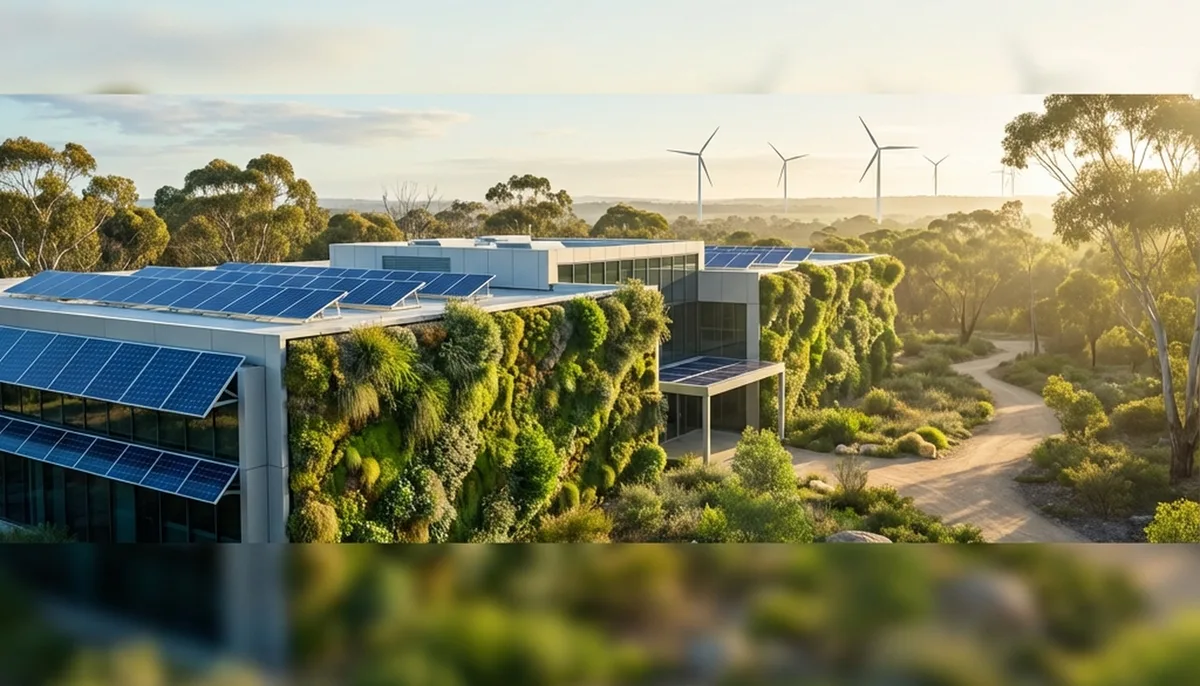
When a Melbourne manufacturing facility started using AI to optimise its production line, the team expected efficiency gains. What they didn't anticipate was a 25% reduction in energy consumption alongside a 30% drop in waste, translating to both significant cost savings and a 35% reduction in their carbon footprint [Source 4: Praxie]. This isn't an isolated success story. It's becoming the norm for Australian businesses that recognise something crucial: the path to sustainability and the path to profitability aren't divergent. They're increasingly the same road.
Australian companies face mounting pressure from multiple directions. Investors are demanding ESG accountability, with nearly $1.6 trillion in super fund assets now managed with sustainability criteria [Source 49: Rainmaker Information]. Customers want to support environmentally responsible businesses. And from 1 January 2025, ASX 200 companies must comply with mandatory climate disclosure requirements under new AASB standards [Source 47: BDO Australia]. The question isn't whether to address sustainability but how to do it effectively.
Artificial intelligence offers a compelling answer. When we talk about Green AI, we're discussing two interconnected concepts: using AI to optimise environmental outcomes across business operations and designing AI systems themselves to be energy-efficient. The business case is straightforward. Lower energy consumption means lower operating costs. Reduced waste translates to material savings. Improved efficiency creates competitive advantages. And all of this contributes to meeting increasingly stringent ESG requirements that determine access to capital and market opportunities.
What makes this particularly relevant for Australian businesses is the alignment of incentives. Our electricity costs are among the highest in the developed world, creating immediate financial benefits from energy optimisation. Government programmes like the Clean Energy Finance Corporation's $18.3 billion in committed investments and ARENA's $1.5 billion Future Made in Australia Innovation Fund provide substantial support for green technology adoption [Source 22: CEFC; Source 24: ARENA]. State-level initiatives add further incentives, with NSW allocating $17.5 million for commercial energy efficiency in 2025, offering up to 50% matched funding for eligible projects [Source 30: energy.gov.au].
This article examines how Australian businesses are implementing Green AI across industries, from manufacturing and transport to agriculture and energy management. We'll explore specific applications, measure AI's own environmental footprint, and provide practical guidance for designing energy-efficient AI systems. Most importantly, we'll demonstrate how sustainability and cost optimisation reinforce each other, creating a business case that appeals to both CFOs and sustainability officers.
How AI Optimises Energy and Resources Across Australian Industries
The promise of AI for sustainability isn't theoretical. Australian companies across sectors are deploying intelligent systems that simultaneously reduce environmental impact and improve bottom lines. Let's examine how this works in practice.
Energy Management and the Smart Grid
Australia's electricity grid is undergoing a fundamental transformation, and AI is central to managing this change. The Australian smart grid market reached $1.1 billion in 2024 and is projected to grow to $3.9 billion by 2033, driven largely by AI-enabled predictive analytics that enhance real-time grid management and fault detection [Source 1: OpenPR].
The challenge is significant. As renewable energy sources like solar and wind become more prevalent, the grid must balance supply that fluctuates based on weather conditions with demand that varies throughout the day. Traditional grid management struggles with this complexity. AI excels at it.
A South Australian utility demonstrated this capability by deploying machine learning algorithms for demand prediction. The system analysed weather patterns, historical consumption data, and renewable energy generation forecasts. The result? A 15% improvement in demand prediction accuracy and annual savings of $3.2 million [Source 2: Sustainable Future Australia]. More accurate predictions mean more efficient energy distribution, reduced need for expensive peak-time generation, and better integration of renewable sources.
For businesses, smart grid technologies offer direct benefits. Occupancy sensors and AI-driven climate control in Melbourne's Pixel Building achieved a 45% reduction in energy consumption [Source 12: Sustainable Future Australia]. Brisbane's 480 Queen Street building implemented AI climate control and reduced energy use by 40% [Source 12: Sustainable Future Australia]. These aren't marginal gains. They're transformative changes that fundamentally alter operating economics.
The technology works by learning building usage patterns, predicting occupancy, and adjusting systems accordingly. Instead of heating or cooling empty spaces, AI ensures energy is used only when and where needed. When you consider that commercial buildings are responsible for 25% of Australian electricity use and HVAC systems comprise up to 65% of commercial building electricity [Source 12: Sustainable Future Australia], the potential impact becomes clear.
Melbourne-based HAL Systems has developed predictive climate control technology specifically for commercial buildings. Currently piloting at University of Melbourne's Queensbury Street building, the system reduces energy usage between 10 and 25% [Source 11: Melbourne Climate Network]. The company is now in discussions with the City of Melbourne to implement the technology in municipal buildings, demonstrating how successful pilots scale to broader deployments.
The Australian energy-efficient HVAC market reflects this opportunity, valued at $1.56 billion in 2024 and projected to reach $2.72 billion by 2033 [Source 39: Industry Today]. AI integration is driving this growth, particularly in smart building management systems across Sydney and Melbourne where real-time data analysis optimises energy use.
Manufacturing Optimisation
Australian manufacturing consumes nearly 1,000 petajoules annually, representing a quarter of national energy consumption [Source 3: Ai Group]. Over the past decade, the industry achieved a 21% reduction in energy intensity through various efficiency measures [Source 3: Ai Group]. AI accelerates this progress dramatically.
Consider BlueScope Steel's partnership with Siemens on AI-driven predictive maintenance. At their Port Kembla operations, machine learning models analyse equipment data to predict failures before they occur. This avoided approximately 2,000 hours of downtime and prevented 53 full process interruptions worldwide [Source 32: Manufacturers' Monthly]. Beyond preventing costly disruptions, the AI system optimises the zinc coating application process, reducing defects and material waste.
The sustainability impact is substantial. BlueScope achieved a 12% reduction in global steelmaking greenhouse gas emissions in FY2024, alongside an 8.4% reduction in non-steelmaking GHG emissions intensity compared to their FY2018 baseline [Source 33: Australian Manufacturing]. While not all of this reduction comes from AI, predictive maintenance and process optimisation play significant roles.
Amcor, another Australian manufacturing leader, uses AI for predictive maintenance, quality control, and supply chain optimisation. The AI systems optimise resource usage and support development of eco-friendly materials. By FY24, 94% of Amcor's flexible packaging portfolio was developed as recycle-ready, earning the company inclusion in the Dow Jones Sustainability Indices Australia, ranking in the top 12% of its industry [Source 34: PitchGrade].
The pattern is consistent: AI identifies inefficiencies that humans struggle to detect. Production processes using AI and sustainable materials typically achieve 25% reduction in energy use, 30% reduction in waste, 20% reduction in costs, and 35% reduction in carbon footprint [Source 4: Praxie]. AI-enabled systems can reduce manufacturing energy usage by up to 20%, while waste management systems enhanced by AI improve sorting efficiency by 30% [Source 4: Praxie].
These aren't incremental improvements. They're step-changes in operational efficiency that competitors without AI struggle to match. And crucially, they create what economists call "double dividends": both environmental benefits and cost savings that directly improve profitability.
Transport and Logistics Efficiency
Australia's vast distances make transport and logistics particularly energy-intensive. AI route optimisation offers one of the most straightforward applications with immediate environmental and financial returns.
Linfox, one of Australia's largest logistics companies, saved 12% on fuel consumption through AI routing [Source 10: Linfox]. The company's AI-powered driver monitoring system reduced fatigue-related incidents by 15% within one year [Source 10: Linfox]. These improvements come from an intelligent, connected digital ecosystem that analyses traffic patterns, delivery schedules, weather conditions, and vehicle performance data to optimise every aspect of fleet operations.
Toll Group deployed AI-powered predictive maintenance across a 400-vehicle NSW fleet. The system ingests real-time sensor data, including engine vibration, temperature, and mileage, using machine learning to flag anomalies before failures occur [Source 9: Wolf Matrix]. This prevents breakdowns that would otherwise require emergency responses, often involving additional vehicle dispatches and route disruptions that waste fuel and increase emissions.
Research indicates route optimisation cuts CO₂ emissions by 15-25% and reduces fuel consumption by up to 20% [Source 56: ResearchGate]. The global logistics leader UPS provides a benchmark through its ORION AI system, which saves over 10 million gallons of fuel annually and reduces carbon emissions by more than 100,000 metric tons yearly [Source 57: RTS Labs]. Australian logistics companies implementing similar systems report comparable benefits.
The technology delivers multiple environmental advantages. Optimised routes mean fewer kilometres driven, directly reducing fuel consumption and emissions. Predictive maintenance ensures vehicles operate at peak efficiency rather than degrading performance between scheduled service intervals. Load optimisation ensures trucks carry maximum capacity, reducing the total number of trips required. And electrification planning, supported by AI analysis of route patterns and charging infrastructure, accelerates the transition to zero-emission vehicles.
For transport companies, the business case is compelling. An 18% reduction in fuel costs, combined with a 12% cut in delivery times and 25% improvement in fleet utilisation [Source 57: RTS Labs], creates competitive advantages that compound over time. Companies that optimise first can offer better service at lower costs, capturing market share while reducing environmental impact.
Precision Agriculture in Australian Conditions
Australian agriculture faces unique challenges. Water scarcity, particularly in drought-prone regions, makes efficient resource use critical. Variable climate conditions across the continent demand localised, responsive farming practices. AI-powered precision agriculture addresses these challenges directly.
The Australian precision agriculture market reached $261 million in 2024 and is expected to grow to $623.5 million by 2033, driven by water scarcity challenges and government support for agritech [Source 7: IMARC Group]. Queensland farmers are leading adoption, with over 75% using AI-powered crop monitoring systems as of 2024 [Source 37: Queensland DPI].
The COALA project in the Murray-Darling Basin demonstrates what's possible. Using Copernicus satellite data and machine learning algorithms, the initiative achieved a 20% increase in irrigation efficiency and enhanced crop yields by 20 to 30% [Source 6: Farmonaut]. In a region where water is precious and agriculture is vital to the economy, these improvements are transformational.
Australian farmers using precision farming have reduced water usage by up to 30% [Source 6: Farmonaut]. AI-powered irrigation systems, which gather real-time data on soil moisture and weather patterns to predict crop water needs accurately, can reduce water usage by up to 25% [Source 8: Keymakr]. For a large Australian farm, satellite AI analysis pinpointed areas of water stress, enabling targeted irrigation that reduced overall water use by 25% while increasing crop uniformity [Source 35: Medium].
The economics are equally compelling. Variable rate lime application saved one farm $28,000 over three years. Queensland growers using optical spot-spraying technology achieved 82-94% chemical savings. Planter section control reduced seed costs by 24% [Source 36: GRDC]. When you project these savings across entire operations, precision agriculture adoption yields a net present value potentially exceeding $673,000 [Source 36: GRDC].
Beyond water and chemical savings, AI optimises fertiliser application, reducing both costs and environmental impact from chemical runoff. Crop yield predictions help farmers make better decisions about when to plant, irrigate, and harvest. Livestock monitoring systems identify health issues early, reducing loss and improving animal welfare.
Australia's smart waste revolution extends to agriculture, with the sector participating in a market growing to $5.3 billion by 2033 [Source 5: Vocal Media]. The Kwinana energy recovery facility in Western Australia, which opened in July 2024, converts 460,000 tons of residential waste annually into renewable energy [Source 5: Vocal Media]. While not directly agricultural, this demonstrates the circular economy opportunities where AI helps transform waste into resources.
Smart Buildings Adapted to Australian Climate
Australian climate conditions, particularly the cooling demands in northern regions and variable conditions across states, create specific building energy challenges. Smart building technology addresses these by learning patterns and adapting in real-time rather than following rigid schedules.
Sydney's International Towers feature smart lighting with automated blinds that respond to sunlight levels, reducing both lighting and cooling loads [Source 12: Sustainable Future Australia]. The system doesn't just turn lights on and off. It adjusts based on natural light availability, occupancy patterns, and time of day, creating optimal conditions while minimising energy use.
The technology has matured rapidly. What was experimental five years ago is now proven and scalable. The Australian energy-efficient HVAC market's growth from $1.56 billion to a projected $2.72 billion by 2033 reflects this maturation [Source 39: Industry Today]. AI integration enhances smart building management particularly in Melbourne and Sydney, where real-time data analysis optimises energy use in buildings with complex, varied occupancy patterns.
For building owners and managers, the value proposition is straightforward. A 10-25% reduction in energy costs [Source 11: Melbourne Climate Network] translates directly to improved net operating income. In premium commercial real estate, where tenant attraction and retention depend partly on sustainability credentials, smart building features become differentiators. Buildings with strong environmental performance command higher rents and lower vacancy rates.
The technology also improves occupant comfort. Rather than overheating some areas while freezing others, AI-driven systems maintain consistent, optimal conditions. They prevent the common problem where manual adjustments create inefficient overrides that persist long after they're needed. And they adapt to changing conditions, like unusually hot days, more effectively than scheduled programming.
Measuring AI's Own Carbon Footprint
While AI drives sustainability improvements across industries, we need to address an uncomfortable truth: AI systems themselves consume significant energy and generate carbon emissions. Transparency about this impact is essential for making informed decisions about when and how to deploy AI.
The Energy Cost of Training Large Models
Training large language models requires enormous computational resources. The numbers are sobering. GPT-4 training consumed between 51.8 and 62.3 million kilowatt-hours of electricity [Source 13: Towards Data Science]. Depending on the electricity source, this resulted in emissions of 1,035 to 1,246 metric tons of CO₂ equivalent using eastern Canada's cleaner grid, or 12,456 to 14,994 metric tons using California's grid [Source 13: Towards Data Science]. The model was trained on approximately 25,000 Nvidia A100 GPUs for 90-100 days [Source 13: Towards Data Science].
To put this in perspective, GPT-3 training consumed 1,287 megawatt-hours of electricity and resulted in 502 metric tons of carbon emissions [Source 14: TinyML Newsletter]. GPT-4's electricity consumption was 40-48 times higher [Source 14: TinyML Newsletter]. That's equivalent to the energy consumption of hundreds of Australian homes for an entire year, used for a single model training run.
Meta's Llama 2 provides another data point. Training used 2,048 Nvidia A100-80GB GPUs for approximately five months, consuming 2,638,000 kilowatt-hours of energy [Source 15: Medium]. This resulted in 539 to 1,015 tonnes of CO₂ equivalent emissions, though Meta offset 100% of these emissions through their sustainability programme [Source 15: Medium].
Interestingly, where you train matters enormously. The BLOOM model consumed 433 megawatt-hours (compared to OPT's 324 MWh and GPT-3's 1,287 MWh) but emitted only 25 tonnes of CO₂, versus OPT's 70 tonnes and GPT-3's 502 tonnes [Source 16: arXiv]. Why? BLOOM was trained using French nuclear power at 57 grams of CO₂ equivalent per kilowatt-hour, compared to the US grid's 429 grams [Source 16: arXiv]. The same computational work produces vastly different carbon footprints depending on energy sources.
For context, early research into BERT training showed it produced approximately 1,400 pounds of CO₂ equivalent [Source 17: MIT Technology Review]. Larger models can emit up to 626,000 pounds of CO₂ equivalent, roughly five times the lifetime emissions of an average car [Source 17: MIT Technology Review].
Inference Emissions and Operational Impact
Training is a one-time cost, but inference runs continuously every time someone uses an AI system. Each ChatGPT query consumes 0.3 to 0.4 watt-hours, resulting in approximately 0.15 grams of CO₂ per response [Source 18: Smartly.AI]. That's 4-5 times more energy than a standard search engine query [Source 18: Smartly.AI].
Individual queries seem negligible. But at scale, they accumulate significantly. When millions of people make billions of queries daily, the cumulative impact becomes substantial. This is particularly relevant for Australian businesses deploying customer-facing AI systems or using AI extensively in operations.
Data centres globally consumed 415 terawatt-hours in 2024, representing 1.5% of global electricity [Source 52: IEA]. That's projected to double to 945 TWh by 2030, reaching approximately 3% of global consumption [Source 52: IEA]. AI currently represents 5-15% of data centre power but could reach 35-50% by 2030 [Source 52: IEA].
Australia has approximately 200 data centres using 5% of national electricity [Source 45: Austrade International]. Goldman Sachs projects that AI will drive a 165% increase in data centre power demand by 2030 [Source 54: Goldman Sachs]. AI-optimised chips consume 2-4 times more watts than traditional counterparts [Source 54: Goldman Sachs].
For Australian businesses, this means energy costs for AI workloads will grow unless actively managed. The good news is that measurement tools and optimisation strategies exist to address this challenge.
Australian Grid Carbon Intensity
Understanding Australia's grid carbon intensity is critical for calculating AI's environmental impact. According to the Department of Climate Change, Energy, Environment and Water, the national emissions intensity averaged 0.56 tonnes of CO₂ equivalent per megawatt-hour in 2024 [Source 19: DCCEEW]. That's equivalent to 560 kilograms of CO₂ equivalent per megawatt-hour, or 0.56 kilograms per kilowatt-hour.
There's significant variation by state. NSW's specific intensity is 0.66 kilograms of CO₂ equivalent per kilowatt-hour [Source 19: DCCEEW]. Thermal generation produces 0.91 tonnes of CO₂ equivalent per megawatt-hour [Source 19: DCCEEW].
This means an AI training run that consumes 1,000 kWh in NSW would generate approximately 660 kilograms of CO₂ equivalent. The same workload running on renewable energy would produce dramatically less. This creates strong incentives to use renewable-powered data centres or run intensive AI workloads when renewable energy availability is highest.
Tools for Measuring Carbon Footprint
Several tools help Australian businesses measure and manage AI's carbon footprint. AWS Customer Carbon Footprint Tool provides Scope 3 emissions data for workloads running on Amazon's cloud, breaking down emissions by AWS region and offering both location-based and market-based accounting methods [Source 20: AWS]. Historical data from January 2022 allows businesses to track trends and measure improvement. The tool is free for all AWS customers.
Azure and Google Cloud offer similar calculators, enabling businesses to understand the environmental impact of their cloud AI workloads. For Australian companies subject to National Greenhouse and Energy Reporting requirements or preparing for mandatory climate disclosures, these tools provide essential data.
CodeCarbon offers a different approach. This open-source Python package tracks computational carbon footprint at a granular level, measuring GPU, CPU, and RAM electricity consumption and applying regional carbon intensity [Source 21: CodeCarbon]. With over 1,500 GitHub stars and 2 million PyPI downloads [Source 21: CodeCarbon], it's become a standard tool for researchers and developers who want to track emissions at 15-second intervals during model development.
These measurement tools serve multiple purposes. They provide data for sustainability reporting, help teams identify optimisation opportunities, and create awareness that often leads to behaviour change. When developers can see the carbon cost of different model choices or training approaches, they tend to make more efficient decisions.
The Net Impact Question
The critical question isn't whether AI consumes energy. It clearly does. The question is whether AI's energy consumption is justified by the sustainability benefits it enables. This requires calculating net impact: the emissions from AI systems minus the emissions reductions AI creates.
For the Melbourne manufacturing facility that reduced its carbon footprint by 35% using AI optimisation [Source 4: Praxie], the energy consumed by their AI system is negligible compared to the emissions avoided. A logistics company that cuts fuel consumption by 12% [Source 10: Linfox] generates far more carbon savings than the AI systems require. Agricultural AI that reduces water and chemical use by 25-30% [Source 6: Farmonaut; Source 8: Keymakr] clearly creates net positive environmental outcomes.
The key is avoiding wasteful AI deployment. Not every problem requires the largest model. Often, smaller, more efficient models deliver comparable results with a fraction of the energy cost. Edge computing can move processing closer to data sources, reducing transmission energy. And strategic timing of intensive workloads to periods of high renewable energy availability minimises carbon impact.
Transparency and measurement enable informed decisions. When businesses understand both the costs and benefits, they can deploy AI strategically where it creates the greatest net positive impact.
Australian Government Support for Green Technology
Australian businesses implementing Green AI benefit from substantial government support across federal and state levels. Understanding available programmes helps maximise both environmental and financial returns.
Clean Energy Finance Corporation Investment
The Clean Energy Finance Corporation committed a record $4.7 billion in new investments recently, bringing total commitments to $18.3 billion across more than 400 investments since inception [Source 22: CEFC]. The organisation has delivered $85.3 billion in transaction value through 30 June 2025 [Source 22: CEFC].
CEFC supports AI-driven initiatives directly. Their backing of SwarmFarm, a Queensland agtech company, demonstrates this commitment. SwarmFarm's self-driving precision robots help farmers kill weeds using fewer herbicides and less fuel [Source 23: Energy Monitor]. The robots represent exactly the kind of technology that combines AI, automation, and sustainability outcomes that CEFC prioritises.
For businesses considering AI implementations with environmental benefits, CEFC offers financing that can make projects economically viable. Rather than requiring full upfront capital, CEFC structures allow businesses to fund investments through future savings. This is particularly valuable for capital-intensive projects like smart building systems or manufacturing optimisation where upfront costs might otherwise prevent adoption.
Australian Renewable Energy Agency Grants
ARENA manages several substantial funding programmes relevant to Green AI initiatives. The Future Made in Australia Innovation Fund allocates $1.5 billion, announced in May 2024 [Source 24: ARENA]. The Battery Breakthrough Initiative provides $500 million from the 2024-2025 Budget [Source 24: ARENA]. The Solar Sunshot programme, announced in March 2024, supports solar innovation. And Community Batteries Round 2 distributed $46.3 million in February 2025 [Source 24: ARENA].
ARENA has specifically supported machine learning applications for renewable energy. An Australian National University-led project developed ML techniques for solar PV forecasting to accurately predict rooftop solar output for grid stability [Source 25: ARENA]. The resulting commercial product now serves utilities and companies across Australia, demonstrating how ARENA-funded research transitions to practical applications.
These grants target technology development and demonstration. For businesses developing novel AI applications for sustainability, particularly in renewable energy integration, energy storage, or grid management, ARENA funding can offset development costs and accelerate commercialisation.
R&D Tax Incentive for Clean Energy
Clean energy and sustainability initiatives are explicitly eligible for Australia's R&D Tax Incentive [Source 26: business.gov.au]. In the most recent reporting period, $11.2 billion in R&D spend generated $3 billion in tax offsets, representing a 12% increase [Source 26: business.gov.au]. Tech-driven industries, including software, AI, and climate tech, made up 45% of claims [Source 26: business.gov.au].
The energy sector coverage includes generation, distribution, storage, and emerging technologies [Source 26: business.gov.au]. This means Australian businesses developing AI systems for energy optimisation, renewable forecasting, or smart grid management can claim substantial R&D tax offsets that reduce net development costs.
For businesses already investing in AI development, ensuring sustainability applications are properly documented and claimed under the R&D Tax Incentive can recoup 43.5% of eligible expenditure for companies with turnover below $20 million, or 38.5% for larger companies. This significantly improves the economics of innovation.
Future Made in Australia Tax Credits
The Future Made in Australia programme allocates $13.7 billion in tax incentives between 2027 and 2040 [Source 27: Investor Group on Climate Change]. This includes $2 per kilogram for green hydrogen produced, along with support for onshore clean technology manufacturing and critical minerals processing [Source 27: Investor Group on Climate Change].
While primarily targeting manufacturing and energy production, these incentives create downstream opportunities for AI systems that optimise production processes, reduce energy consumption, or improve efficiency. Businesses in these sectors should consider how AI can help them maximise the value they extract from these tax credits.
National Greenhouse and Energy Reporting Scheme
NGER is Australia's national framework for corporate emissions reporting [Source 29: DCCEEW]. The 2024 updates include market-based reporting for renewable liquid fuels and new methods for fugitive emissions from natural gas flaring for the 2024-25 reporting year [Source 29: DCCEEW]. The reporting deadline is 31 October annually [Source 29: DCCEEW].
For businesses subject to NGER requirements, AI can dramatically simplify compliance. Automated systems track energy consumption across operations, calculate emissions using appropriate factors, and generate reports in required formats. This reduces both compliance costs and the risk of errors that might trigger regulatory scrutiny.
More strategically, AI-powered analytics help businesses identify the highest-impact opportunities for emissions reduction. Rather than implementing changes blindly, companies can use AI to model different scenarios, predict outcomes, and prioritise investments that deliver the greatest environmental and financial returns.
Climate Active Certification
Climate Active is the Australian Government programme for carbon neutrality certification [Source 28: DCCEEW]. The programme is currently operational but undergoing reforms, including requirements for a minimum 20% of offsets to be Australian Carbon Credit Units [Source 28: DCCEEW]. The programme is facing scrutiny over offset integrity [Source 28: DCCEEW].
For businesses seeking carbon neutral certification, AI helps in two ways. First, accurate measurement of emissions across complex operations requires sophisticated data collection and analysis that AI facilitates. Second, optimisation algorithms identify cost-effective abatement opportunities that reduce the volume of offsets required, lowering both costs and exposure to offset quality concerns.
State-Level Programmes
NSW allocated $17.5 million for commercial energy efficiency in 2025, providing businesses up to 50% of project costs through matched funding [Source 30: energy.gov.au]. The Energy Savings Scheme and Building Upgrade Finance offer additional support with minimal upfront costs [Source 30: energy.gov.au].
Queensland's Business Energy Savers Programme provides audits and co-funding, while Advance Queensland grants support renewable energy technologies [Source 31: Business Queensland]. Recent initiatives include $5.5 million funding for a solar panel recycling pilot in 2024, and the state saw a 42% increase in commercial solar adoption in regional areas [Source 31: Business Queensland].
For businesses implementing AI-driven energy efficiency projects, these state programmes can cover a significant portion of capital costs, dramatically improving project economics. When combined with federal R&D tax incentives and energy savings, many projects achieve positive returns within months rather than years.
Real Australian Industry Implementations
Theory matters, but results matter more. Let's examine verified examples of Australian companies using AI for sustainability, documenting both environmental and financial outcomes.
Manufacturing: BlueScope Steel and Amcor
BlueScope Steel's implementation of Siemens Senseye Predictive Maintenance at Port Kembla operations delivered measurable results. The facility avoided approximately 2,000 hours of downtime and prevented 53 full process interruptions worldwide [Source 32: Manufacturers' Monthly]. Machine learning models now reduce defects and optimise zinc coating application, cutting material waste [Source 32: Manufacturers' Monthly].
The company's broader sustainability achievements demonstrate the cumulative impact of multiple initiatives. FY2024 saw a 12% reduction in global steelmaking greenhouse gas emissions and an 8.4% reduction in non-steelmaking GHG emissions intensity compared to the FY2018 baseline [Source 33: Australian Manufacturing]. BlueScope is exploring hydrogen and natural gas alternatives that could potentially reduce emissions by 85% [Source 33: Australian Manufacturing]. Their Port Kembla site achieved ResponsibleSteel™ certification [Source 33: Australian Manufacturing].
Amcor demonstrates how AI integrates across multiple sustainability dimensions. The company uses AI for predictive maintenance, quality control, and supply chain optimisation [Source 34: PitchGrade]. AI systems optimise resource usage and support development of eco-friendly materials [Source 34: PitchGrade]. By FY24, 94% of Amcor's flexible packaging portfolio was developed as recycle-ready [Source 34: PitchGrade]. This performance earned inclusion in the Dow Jones Sustainability Indices Australia, ranking in the top 12% of the industry [Source 34: PitchGrade].
The manufacturing examples illustrate several patterns. First, AI delivers multiple benefits simultaneously: reduced downtime, improved quality, lower material waste, and decreased energy consumption. Second, environmental improvements translate to financial performance, creating self-reinforcing cycles where sustainability investments pay for themselves. Third, publicly reporting achievements enhances corporate reputation and supports premium market positioning.
Transport and Logistics: Linfox and Toll Group
Linfox's results demonstrate the direct financial value of AI optimisation. The company saved 12% on fuel consumption through AI routing [Source 10: Linfox]. Their AI-powered driver monitoring system reduced fatigue-related incidents by 15% within one year [Source 10: Linfox]. These improvements come from an intelligent, connected digital ecosystem operating across Australia and New Zealand [Source 10: Linfox].
The 12% fuel saving alone creates enormous value for a large fleet. If we conservatively estimate a fleet consuming 10 million litres annually, a 12% reduction saves 1.2 million litres. At typical diesel prices, that's over $2 million in direct cost savings annually. The carbon benefit is equally significant, avoiding approximately 3,200 tonnes of CO₂ equivalent emissions.
Toll Group's approach through predictive maintenance demonstrates preventative value. Their 400-vehicle NSW fleet uses AI to ingest real-time sensor data, including engine vibration, temperature, and mileage [Source 9: Wolf Matrix]. Machine learning flags anomalies before failures occur [Source 9: Wolf Matrix]. This prevents breakdowns that would otherwise require emergency responses, additional vehicle dispatches, and disrupted schedules that waste fuel and increase emissions.
The technology also improves safety. Fewer mechanical failures mean fewer roadside emergencies. Driver monitoring reduces accident risk. And optimised routing decreases time pressure that might otherwise encourage unsafe practices. These benefits compound the business case beyond pure fuel and emissions savings.
Agriculture: Queensland Farms and Precision Irrigation
The COALA project in the Murray-Darling Basin achieved documented results that matter enormously in Australian agriculture. Using Copernicus satellite data and machine learning, the initiative achieved a 20% increase in irrigation efficiency and enhanced crop yields by 20 to 30% [Source 6: Farmonaut].
For farms in drought-prone regions, a 20% improvement in irrigation efficiency can mean the difference between viable operations and failure. Water is often the limiting constraint on production. Using it more effectively increases yields without increasing water consumption, or maintains yields while using less water, preserving this precious resource for future seasons.
A large Australian farm using satellite AI analysis provides a specific example. The system pinpointed areas of water stress, enabling targeted irrigation that reduced overall water use by 25% while increasing crop uniformity [Source 35: Medium]. More uniform crops simplify harvesting and often command better prices, creating both environmental and economic value.
The economics of precision agriculture are well-documented. Variable rate lime application saved one farm $28,000 over three years [Source 36: GRDC]. Queensland growers using optical spot-spraying technology achieved 82-94% chemical savings [Source 36: GRDC]. Planter section control reduced seed costs by 24% [Source 36: GRDC]. When modelled across entire operations, precision agriculture adoption can yield a net present value exceeding $673,000 [Source 36: GRDC].
With over 75% of Queensland farmers now using AI-powered crop monitoring systems [Source 37: Queensland DPI], we're seeing widespread adoption driven by proven results. This isn't experimental technology anymore. It's becoming standard practice because it demonstrably improves outcomes.
Energy: Renewable Forecasting and Grid Management
While specific implementations by Origin Energy and AGL weren't verified in available sources, the industry applications of AI for renewable forecasting are well-established. AI forecasting reduces root mean square error by 15-20% in solar irradiance predictions [Source 38: Delfos Energy]. Machine learning models, including artificial neural networks and LSTM networks, capture non-linear relationships that traditional methods miss [Source 38: Delfos Energy].
Accurate forecasting is essential for scheduling maintenance of renewable facilities and for grid operators managing supply and demand balance [Source 38: Delfos Energy]. When utilities can predict solar and wind output more accurately, they can optimise dispatch of other generation sources, reducing reliance on expensive peak-time plants that typically have higher emissions.
The South Australian utility example we discussed earlier achieved a 15% improvement in demand prediction accuracy with annual savings of $3.2 million [Source 2: Sustainable Future Australia]. This demonstrates the financial value that accurate AI forecasting creates for energy companies. Better predictions mean better resource allocation, which translates to both cost savings and emissions reductions.
Buildings: HAL Systems and Commercial Implementations
HAL Systems' Melbourne-based technology represents Australian innovation in smart building management. The predictive climate control system reduces energy usage between 10 and 25% [Source 11: Melbourne Climate Network]. Currently piloting at University of Melbourne's Queensbury Street building, the company is discussing implementation in City of Melbourne municipal buildings [Source 11: Melbourne Climate Network].
The variation in savings (10-25%) reflects different building types and usage patterns. Buildings with highly variable occupancy patterns tend to see larger savings because AI can respond to these variations more effectively than scheduled programming. Buildings with more consistent usage still benefit but typically at the lower end of the range.
Sydney's International Towers use smart lighting with automated blinds, responding to sunlight levels to reduce both lighting and cooling loads [Source 12: Sustainable Future Australia]. Melbourne's Pixel Building achieved a 45% reduction in energy consumption through occupancy sensors [Source 12: Sustainable Future Australia]. Brisbane's 480 Queen Street building reduced energy by 40% through AI climate control [Source 12: Sustainable Future Australia].
These implementations share common characteristics. They collect real-time data about occupancy, environmental conditions, and energy consumption. They use machine learning to understand patterns and predict future needs. And they automatically adjust building systems to maintain comfort while minimising energy use. The technology has matured to the point where installations are reliable and maintenance requirements are reasonable.
For building owners, the 10-40% energy savings translate directly to improved net operating income. A commercial building spending $500,000 annually on energy that achieves a 25% reduction saves $125,000 per year. Over a 10-year period, that's $1.25 million in savings, often exceeding the system installation costs within 3-5 years.
Designing Energy-Efficient AI Systems
Understanding how to build efficient AI systems is crucial for Australian businesses developing or deploying AI applications. Several strategies dramatically reduce energy consumption without proportionally sacrificing performance.
Model Efficiency Through Compression
Large models aren't always necessary. Often, smaller models achieve comparable results with a fraction of the computational cost. Model compression techniques make this possible.
Pruning removes unnecessary connections in neural networks, reducing computational requirements. Research shows pruning can reduce BERT's energy consumption by 32% [Source 40: Nature]. The pruned model maintains most of its accuracy while requiring significantly less computation for both training and inference.
Quantization moves from 32-bit to 8-bit precision or even lower [Source 40: Nature]. While this might sound like it would degrade accuracy, careful implementation often maintains performance within acceptable bounds. The energy savings are substantial because lower precision requires less memory and fewer computational operations.
Knowledge distillation creates smaller "student" models that learn from larger "teacher" models, retaining performance in a more efficient architecture [Source 40: Nature]. This approach is particularly valuable when you need to deploy models on edge devices or in environments where computational resources are limited.
Compressed models aren't just more energy-efficient. They're also more environmentally friendly across their entire lifecycle [Source 40: Nature]. Smaller models train faster, require less cooling in data centres, and enable deployment on less powerful hardware that consumes less electricity during operation.
Efficient Architectures for Edge Deployment
Purpose-built efficient architectures like MobileNet and EfficientNet provide alternatives to general-purpose large models. MobileNetV3 offers the most balanced architecture for edge devices, while EfficientNetV2 delivers the highest accuracy but with a larger model size [Source 41: arXiv].
The energy difference between edge and cloud computing is significant. Edge computing consumes approximately 0.5 millijoules per image, compared to cloud processing at 1.2 millijoules [Source 41: arXiv]. While this seems small per transaction, it accumulates substantially across millions of operations. Depth-wise separable convolutions, used in efficient architectures, reduce computational burden without proportionally sacrificing accuracy [Source 41: arXiv].
Edge computing offers additional benefits beyond direct energy savings. Processing data locally reduces transmission requirements, which saves energy and reduces latency. Research shows a 5G base station with edge computing can achieve over 90% energy savings compared to mobile-only computation [Source 42: Digi International]. For applications requiring real-time responses, edge deployment becomes both more efficient and more effective.
One grocer implementing edge solutions reported a 35% reduction in engineering costs and 50% faster deployment [Source 42: Digi International]. Edge devices also reduce data centre cooling requirements because less heat is concentrated in central facilities [Source 42: Digi International].
For Australian businesses, edge computing is particularly relevant given our geography. Remote operations, whether mining sites, agricultural facilities, or regional offices, benefit from local processing that doesn't depend on reliable high-bandwidth connections to distant data centres.
Infrastructure Optimisation
Where you run AI matters. Using renewable-powered data centres dramatically reduces carbon footprint. Amazon is investing AU$20 billion in AI data centres backed by solar power in Australia, with three new solar farms planned [Source 44: About Amazon]. Amazon's existing portfolio includes eight solar and wind projects across NSW, QLD, and VIC, generating 1.4 million megawatt-hours of carbon-free energy annually, enough to power 290,000 homes [Source 44: About Amazon].
AWS procurement contributes 39% of carbon emissions reduction for compute workloads [Source 44: About Amazon]. For Australian businesses running AI on AWS, this means a substantial portion of emissions reduction happens automatically through infrastructure choices Amazon makes. Similar commitments from other cloud providers create competitive pressure that benefits all customers.
Australian green data centre innovation is accelerating. GreenSquareDC's WAi1 facility in Western Australia represents a $1 billion investment in a 96-megawatt AI-focused data centre powered by clean energy, with a 300-megawatt wind and solar farm [Source 45: Austrade International]. Western Australia and Northern Territory are emerging as green data centre hubs [Source 45: Austrade International].
Australia has approximately 200 data centres using 5% of national electricity [Source 45: Austrade International]. NEXTDC offers Climate Active carbon-neutral colocation [Source 45: Austrade International]. For businesses requiring Australian data residency, these facilities provide options to minimise carbon impact while meeting regulatory requirements.
Carbon-Aware Computing
Google demonstrates a sophisticated approach by moving workloads between data centres to use greener energy [Source 43: Google]. The company shifts YouTube and Google Photos processing to locations with green power availability [Source 43: Google]. Software and network connectivity enable this flexibility in ways that transcend traditional green computing limitations [Source 43: Google].
Australian businesses can adopt similar strategies. Running intensive AI workloads during periods of high renewable energy generation reduces carbon impact. In South Australia and Queensland, where solar generation peaks during midday, scheduling training jobs or batch processing during these hours leverages cleaner electricity.
This requires some flexibility in workflow, but the environmental benefits can be substantial. A training job that might produce 500 kilograms of CO₂ equivalent when run on evening peak power could produce 200 kilograms when run during midday solar peak. For organisations running multiple training jobs weekly, these differences accumulate meaningfully.
Software Optimisation
Efficient code and algorithms matter. Batch processing, rather than individual transactions, reduces overhead. Caching and model reuse avoid redundant computation. These practices don't just reduce energy consumption. They also improve performance and reduce costs.
Avoiding unnecessary compute is perhaps the most important principle. Not every query requires running an entire large language model. Simpler approaches often suffice. Implementing logic that routes requests to appropriate-sized models based on complexity ensures you're not using a sledgehammer when a regular hammer would do.
Similarly, training new models from scratch isn't always necessary. Transfer learning and fine-tuning leverage existing models, requiring far less computation than starting fresh. When model sharing through platforms like Hugging Face provides access to pre-trained models, using them rather than retraining saves enormous energy.
These practices reflect lifecycle thinking. Just as manufacturing considers the full lifecycle environmental impact of products, AI development should consider the cumulative energy cost across training, deployment, inference, and eventual replacement. Optimising each phase creates compounding benefits.
The Aligned Business Case: Cost Savings and Sustainability
One of the most compelling aspects of Green AI is the alignment between environmental objectives and financial performance. This isn't a trade-off. It's a reinforcing cycle where the same actions deliver multiple benefits.
Energy Efficiency Equals Cost Reduction
The relationship is straightforward. Reducing compute requirements reduces cloud costs or on-premises electricity consumption. A 32% reduction in energy consumption through pruning [Source 40: Nature] translates directly to a 32% reduction in computational costs. For businesses spending $100,000 monthly on AI infrastructure, that's $32,000 in monthly savings, or $384,000 annually.
Australian electricity costs create even stronger incentives for efficiency. Our electricity prices are among the highest in developed countries, making energy optimisation particularly valuable. A manufacturing facility that reduces energy consumption by 25% [Source 4: Praxie] doesn't just cut emissions. It also reduces one of its largest operating expenses.
This alignment means businesses don't need to choose between sustainability and profitability. The optimal financial decision is often the optimal environmental decision. CFOs and sustainability officers can work toward the same objectives rather than negotiating trade-offs.
Multi-Benefit Optimisation
AI implementations often deliver benefits across multiple dimensions simultaneously. The Melbourne manufacturing facility that reduced energy by 25%, waste by 30%, costs by 20%, and carbon footprint by 35% [Source 4: Praxie] illustrates this pattern. These aren't separate initiatives requiring separate investments. They're different outcomes from the same system.
Similarly, Linfox's 12% fuel saving [Source 10: Linfox] simultaneously reduces costs, cuts emissions, decreases vehicle wear and tear (extending asset life), and improves delivery predictability (enhancing customer satisfaction). The 15% reduction in fatigue-related incidents [Source 10: Linfox] reduces insurance costs, prevents injury, and avoids disruption. Each benefit strengthens the business case independently, and collectively they create overwhelming justification.
This multi-benefit characteristic makes Green AI investments easier to approve than single-benefit proposals. When building a business case, documenting all benefits creates multiple paths to justification. If one benefit turns out smaller than expected, others still support the investment.
ESG Value Creation
Beyond operational savings, Green AI creates strategic value through ESG performance. Australian super funds managing $1.6 trillion now apply ESG criteria [Source 49: Rainmaker Information]. Green investments have risen from AUD $20 billion to AUD $157 billion over five years, with AUD $25 billion invested in the first half of 2025 alone [Source 51: ESG Post].
For companies seeking capital, strong ESG performance improves access and potentially reduces capital costs. Major funds explicitly screen investments based on climate commitments and performance. Companies demonstrating genuine action rather than just commitments have competitive advantages in attracting investment.
Similarly, customers increasingly consider sustainability in purchasing decisions. B2B buyers face pressure from their own stakeholders to work with environmentally responsible suppliers. Consumer-facing companies find that sustainability credentials influence brand perception and purchasing behaviour. Green AI enables companies to demonstrate concrete action, not just aspirations.
Talent attraction represents another ESG benefit. Employees, particularly younger professionals, increasingly care about working for companies aligned with their values. Organisations with genuine sustainability commitments find recruiting easier and retention stronger. In competitive labour markets, this creates real value.
Government Incentives Improving Economics
The programmes we discussed earlier, including CEFC financing, ARENA grants, R&D tax incentives, and state matched funding, substantially improve project economics. A project requiring $500,000 in capital that receives $250,000 in matched funding from NSW programmes and claims $150,000 in R&D tax offsets effectively costs $100,000 net.
When that project saves $125,000 annually through energy efficiency and waste reduction, it achieves payback in less than a year. These aren't marginal investments requiring 10-year payback periods. They're highly attractive financial opportunities that happen to also deliver environmental benefits.
Businesses not systematically pursuing available incentives leave substantial value unclaimed. Ensuring teams responsible for sustainability initiatives work closely with finance teams who understand available programmes maximises captured value.
Measuring and Reporting Success
Demonstrating results requires measurement. For cost savings, this is straightforward. Energy bills, fuel consumption, and material usage provide clear before-and-after comparisons. For emissions reduction, applying appropriate factors to energy and material consumption changes quantifies carbon impact.
The tools we discussed earlier, including AWS Customer Carbon Footprint Tool [Source 20: AWS], Azure calculators, and CodeCarbon [Source 21: CodeCarbon], facilitate this measurement. Rather than estimation, businesses can document actual reductions with credible data supporting ESG reports and stakeholder communications.
Measuring success also enables continuous improvement. Understanding which initiatives deliver the greatest returns helps prioritise future investments. Teams learn what works in their specific context, building institutional knowledge that improves subsequent projects.
For businesses subject to mandatory climate reporting from 1 January 2025 [Source 47: BDO Australia], measurement isn't optional. It's a compliance requirement. Implementing systems now positions companies to meet obligations while also optimising operations.
ESG, Investors, and Corporate Responsibility
The pressure for environmental action isn't abstract. It comes from specific stakeholders with real power to influence business outcomes. Understanding these pressures helps businesses respond strategically.
Australian Super Fund Climate Demands
Australian super funds control enormous capital. With $1.6 trillion in ESG-managed assets [Source 49: Rainmaker Information], their investment decisions fundamentally shape which companies access capital and on what terms. These funds face pressure from their own members to invest responsibly, creating cascading pressure on portfolio companies.
HESTA, one of Australia's largest industry super funds, has committed to a 50% emissions reduction target by 2030 [Source 50: AustralianSuper]. Despite global anti-ESG sentiment in some regions, Australian funds are maintaining their net zero by 2050 commitments [Source 50: AustralianSuper]. Interest in climate solutions and renewable energy infrastructure continues rising [Source 50: AustralianSuper].
The scale of green bond purchases illustrates this commitment. AUD $145 billion in green, social, and sustainable bonds have been purchased, compared to AUD $17 billion in 2020 [Source 50: AustralianSuper]. That's an 850% increase in five years, demonstrating both commitment and accelerating momentum.
For companies seeking investment, understanding what super funds require isn't optional. Funds increasingly demand climate transition plans, emissions reduction targets, and credible pathways to achievement. Companies that can demonstrate these elements access capital more easily and potentially at better terms than competitors without such credentials.
ASX Requirements and Mandatory Disclosure
Nearly 70% of ASX 200 companies now report against TCFD frameworks [Source 46: ACSI]. Market capitalisation covered by net zero commitments has reached 80% [Source 46: ACSI]. Nearly 75% voluntarily report climate information [Source 46: ACSI]. But voluntary reporting is transitioning to mandatory requirements.
Treasury Laws Amendment passed Parliament on 9 September 2024, establishing mandatory sustainability reporting for Group 1 entities (ASX 200 equivalent) beginning 1 January 2025 [Source 47: BDO Australia]. Scope 1 and 2 emissions are required from year one, with Scope 3 emissions required from year two onwards [Source 47: BDO Australia].
The Australian Accounting Standards Board issued AASB S1 (voluntary) and AASB S2 (mandatory) on 8 October 2024 [Source 48: AASB]. These standards are broadly aligned with IFRS Sustainability Disclosure Standards [Source 48: AASB], creating international consistency. Reasonable assurance will be required from years commencing 1 July 2030 onwards [Source 48: AASB].
This regulatory timeline creates urgency. Companies need systems in place now to collect data for 2025 reporting. Those without existing measurement and reporting infrastructure face compressed timelines to develop capabilities. Those who've already implemented AI-powered monitoring and reporting systems have competitive advantages in compliance costs and accuracy.
AI Supporting ESG Reporting
AI helps meet reporting requirements in several ways. Automated emissions tracking across complex operations with multiple sites, energy sources, and processes captures comprehensive data that manual methods struggle to match. AI-powered analytics identify anomalies and errors, improving data quality that auditors will scrutinise.
Supply chain transparency, required for Scope 3 emissions reporting, particularly benefits from AI. Machine learning can analyse supplier data, identify emissions hotspots, and track changes over time. This is crucial because supply chain emissions are often 11.4 times higher than operational emissions [Source 58: EDITED].
Sustainability analytics platforms use AI to aggregate data from multiple sources, apply appropriate calculation methodologies, and generate reports in required formats. This reduces manual effort, minimises errors, and creates audit trails demonstrating compliance. For large organisations with complex operations, AI transitions sustainability reporting from burdensome compliance exercise to strategic capability.
Corporate Climate Commitments
Beyond regulatory requirements, many Australian companies have made voluntary climate commitments. The ASX 200 data showing 80% market capitalisation covered by net zero commitments [Source 46: ACSI] reflects strategic decisions that companies believe create long-term value.
These commitments create accountability. Stakeholders expect progress, not just promises. Companies need to demonstrate actual emissions reductions, not just offset purchases. AI enables this by identifying and quantifying opportunities for operational improvement.
For companies exploring hydrogen and natural gas alternatives like BlueScope's investigation that could potentially reduce emissions by 85% [Source 33: Australian Manufacturing], AI can model different scenarios, optimise implementation timelines, and track progress toward ambitious targets.
Brand Value and Market Differentiation
Sustainability performance increasingly influences brand value and market positioning. B2B buyers screening suppliers based on ESG criteria means companies without credible sustainability credentials lose opportunities. Consumer research consistently shows environmental responsibility influences purchasing decisions, particularly among younger demographics.
Green AI enables companies to tell authentic stories about environmental action. Rather than vague commitments, businesses can share specific data: "We reduced energy consumption by 25%," "Our AI-optimised logistics cut emissions by 12%," "Precision agriculture reduced water use by 30%." These concrete achievements resonate more powerfully than aspirational statements.
For companies in competitive markets, sustainability differentiation creates advantages that competitors struggle to replicate quickly. Building AI capabilities and demonstrating results takes time and investment. Companies that move first establish positions that followers can't easily match.
The Future of Green AI in Australia
Looking forward, several trends will shape how Australian businesses use AI for sustainability and how regulatory and market pressures evolve.
Technology Evolution
AI models continue becoming more efficient. Research into model compression, efficient architectures, and optimised training methods accelerates. The gap between state-of-the-art performance and energy consumption is narrowing. Models that once required thousands of GPUs for months can now be approximated using hundreds of GPUs for weeks, and this trajectory continues.
Specialised green AI hardware is emerging. Chips designed specifically for inference rather than general computation consume less power while delivering comparable performance. Neuromorphic computing, which mimics biological neural networks, promises dramatic efficiency improvements though it's still largely experimental.
Carbon-aware AI systems that automatically schedule workloads to minimise environmental impact will become more sophisticated. Rather than requiring manual intervention, these systems will optimise automatically, considering energy prices, grid carbon intensity, and workload priorities to make optimal decisions.
Renewable-powered AI infrastructure will expand. The investments by AWS, Google, and Australian data centre providers in renewable energy and green facilities create competitive pressure. Over time, running AI on fossil-fuelled infrastructure will become both more expensive and less socially acceptable.
Policy and Regulatory Trends
Australia's mandatory climate disclosure requirements beginning 1 January 2025 represent just the first step. Requirements will likely expand to smaller companies over time, and assurance requirements will strengthen. The progression from voluntary to mandatory reporting, and from self-reported to independently assured, follows patterns established in financial reporting.
Potential carbon pricing in Australia would create additional incentives for efficiency. While politically challenging, the economic logic of pricing externalities remains compelling. If implemented, carbon pricing would strengthen the business case for Green AI by making emissions reduction directly financially valuable beyond energy cost savings.
AI-specific sustainability standards may emerge. As AI becomes more pervasive and its energy consumption grows, regulators might establish specific requirements for AI efficiency, transparency about environmental impacts, or minimum standards for systems deployed at scale.
International alignment with EU and US policies will influence Australian requirements. The EU's comprehensive sustainability frameworks and the US Inflation Reduction Act's clean energy incentives create global context that shapes Australian policy development. Australian businesses operating internationally will need to meet the most stringent requirements they face, creating pressure to adopt best practices regardless of local minimums.
Business Opportunities
Green AI creates competitive advantages that translate to market opportunities. Companies that optimise first can offer better service at lower costs, capturing market share. The operational efficiencies become barriers to entry that protect market positions.
New markets in carbon credits and sustainability services are emerging. Companies with sophisticated AI capabilities can offer services to others, monetising expertise beyond their primary operations. Australian green tech exports represent significant opportunities if local companies develop world-class capabilities.
The intersection of AI, renewable energy, and sustainability creates ecosystem opportunities. Companies that integrate across these domains, offering comprehensive solutions rather than point products, can capture disproportionate value. Australia's resources, technical capabilities, and policy environment position us well for leadership if we act strategically.
The Path Forward for Australian Business
The businesses that will thrive in coming years are those that recognise sustainability and profitability as aligned rather than competing objectives. Green AI represents a powerful tool for achieving both simultaneously.
Starting now matters. The companies implementing AI sustainability solutions today build capabilities and demonstrate results that position them advantageously as requirements intensify and competition increases. Early movers establish relationships with government funding bodies, develop institutional knowledge, and create track records that later entrants struggle to match.
The technology is mature enough for confident deployment. While cutting-edge research continues, proven applications across energy management, manufacturing, transport, agriculture, and buildings deliver measurable results today. Businesses don't need to wait for perfect solutions. Good solutions exist now and will improve over time.
Australian government support, through CEFC, ARENA, R&D tax incentives, and state programmes, makes investments more attractive than they might appear initially. When properly structured, many projects achieve rapid payback while delivering long-term benefits.
The question isn't whether Australian businesses will adopt Green AI. Market forces, regulatory requirements, and competitive pressures make adoption inevitable. The question is who moves first, captures the advantages, and establishes leadership positions versus who follows reluctantly and plays catch-up.
Key Takeaways
AI for Sustainability:
- Smart grid AI improves demand prediction by 15%, saving utilities millions annually while enabling renewable integration [Source 2: Sustainable Future Australia]
- Manufacturing AI reduces energy use by 25%, waste by 30%, and carbon footprint by 35% while cutting costs by 20% [Source 4: Praxie]
- Precision agriculture AI increases irrigation efficiency by 20% and crop yields by 20-30% while reducing water use up to 30% [Source 6: Farmonaut]
- Smart building AI reduces energy consumption by 10-45% depending on building type and usage patterns [Sources 11, 12: Melbourne Climate Network, Sustainable Future Australia]
Carbon Footprint Awareness:
- GPT-4 training consumed 51.8-62.3 million kWh, producing 1,035-14,994 tonnes CO₂ equivalent depending on grid source [Source 13: Towards Data Science]
- Each ChatGPT query uses 0.3-0.4 Wh (4-5× a Google search), accumulating significantly at scale [Source 18: Smartly.AI]
- Data centres globally consume 415 TWh (2024), projected to reach 945 TWh by 2030, with AI representing 5-15% currently and potentially 35-50% by 2030 [Source 52: IEA]
- Model compression through pruning reduces energy consumption by 32% while maintaining performance [Source 40: Nature]
Business Benefits:
- Linfox saved 12% on fuel consumption through AI routing, translating to millions in cost savings and thousands of tonnes of avoided emissions [Source 10: Linfox]
- BlueScope Steel avoided ~2,000 hours downtime and prevented 53 process interruptions, achieving 12% GHG emissions reduction [Sources 32, 33: Manufacturers' Monthly, Australian Manufacturing]
- Australian super funds managing $1.6 trillion apply ESG criteria, with green investments rising from $20B to $157B in five years [Sources 49, 51: Rainmaker, ESG Post]
- Government support includes CEFC's $18.3 billion committed, ARENA's $1.5 billion Innovation Fund, and NSW's $17.5 million in matched funding up to 50% [Sources 22, 24, 30]
The intersection of AI and sustainability represents one of the most significant opportunities for Australian business in this decade. The technology delivers measurable environmental benefits while improving financial performance. Government support reduces implementation costs and risks. Regulatory requirements create deadlines that demand action. And competitive dynamics reward those who move decisively.
The businesses that recognise this opportunity and act on it will lead their industries. Those that hesitate will find themselves playing catch-up in increasingly challenging circumstances. The path forward is clear: embrace Green AI as both environmental responsibility and strategic imperative.
---
Sources
- OpenPR / Market Research Reports. "Australia Smart Grid Market 2025 Surge to USD 3.9 Billion by 2033". Accessed 2025. https://www.openpr.com/news/4270661/australia-smart-grid-market-2025-surge-to-usd-3-9-billion-by-2033
- Sustainable Future Australia. "Smart Energy Forecasting: How AI is Revolutionising Australia's Power Grid". Accessed 2024. https://biomassproducer.com.au/smart-energy-systems/smart-energy-forecasting-how-ai-is-revolutionising-australias-power-grid/
- Australian Industry Group. "Measuring Progress in Australia's Energy Transition". Accessed 2024. https://www.aigroup.com.au/resourcecentre/research-economics/economics-intelligence/2024/measuring-progress-in-australias-energy-transition/
- Praxie. "AI for Energy Efficiency in Manufacturing". Accessed 2024. https://praxie.com/ai-for-energy-efficiency-in-manufacturing/
- Vocal Media Journal. "Australia's Smart Waste Revolution: Market Grows to 5.3B by 2033 with AI Power". Accessed 2024. https://vocal.media/journal/australia-s-smart-waste-revolution-market-grows-to-5-3-b-by-2033-with-ai-power
- Farmonaut. "Sustainable Agriculture in Australia: Precision Farming Technologies for Water Conservation and Crop Management". Accessed 2024. https://farmonaut.com/australia/sustainable-agriculture-in-australia-precision-farming-technologies-for-water-conservation-and-crop-management/
- IMARC Group. "Australia Precision Agriculture Market". Accessed 2024. https://www.imarcgroup.com/australia-precision-agriculture-market
- Keymakr. "Precision Irrigation: How AI Can Optimize Water Usage in Agriculture". Accessed 2024. https://keymakr.com/blog/precision-irrigation-how-ai-can-optimize-water-usage-in-agriculture/
- Wolf Matrix. "Fleet Automation Solutions Australia". Accessed 2024. https://wolfmatrix.com/fleet-automation-solutions-australia/
- Linfox Logistics. "Technology Streamlines Fleet Maintenance". Accessed 2024. https://www.linfox.com/technology-streamlines-fleet-maintenance/
- Melbourne Climate Network. "Predictive Climate Control for Commercial Buildings: HAL Systems". Accessed 2024. https://climatenetwork.melbourne/stories/predictive-climate-control-commercial-buildings-hal-systems
- Sustainable Future Australia. "These Smart Buildings are Slashing Energy Costs Across Australia's Cities". Accessed 2024. https://biomassproducer.com.au/urban-renewable-innovation/these-smart-buildings-are-slashing-energy-costs-across-australias-cities/
- Towards Data Science. "The Carbon Footprint of GPT-4". Accessed 2024. https://towardsdatascience.com/the-carbon-footprint-of-gpt-4-d6c676eb21ae/
- TinyML Newsletter. "The Carbon Impact of Large Language Models". Accessed 2023. https://tinyml.substack.com/p/the-carbon-impact-of-large-language
- Kasper Groes Ludvigsen / Medium. "Facebook Disclose the Carbon Footprint of Their New Llama Models". Accessed 2023. https://kaspergroesludvigsen.medium.com/facebook-disclose-the-carbon-footprint-of-their-new-llama-models-9629a3c5c28b
- arXiv / JMLR. "BLOOM Training Carbon Footprint Study". Accessed 2023. https://arxiv.org/pdf/2211.02001
- MIT Technology Review. "Training a Single AI Model Can Emit as Much Carbon as Five Cars in Their Lifetimes". Accessed 2019. https://www.technologyreview.com/2019/06/06/239031/training-a-single-ai-model-can-emit-as-much-carbon-as-five-cars-in-their-lifetimes/
- Smartly.AI. "The Carbon Footprint of ChatGPT: How Much CO2 Does a Query Generate". Accessed 2024. https://smartly.ai/blog/the-carbon-footprint-of-chatgpt-how-much-co2-does-a-query-generate
- Department of Climate Change, Energy, Environment and Water. "National Greenhouse Account Factors 2024". Accessed 2024. https://www.dcceew.gov.au/sites/default/files/documents/national-greenhouse-account-factors-2024.pdf
- Amazon Web Services. "AWS Customer Carbon Footprint Tool". Accessed 2024. https://aws.amazon.com/sustainability/tools/aws-customer-carbon-footprint-tool/
- CodeCarbon. "Track and Reduce CO2 Emissions from Your Computing". Accessed 2024. https://codecarbon.io/
- Clean Energy Finance Corporation. "CEFC Investment Overview". Accessed 2025. https://www.cefc.com.au/
- Energy Monitor. "CEFC Makes Record Clean Energy Investment". Accessed 2024. https://www.energymonitor.ai/news/cefc-makes-record-clean-energy-investment/
- Australian Renewable Energy Agency. "ARENA Funding Programs". Accessed 2025. https://arena.gov.au/funding/
- Australian Renewable Energy Agency. "Machine Learning Based Forecasting of Distributed Solar Energy Production". Accessed 2016. https://arena.gov.au/projects/machine-learning-based-forecasting-distributed-solar-energy-production/
- business.gov.au. "Research and Development Tax Incentive". Accessed 2024. https://business.gov.au/grants-and-programs/research-and-development-tax-incentive
- Investor Group on Climate Change. "Landmark Tax Credits to Supercharge Green Investment in Australian Industry". Accessed 2024. https://igcc.org.au/landmark-tax-credits-to-supercharge-green-investment-in-australian-industry/
- Department of Climate Change, Energy, Environment and Water. "Climate Active Certification". Accessed 2024. https://www.dcceew.gov.au/climate-change/climate-active
- Department of Climate Change, Energy, Environment and Water / Clean Energy Regulator. "National Greenhouse and Energy Reporting Scheme". Accessed 2024. https://www.dcceew.gov.au/climate-change/emissions-reporting/national-greenhouse-energy-reporting-scheme
- energy.gov.au. "Business Grants and Funding". Accessed 2025. https://www.energy.gov.au/business/grants-and-funding
- Business Queensland. "Grants and Support for Renewable Energy Research". Accessed 2024. https://www.business.qld.gov.au/industries/mining-energy-water/energy/renewable/project-development/grants-support/research
- Manufacturers' Monthly. "BlueScope Partners with Siemens on AI-Driven Predictive Maintenance". Accessed 2024. https://www.manmonthly.com.au/bluescope-partners-with-siemens-on-ai-driven-predictive-maintenance/
- Australian Manufacturing. "BlueScope's 2024 Sustainability Report Highlights Emission Reductions". Accessed 2024. https://www.australianmanufacturing.com.au/bluescopes-2024-sustainability-report-highlights-emission-reductions/
- PitchGrade. "Amcor AI Use Cases". Accessed 2024. https://pitchgrade.com/companies/amcor-ai-use-cases
- Mark and Focus / Medium. "Precision Agriculture, AI and Water Efficiency: The Future of Farming". Accessed 2024. https://medium.com/mark-and-focus/precision-agriculture-ai-and-water-efficiency-the-future-of-farming-b959ac0b6017
- Grains Research and Development Corporation. "Economic Benefits of Precision Agriculture: Case Studies from Australian Grain Farms". Accessed 2024. https://grdc.com.au/resources-and-publications/grdc-update-papers/tab-content/grdc-update-papers/2008/02/economic-benefits-of-precision-agriculture-case-studies-from-australian-grain-farms
- Queensland Department of Primary Industries. "Precision Agriculture for Grains". Accessed 2024. https://www.dpi.qld.gov.au/news-media/campaigns/agtech/action/research/precision-agriculture-grains
- Delfos Energy. "How AI is Revolutionizing Energy Management: Benefits and Trends". Accessed 2024. https://www.delfos.energy/blog-posts/how-ai-is-revolutionizing-energy-management-benefits-and-trends
- Industry Today. "Australia Energy-Efficient HVAC Systems Market Size & Share Report 2025-2033". Accessed 2025. https://industrytoday.co.uk/energy_and_environment/australia-energy-efficient-hvac-systems-market-size-share-report-2025-2033
- Scientific Reports / Nature. "Model Compression Energy Savings Study". Accessed 2025. https://www.nature.com/articles/s41598-025-07821-w
- arXiv. "MobileNet and EfficientNet Performance Analysis". Accessed 2025. https://arxiv.org/html/2505.03303v1
- Digi International. "How Edge Computing Supports Sustainability". Accessed 2024. https://www.digi.com/blog/post/how-edge-computing-supports-sustainability
- Google. "Carbon-Aware Computing by Location". Accessed 2024. https://blog.google/outreach-initiatives/sustainability/carbon-aware-computing-location/
- About Amazon Australia. "AWS Can Help Australian Organisations Reduce Carbon Emissions of AI Workloads". Accessed 2024. https://www.aboutamazon.com.au/news/aws/aws-can-help-australian-organisations-reduce-carbon-emissions-of-ai-workloads
- Austrade International. "Australia: APAC's Rising Regional Hub for Green Data Centres". Accessed 2024. https://international.austrade.gov.au/en/news-and-analysis/news/australia-apacs-rising-regional-hub-for-green-data-centres
- Australian Council of Superannuation Investors. "Promises, Pathways and Performance: Climate Change Disclosure in the ASX200". Accessed 2024. https://acsi.org.au/research-reports/promises-pathways-and-performance-climate-change-disclosure-in-the-asx200/
- BDO Australia. "Mandatory Sustainability Reporting in Australia Starts on 1 January 2025". Accessed 2024. https://www.bdo.com.au/en-au/insights/esg-sustainability/mandatory-sustainability-reporting-in-australia-starts-on-1-january-2025
- Australian Accounting Standards Board. "AASB Sustainability Reporting Standards". Accessed October 2024. https://standards.aasb.gov.au/sites/default/files/2024-10/AASBS2_09-24.pdf
- Rainmaker Information. "Australia ESG Superannuation Fund". Accessed 2024. https://www.rainmaker.com.au/media-release/australia-esg-superannuation-fund
- AustralianSuper. "How We Invest: Climate Change". Accessed 2024. https://www.australiansuper.com/investments/how-we-invest/climate-change
- ESG Post. "Australian Demand for Green Investment Surges Despite US-Driven Backlash Report Shows". Accessed 2025. https://esgpost.com/australian-demand-for-green-investment-surges-despite-us-driven-backlash-report-shows/
- International Energy Agency. "Energy and AI: Energy Demand from AI". Accessed 2024. https://www.iea.org/reports/energy-and-ai/energy-demand-from-ai
- Pew Research Center. "What We Know About Energy Use at US Data Centers Amid the AI Boom". Accessed 2025. https://www.pewresearch.org/short-reads/2025/10/24/what-we-know-about-energy-use-at-us-data-centers-amid-the-ai-boom/
- Goldman Sachs. "AI to Drive 165% Increase in Data Center Power Demand by 2030". Accessed 2024. https://www.goldmansachs.com/insights/articles/ai-to-drive-165-increase-in-data-center-power-demand-by-2030
- Stantec Australia. "How Can We Create Sustainable Data Centres in Australia". Accessed 2025. https://www.stantec.com/au/ideas/content/blog/2025/how-can-we-create-sustainable-data-centres-australia
- ResearchGate. "Artificial Intelligence for Sustainable Logistics: Reducing Carbon Emissions and Fuel Consumption Through Route Optimization". Accessed 2024. https://www.researchgate.net/publication/393169189_Artificial_Intelligence_for_sustainable_logistics_Reducing_carbon_emissions_and_fuel_consumption_through_route_optimization
- RTS Labs. "AI Logistics Sustainability and Efficiency". Accessed 2024. https://rtslabs.com/ai-logistics-sustainability-efficiency
- EDITED. "Retail Demand Forecasting: The Importance of AI for Sustainability in Retail". Accessed 2024. https://edited.com/blog/retail-demand-forecasting-the-importance-of-ai-for-sustainability-in-retail/
- Alberta Machine Intelligence Institute. "Energy Demand Forecasting Use Case". Accessed 2024. https://www.amii.ca/use-cases/energy-demand-forecasting