


For about two years now, every time a Chinese lab shipped something good, the story wrote itself. Cheap, open, good enough, and a fraction of the price of whatever OpenAI or Anthropic was charging. DeepSeek did it. GLM did it. I've written that story myself more than once. So when Moonshot released Kimi K3 on 16 July, I sat down expecting to write it again. Frontier-adjacent capability at a bargain rate, you know the shape of it.
That's not the story. K3 is genuinely frontier-class, and Moonshot priced it like it knows that. The cheap-Chinese-AI reflex I walked in with turned out to be the thing I got wrong, and the second half of that surprised me more than the first.
China's actually at the frontier now
Start with where K3 lands, because "frontier" gets thrown around at every launch and I've spent months telling you not to take a lab's word for it.
The independent number I trust most: Artificial Analysis puts K3 at an Intelligence Index of 57, fourth out of roughly 187 models they track (Artificial Analysis, 2026). Fable 5 sits at 60, GPT-5.6 Sol at 59, Opus 4.8 just below at 56, a one-point gap I wouldn't read much into. So this isn't "K3 beats the West." It's "K3 is in the room with the West's best," which nobody could say about a Chinese model this time last year.
| Model | Intelligence Index (Artificial Analysis) | Price signal |
|---|---|---|
| Claude Fable 5 | 60 | Premium tier (~$50/M output) |
| GPT-5.6 Sol | 59 | $5 / $30 per M, ~$1.04 per task |
| Kimi K3 | 57 | $3 / $15 per M, ~$0.94 per task |
| Claude Opus 4.8 | 56 | ~$1.80 per task |
There's one place K3 tops the board, and it's its cleanest independent win. The Frontend Code Arena, run through LMArena, has it at number one on roughly a 76% pairwise win rate, beating Fable 5 head to head on front-end coding (latent.space, 2026). That's human-preference voting on real outputs, not a lab grading its own homework. The arena said so itself.


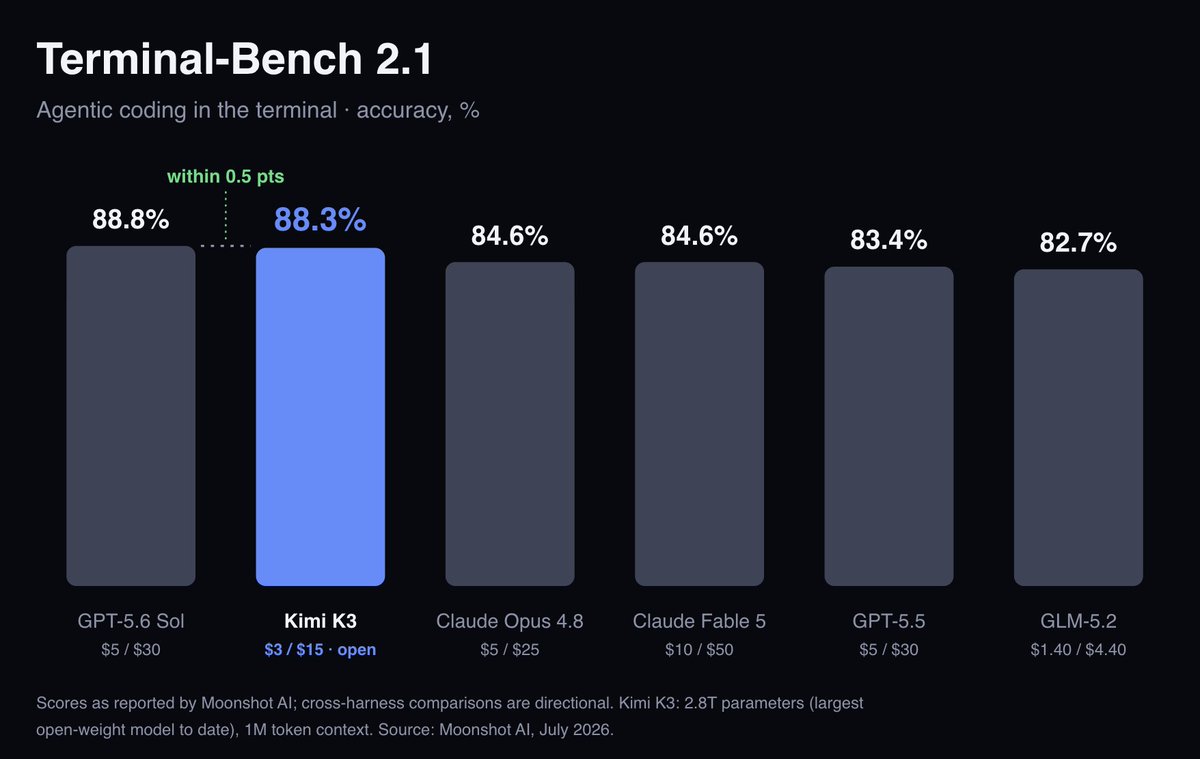
Moonshot's own announcement quotes bigger numbers, GPQA at 93.5%, Terminal-Bench at 88.3%, BrowseComp at 91.2%, and a claim it beats every system they tested. Those are Moonshot's figures, on Moonshot's chosen tasks. I've held xAI and Zhipu to exactly this rule these past few weeks, so I'm not suspending it because the accent changed. The parity claim I'll make rests on the independent evals and the coding arena, not the marketing table.
K3 is about 2.8 trillion parameters, a mixture-of-experts design (Moonshot says around 896 experts, 16 active), which makes it the largest open-weight model yet, once the weights land (Fortune, 2026). Whether "open-weight" means what you think it does, I'll get to.
Here's the surprise: it isn't the cheap one
The DeepSeek reflex says a Chinese frontier model undercuts the West by an order of magnitude. K3 doesn't. Moonshot priced it at $3 per million input tokens and $15 per million output, cache reads at 30 cents. Its predecessor K2.6 charged about 95 cents in and $4 out, so K3's three to four times dearer per token, landing almost exactly on Claude Sonnet 5's rate card. The-decoder called it "the end of super cheap Chinese AI" (the-decoder, 2026). Moonshot's pricing on capability now, not on undercutting anyone.
Per-token it still looks cheap, K3's $15 output is half of Sol's $30 and a fifth of Fable's $50 list. But per-token isn't per-task, and this is the number that reframes the whole thing. K3's verbose. Across the Artificial Analysis index it burned about 130 million output tokens to Sol's roughly 70 million, about 1.9 times the output for the same work (Artificial Analysis, 2026). Cost out a finished task rather than a single token and K3 lands near 94 cents to Sol's $1.04. Marginally cheaper, yes. An order of magnitude cheaper, absolutely not. Line-ball with Sol, and the independent evaluator put the same point plainly.


On the efficiency behind that number, Sol clearly wins. K3 did improve, about 21% fewer tokens than K2.6 for 13 more index points, but it's still a very talkative model, and if your bill is output-heavy, and agentic work usually is, that verbosity eats most of the per-token discount before you ever see it. I've been building output-heavy agentic workflows for clients all year, and that's precisely where the cost hides.
So the reason to reach for K3 isn't price. It's a different thing entirely, and it's the part I trust least when I read the hype.
The real edge is fewer restrictions, and it cuts both ways
"Less restricted" is easy to say and easy to oversell. The honest version has three parts that don't all point the same way.
First, the real one: deployment freedom. Moonshot has committed to releasing K3's full weights on Hugging Face around 27 July. As I write this on 18 July, that hasn't happened, so anyone calling K3 "open source" today is describing a promise, not a fact, and the licence isn't confirmed. When the weights land, the difference from a closed API is real, in principle. You can self-host, fine-tune, keep your data in-region, and nobody can pull the model out from under you. Dev tooling's already excited about that last part.

Second, and this one should make you uncomfortable rather than sell you: independent safety testing of the predecessor K2.5 found it refuses harmful requests far less often than Western frontier models do, matching them on dangerous knowledge (biology especially) while being notably more willing to help with harmful agentic tasks, disinformation and copyright infringement among them (arXiv, 2026). "Fewer restrictions" absolutely includes "fewer guardrails," and I'm not filing that under a win.
Third, the catch, and it's more specific than the usual "Chinese model, so it's censored" reflex. In English, Kimi mostly isn't. An independent 168-case test found K2.5 answered about 98.8% of English-language political prompts without censoring, right in line with Claude and GPT, while DeepSeek failed roughly 81% of the same set (ellamind, 2026). The catch shows up when you switch languages: that same evaluation found K2.5 tracks close to official CCP positions specifically when you prompt it in Chinese. About as open as a Western model in English, noticeably more aligned to Beijing's line in Chinese. K3's own behaviour hasn't been measured yet.
So "less restricted" is true for deployment, uncomfortably true for safety guardrails, and it depends on the language for political content. All three are "restrictions," and they don't move together.
What this means for Anthropic
Anthropic has treated Fable's availability as a lever. It's been export-controlled, pulled offline, rationed, and shuffled in and out of plans. I wrote about that vendor risk a few weeks back, the fact that a model you build your business on can vanish overnight if the vendor decides it should.

The real Fable 5 lesson isn't the model, it's that it can vanish overnight
You can't review a model you had for three days. Claude Fable 5 was pulled globally for 18 days by a US export-control order, and the real lesson...
Read full articleK3 changes the maths, and I won't oversell the "portable" part. For almost everyone, K3 isn't a model you'll run yourself, it's another hosted API (the hardware reality's brutal, more on that below). But that's enough. The point was never self-hosting your way out of Anthropic's constraints. It's that a credible frontier-class alternative now sits one API key away, on Moonshot's own endpoint or through OpenRouter. Availability games used to be a moat, because the alternative was a big step down in capability. K3 removes that step. So every time you make your best model hard to get, you hand customers a reason to look elsewhere, and now there's somewhere to look.
Usual disclosure: we use Claude every day at Webcoda, and this site's tooling is built on it. Factor that in. I'm not neutral about Anthropic, which is precisely why I'd rather they didn't hand Moonshot this particular gift.
And to be fair, some of the restriction isn't Anthropic's choice. Export controls are real, and Transformer News made the case they still bite regardless of how good K3 is (Transformer News, 2026). Fine. But customers don't care why your model's hard to get. They care that the alternative isn't hard anymore.
What the room actually thinks
The reaction split cleanly, and the split is the story. Axios ran "China just erased America's AI lead" (Axios, 2026); Transformer News ran "no reason for China panic." Same model, same week, opposite conclusions. Plenty of people landed at the excitable end.

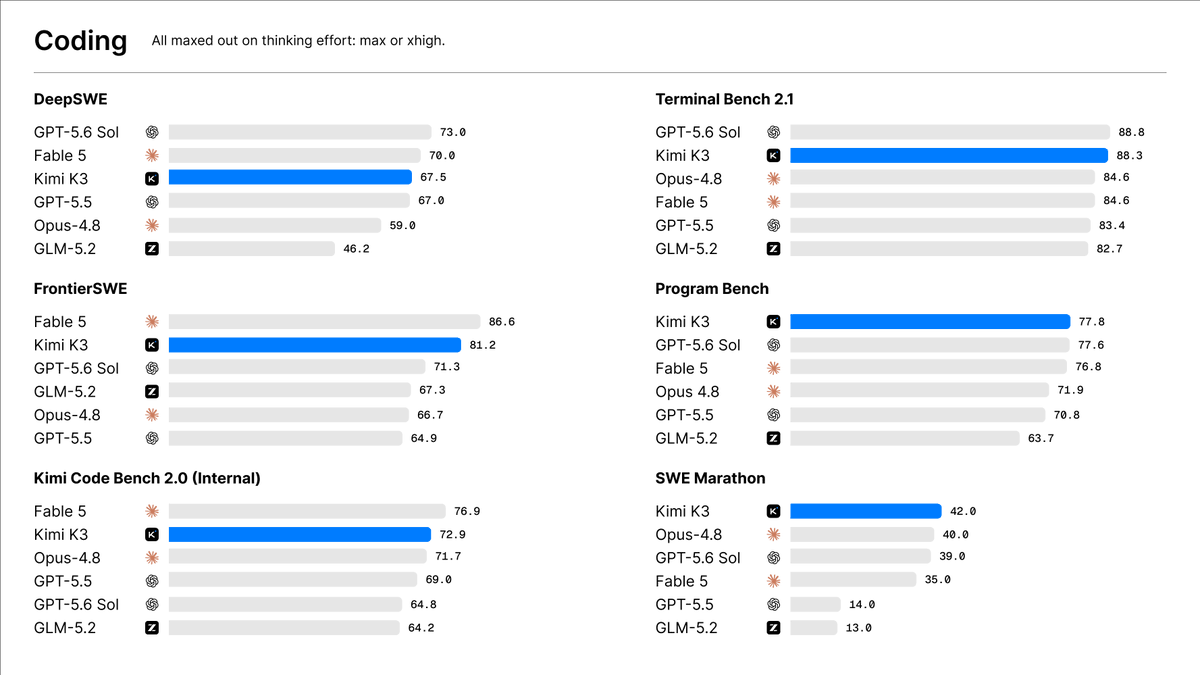
The developers were more measured. On r/kimi and r/LocalLLaMA the hands-on takes were "good, but not that much better than K2.7," with a real gripe about resource use, one user reckoned they burned 6% of their weekly quota per hour under load. Simon Willison found the vision and alt-text genuinely good while noting one pelican SVG cost him about 25 cents and 16,658 output tokens, which, again, verbose (Simon Willison, 2026).
And here's where "open" meets reality, the caveat that keeps me honest about the whole Anthropic argument. At about 2.8 trillion parameters, K3 isn't something you spin up on a spare box. Moonshot recommends something like 64 accelerators and a memory floor north of 650GB, and the architecture isn't in llama.cpp or Ollama yet. Open in principle, hosted in practice.

The strongest case against everything I just said
Let me argue the other side, because it's decent. A fourth-place ranking, a one-point edge over Opus, and one arena win don't make K3 "frontier." Strip out Moonshot's own benchmarks and what's left is respectable, not dominant. And if the independent evals are themselves soft, and a one-point gap is inside the noise I told you to ignore for Opus, then "fourth in the world" is doing some rhetorical work too. "Fewer restrictions" is thin when the weights aren't out yet and the politics change with the language. And telling Anthropic what to do is armchair strategy, they restricted Fable for export-control reasons K3 doesn't face.
Fair, and I'll concede most of it. "Frontier" here means "in the conversation," not "on top," which is why I leaned on the human-preference coding arena over the index number. And I'll own an inconsistency: I waved off Moonshot's K3 benchmarks as marketing, then leaned on K2.5's safety data to describe a K3 that isn't out yet. Treat that section as a prior, not a verdict, until someone independent tests the real weights.
Where I don't budge is the Anthropic point, because it needs none of that. It needs only K3 being good enough, and available, to be a credible alternative when Anthropic makes Fable hard to get. Fourth in the world, first on a coding board, one API key away, clears that bar. Customer optionality doesn't need K3 to win. It just needs K3 to exist and answer the phone.
So where does this leave us
The frontier isn't a two-horse race between OpenAI and Anthropic anymore, and it isn't even a Western one. That's the real headline, and it's bigger than any single benchmark.
And notice what the choice between labs is actually about now. It isn't price. K3 closed the cheap-Chinese-model era by pricing itself at Western rates. It's restrictions, portability and trust. Do you want a model you can eventually hold in your own infrastructure, knowing it's weaker on safety guardrails and toes Beijing's line in Chinese? Or a hosted Western model with better guardrails and a vendor who might ration it? There's no clean answer, and anyone selling you one is selling you something.
Here's the thing I'm actually fairly sure of. "We'll just use the best model and it'll always be a Western API" isn't a safe assumption anymore. If you're building anything you expect to run for years, that's the shift worth sitting with. I'm sitting with it too.
Key Takeaways
Where K3 actually stands:
- Fourth of about 187 models on the independent Artificial Analysis Index (57), behind Fable 5 (60) and GPT-5.6 Sol (59), level-ish with Opus 4.8 (56).
- Its one clean independent win is the Frontend Code Arena, ranked first at roughly a 76% win rate. Moonshot's own GPQA/Terminal-Bench/BrowseComp numbers are self-reported, treat them as such.
The price story:
- $3/$15 per million tokens, roughly three to four times its own K2.6 and right on Claude Sonnet 5's rates.
- But K3 runs about 1.9x Sol's output tokens, so per finished task it's roughly 94 cents to Sol's $1.04. Line-ball, not a bargain, and Sol's the more efficient model.
On "fewer restrictions":
- Deployment freedom is real once the weights ship (around 27 July, licence unconfirmed, not out yet), but at 2.8T params it's cloud-rentable, not self-hostable, for almost everyone.
- Independent testing of predecessor K2.5 found far fewer harmful-request refusals, which should worry you, not sell you.
- Kimi K2.5 was about as open as Western models on English political prompts, but tracked CCP positions in Chinese. "Less restricted" isn't "unbiased," and it's the predecessor, not K3, that's been tested.
The strategic read:
- A credible frontier model that's one API key away turns Anthropic's Fable availability lever from a moat into a liability. Customer optionality only needs K3 to exist, not to win.
Sources
- Artificial Analysis. "Kimi K3 model page." 2026. https://artificialanalysis.ai/models/kimi-k3
- Artificial Analysis. "Kimi K3 vs GPT-5.6 Sol comparison." 2026. https://artificialanalysis.ai/models/comparison...
- the-decoder. "Kimi's open model K3 nears GPT-5.6 Sol and Fable 5 while signaling the end of super cheap Chinese AI." 16 July 2026. https://the-decoder.com/kimis-open-model-k3-nea...
- Simon Willison. "Kimi K3." 16 July 2026. https://simonwillison.net/2026/Jul/16/kimi-k3/
- Fortune. "Moonshot's Kimi K3 pushes Chinese AI into Fable-level territory." 16 July 2026. https://fortune.com/2026/07/16/moonshots-kimi-k...
- latent.space. "AINews: Kimi K3 (2.8T-A50B), the largest open-weight model." 16 July 2026. https://www.latent.space/p/ainews-kimi-k3-28t-a...
- Axios. "China AI: Kimi K3, open source, Anthropic, Opus." 17 July 2026. https://www.axios.com/2026/07/17/china-ai-kimi-...
- Transformer News. "Kimi K3 is no reason for China panic (export controls)." 2026. https://www.transformernews.ai/p/kimi-k3-is-no-...
- ellamind. "LLM censorship and bias in Chinese models." 2026. https://www.ellamind.com/blog/llm-censorship-bi...
- arXiv. "Independent safety evaluation of Kimi K2.5." 2026. https://arxiv.org/abs/2604.03121