


Here's a number worth sitting with for a moment: 3.3%.
Out of roughly 450 million Microsoft 365 users, approximately 15 million are paying for Copilot. That's 3.3%. Everyone else, the 97% of people who open Word, Excel, and Outlook every single day, looked at Copilot and said "not for me, thanks."
This isn't a niche product with a niche audience problem. Microsoft 365 is the most widely used productivity suite on the planet. If you can't convert your own captive user base, that's a verdict.
What Microsoft changed (and when)
Around May 2026, Microsoft restricted in-app Copilot features in Word, Excel, PowerPoint, and OneNote for unlicensed users in larger organisations. If you're on the free Copilot Chat tier, you no longer get AI assistance inside those apps. You need a paid M365 Copilot licence to keep it.
That's not a tweak. That's the end of the free-tier experiment in Office.
At roughly the same time, Microsoft scrapped Copilot on Xbox entirely. Tom Warren at The Verge posted "wow. Microsoft is scrapping Copilot on Xbox..." and it hit 245,000 views.

Brad Sams put it plainly:

This is a product that Microsoft told us would be in everything. Now it's being quietly removed from some things and renamed in others. I don't think that was the original plan.
The "missed the AI wave" framing
In mid-May, Windows Latest reported that Mat Velloso, a former Microsoft Partner Director who was previously a technical advisor to Satya Nadella, said Microsoft missed the AI wave the way it missed the internet and mobile. The post reached 54,000 views.


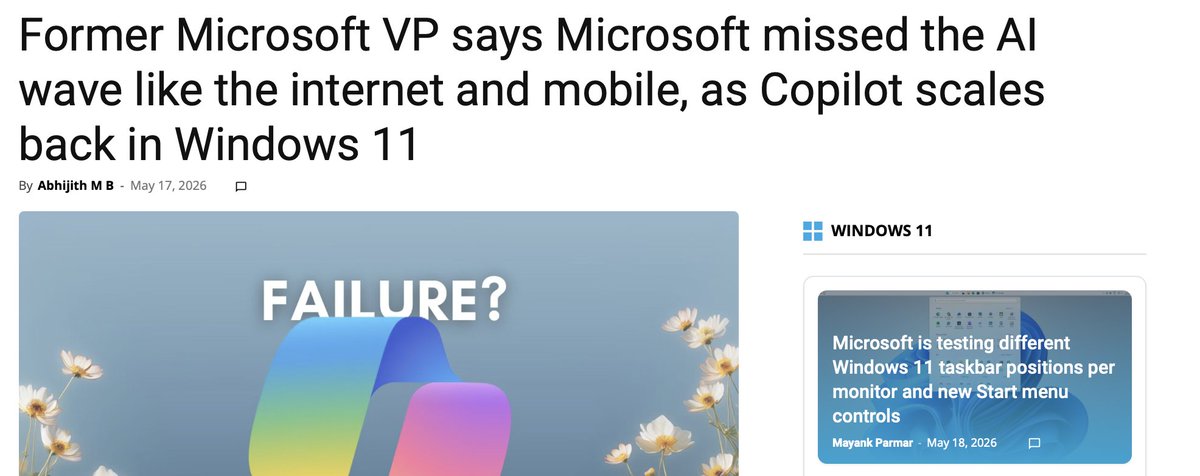
That's a pretty scorching internal assessment, and it's coming from someone who was inside the room.
I want to be careful not to oversell this. "Former executive says company missed trend" is a genre of LinkedIn post that arrives every fortnight. But the 3.3% figure is not an opinion, it's a number. And the number is doing the work here.
Microsoft invested around $13 billion in OpenAI. It built Copilot into Teams, Outlook, Word, Excel, PowerPoint, OneNote, Windows, Edge, Bing, and Xbox. It ran advertising campaigns. It gave chunks of it away free. And after all that, 97% of its existing paying customers said they'd rather not pay more for the AI version.
That's not a messaging problem. That's a product-market fit problem.
The counterargument (and it's a real one)
Here's the thing though: Microsoft might not actually care that much.
Azure OpenAI is a different story. Businesses that don't pay for Copilot licences are often building their own tools on Azure OpenAI endpoints, or using OpenAI directly via API. Microsoft still gets the infrastructure revenue either way. If enterprises are running Claude via API (we do this at Webcoda, I'll be honest about that), they're often running it on Azure too.
So it's possible Microsoft's AI revenue is growing fine, just not in the Copilot-branded product. The seat count number might be less important to the board than it looks from the outside.
That said, if the thesis was "Copilot becomes the default AI interface for knowledge workers at scale," that thesis is not playing out.
What businesses are actually using instead
The practical question, if you're an IT manager or a business owner sitting on M365 licences you didn't upgrade: what's your team doing for AI right now?
In my experience talking to clients, the honest answer is usually one of three things. Nothing at all. ChatGPT on personal accounts. Or a mix of tools that nobody's managing centrally.
None of those are great answers, and all of them are incredibly common.
We've written before about the SharePoint and Copilot features that organisations are paying for and never turning on, which is its own problem. But the flip side is that people who didn't turn it on often aren't using anything. They're just... waiting. For what, I'm not sure.

You're Probably Paying for SharePoint AI You've Never Switched On
Most Australian organisations with M365 licences have AI capabilities sitting dormant in SharePoint. Here's what's available, what it costs, and how...
Read full articleAnd if you're wondering whether the per-seat pricing model itself is the problem, not just Copilot's implementation of it:

HubSpot lost 19% in one day. The market just told us what per-seat pricing is worth in an AI world.
HubSpot announced it'd charge per AI resolution, not per seat. The market knocked nearly 20% off its value in a single trading session. That number...
Read full articleThe pricing is genuinely the issue
M365 Copilot is $30 USD per user per month on top of existing M365 licences. For a 50-person team, that's $1,500 a month, around $18,000 AUD a year.
For a lot of businesses, that's a real conversation, not a quick admin decision. And the ROI case, while it can be made, depends heavily on how aggressively you roll it out and train people to use it. Most organisations don't do that. They enable it, send one email, and six months later half the team can't remember the button exists.
I know because we've done exactly that with tools we've recommended to clients. The "enable and hope" approach to software adoption doesn't work. I should know better by now. I keep recommending it anyway.
The honest assessment
Microsoft's Copilot story is at an inflection point. The free tier is shrinking. The paid tier is getting better features (DLP for prompts, PowerPoint agent mode, authoritative sources management for enterprise). The brand is being rationalised after spreading too thin.
Whether 15 million paid seats is a failure or a foundation depends entirely on what happens next. If enterprise adoption starts compounding, the "missed the AI wave" take looks premature. If the paid seat count is still sitting below 30 million by end of 2026, it's hard to call Copilot's enterprise push a success.
For what it's worth, I don't expect the 15 million figure to double in six months, not at $30 per user per month and not with the adoption friction we're seeing. The 3.3% is the market's verdict so far. It might change. But Microsoft needs it to change a lot, and fast.
---
Sources
- Windows Latest. "Former Microsoft executive says Microsoft missed the AI wave like the internet and mobile." May 2026. https://x.com/WindowsLatest/status/205612939874...
- Tom Warren / The Verge. "Microsoft is scrapping Copilot on Xbox." May 2026. https://x.com/tomwarren/status/2051752720160215058
- Brad Sams. "Copilot brand has been diluted so much that Microsoft is pulling back." May 2026. https://x.com/bdsams/status/2051755137610215764
- @kimmonismus (amplification). "Less than 3.3% of Microsoft 365 users pay for Copilot." May 2026. https://x.com/kimmonismus/status/20562788794600...
- Webcoda. "You're Probably Paying for SharePoint AI You've Never Switched On." February 2026. https://ai-checker.webcoda.com.au/articles/shar...