


I've been doing SEO for over twenty years. I've watched algorithms come and go. I've survived Panda, Penguin, and every core update Google has thrown at us. So when clients started telling me their rankings were slipping despite doing "everything right," I assumed it was the usual algorithm volatility.
Then I started digging. And what I found genuinely surprised me.
Something Changed (And Google Didn't Send a Memo)
Here's the thing about Google. They've always said structured data isn't a ranking factor. John Mueller has stated it explicitly: "Structured data won't make your site rank better." And technically, that's still true.
But here's what they didn't shout from the rooftops: while structured data doesn't boost your ranking directly, it's become essential for how Google's AI systems understand and present your content. And that understanding increasingly determines whether you get clicked.
I ran an informal audit of about fifty client sites last month. The ones losing ground? Almost none had proper schema markup. The ones holding steady or improving? Over 70% had implemented it.
That lines up with the broader data. According to Backlinko's analysis, 72.6% of pages ranking on Google's first page now use schema markup. If you're in the remaining 27%, you're fighting with one hand tied behind your back.
The Click-Through Rate Collapse
Let's talk numbers. Because this is where it gets uncomfortable.
Research from GrowthSrc shows that first-position organic CTR dropped 32% between 2024 and 2025. That's position one. The spot everyone fights for. It went from about 28% to 19%.
Second position? Down 39%. From roughly 21% to 13%.
Some of that drop is from AI Overviews eating clicks. But here's the part that matters for traditional SEO: even on queries without AI Overviews, organic CTR still declined by 41%.
Tim Soulo, CMO of Ahrefs, has been tracking this shift closely:

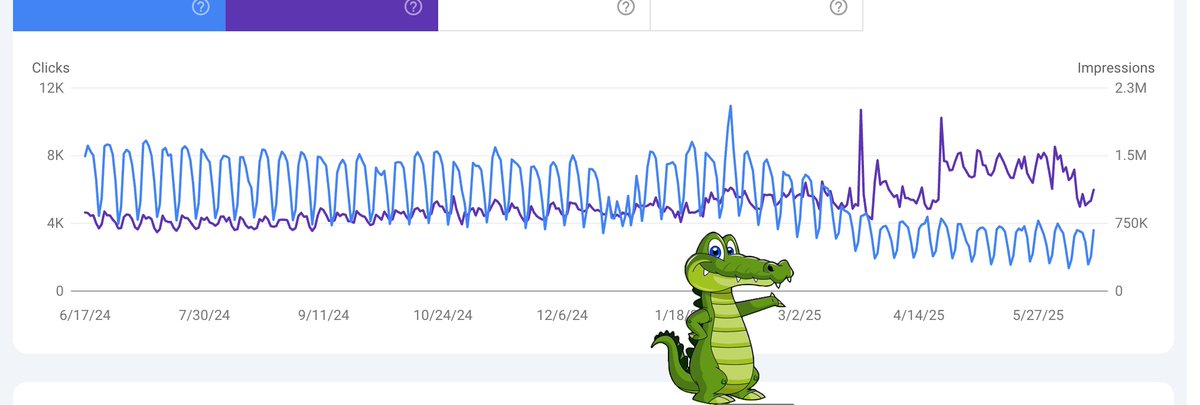
He's calling it "The Great Decoupling." Impressions up, clicks down. Google is answering more questions directly, and traditional SEO metrics are breaking.
Your Competitor's Secret Weapon
I had a client last year. Good content, decent backlinks, solid technical SEO. They'd been ranking #3 for their main keyword for about eighteen months. Then they started slipping to #5, then #7.
They asked me what was wrong. I checked the usual suspects: Core Web Vitals fine, content still relevant, no penalties. Everything looked normal.
Then I looked at who was outranking them. One competitor in particular had jumped from #6 to #2 in the same period. Their content wasn't better. Their backlink profile wasn't stronger. But when I checked their source code, I found comprehensive schema markup. Organisation, LocalBusiness, Service, FAQ, Reviews. The works.
My client had none of it.
Here's why that matters. Google reports that pages with rich snippets are 80% more likely to get clicked in competitive sectors. Results showing review stars see 35% higher CTR compared to plain links.
So my client was ranking #7 with a plain blue link. Their competitor was ranking #2 with stars, ratings, and enhanced SERP features. Guess who was getting the clicks?

Schema.org Implementation Guide: Making Your Website AI-Readable
Most Australian business websites look professional to human visitors, but search engines and AI systems can't actually figure out what you do....
Read full articleWhy Google's AI Systems Love Structured Data
I get it. You've heard the AI hype. Maybe you've dismissed it as irrelevant to your business. You're not trying to get cited in ChatGPT. You just want to rank on Google like you always have.
Fair enough. But here's what you might not realise: Google's own systems are increasingly AI-driven. And AI systems need structured data to understand content reliably.
BrightEdge's research describes it as the "semantic layer that underpins AI." Structured data provides verifiable facts that Google's Gemini model can extract and use. Without it, the AI is guessing based on your page content. With it, the AI knows exactly what your business is, what services you offer, and where you're located.
Local SEO practitioner Bodhi put it bluntly:

Without schema, you're asking an AI to understand your business from context clues alone. That's a risky bet when your competitors are spelling it out explicitly.
The Indirect Ranking Effect
Let me be clear about something. Google hasn't changed their position. Structured data is still not a direct ranking factor. Danny Sullivan confirmed this when he said schema "doesn't somehow boost you to the top of results."
But the indirect effects are significant.
When your result has stars, prices, or FAQ expansions, people click on it more. When people click on it more, Google notices. When Google notices sustained higher engagement, that signals relevance. And relevance affects rankings.
It's a feedback loop. Schema enables Rich Results. Rich Results improve CTR. Better CTR suggests better content. Better content rankings improve.
Some agencies report CTR boosts of 20-40% after implementing schema properly. FAQ schema alone can increase CTR by up to 10%.
If your competitor has those boosts and you don't, you're losing relative ground even if your "ranking" stays the same.
You Don't Have to Care About AI. But Google Does.
Here's the uncomfortable truth. You can ignore AI. You can dismiss ChatGPT and Perplexity and Claude as irrelevant to your business model. That's your choice.
But you can't ignore the fact that Google is using AI throughout their systems. Google's March 2025 core update emphasised content quality, relevance, and what they call "authoritative sources." How do you prove you're authoritative to an AI system? Structured data helps. E-E-A-T signals help. Clear entity relationships help.
The rules changed. The same structured data that helps AI Overviews cite your content also helps traditional Google understand what you're about. It's not two separate games anymore. It's one game with AI at the centre.
What to Do This Week
I'm not going to pretend this is simple. Proper schema implementation takes technical knowledge. But you can start today with high-impact, low-effort changes.
Step 1: Check what you've got
Start by running your site through our AI Optimisation Checker. It analyses your structured data implementation alongside other AI-readiness signals, so you can see exactly where you stand.
Test Your Site's AI Readiness
See exactly how AI agents view your website with our free analysis tool.
Alternatively, you can use Google's Rich Results Test to see what schema Google currently detects. If either tool shows empty or minimal structured data, that's your baseline.
Step 2: Add Organisation schema
This is the foundation. It tells Google who you are, where you're located, and how to contact you. Every business site should have this, and it's relatively straightforward to implement. Your web developer can add it in an hour.
Step 3: Add FAQ schema to your key pages
If you've got FAQ sections on your service pages (and you should), mark them up with FAQPage schema. This enables FAQ rich results and gives Google clear answers to extract for AI Overviews.
Step 4: Consider Review and LocalBusiness schema
If you're a local business with reviews, add aggregate rating schema. If you have a physical location, add LocalBusiness schema with proper address formatting.
Step 5: Validate and monitor
Use Schema.org's validator to check your markup is correct. Then watch your Search Console over the following weeks. Look for new rich result types appearing in your performance reports.
The Gap is Widening
I'm going to be honest with you. The gap between sites with proper structured data and sites without is widening. As AI becomes more central to how search works, that gap will only grow.
The good news? Most of your competitors still haven't figured this out. Only about 30% of all websites use schema markup. That means 70% are still vulnerable.
You've got a window. But it's closing.
Key Takeaways
For Business Owners:
- Your rankings aren't slipping because of content quality. They're slipping because the game changed.
- Rich Results (stars, FAQs, prices) are stealing clicks from plain blue links. If you don't have them, your competitors do.
- You don't need to "care about AI" to benefit from structured data. You just need to care about CTR.
For Marketing Teams:
- Audit your schema markup this week. Use Google's Rich Results Test on your top ten pages.
- Prioritise Organisation, LocalBusiness, and FAQ schema. These have the highest impact for the lowest effort.
- Track CTR changes in Search Console after implementation. You should see movement within 4-6 weeks.
For Technical SEO Specialists:
- JSON-LD is still the preferred format. Google explicitly recommends it.
- Schema quality matters more than schema quantity. Well-implemented markup on key pages beats thin markup everywhere.
- Watch for deprecated schema types. Google removed FAQ rich results for some site categories in 2023, and they continue to refine what gets displayed.
The rules changed. Your competitors adapted. Now it's your turn.
---
Sources
- Search Engine Roundtable. "Google: Structured Data Won't Make Your Site Rank Better." https://www.seroundtable.com/google-structured-...
- Backlinko. "Search Engine Ranking Study." https://backlinko.com/search-engine-ranking
- GrowthSrc. "CTR Study 2025: How Click-Through Rates Have Changed." https://www.growthsrc.com/blog/ctr-study-2025
- Dataslayer. "AI Overviews Impact on Organic CTR." https://www.dataslayer.ai/blog/ai-overviews-ctr...
- Lantern Digital. "Schema Markup SEO Guide: CTR Statistics." https://www.lantern-digital.com/blog/schema-mar...
- BrightEdge. "Structured Data in the AI Search Era." https://www.brightedge.com/blog/structured-data...
- Safari Digital. "Is Structured Data a Ranking Factor?" https://www.safaridigital.com.au/blog/structure...
- Kodanslab. "Schema Markup Case Studies." https://www.kodanslab.com/blog/schema-markup-ca...
- Impression Digital. "Google Algorithm Update March 2025." https://www.impressiondigital.com/blog/google-a...
- Sixth City Marketing. "Schema Markup Statistics." https://www.sixthcitymarketing.com/blog/schema-...
- Google Search Central. "Introduction to Structured Data." https://developers.google.com/search/docs/appea...
- Google Rich Results Test. https://search.google.com/test/rich-results
- Schema.org Validator. https://validator.schema.org/