

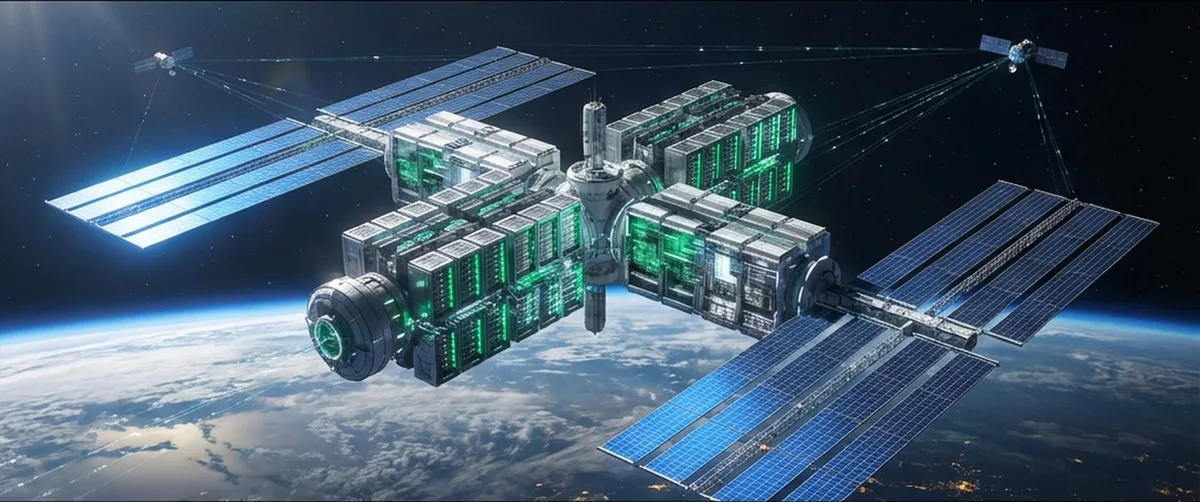
Data centers consume roughly 1.5% of global electricity. They're expected to triple that by 2030. But what if we could move them somewhere with unlimited solar power, free cooling, and zero water consumption?
That's not science fiction anymore. It's happening right now, 500 kilometres above your head.
When I first read about Starcloud last year, I thought it was another Silicon Valley fever dream. Space data centres? Come on. Then I saw the NVIDIA partnership announcement. Then the $21 million funding round. Then the actual launch in November 2025. Now I'm watching my assumptions about computing infrastructure evaporate faster than water in a desert data centre.
Seattle-based startup Starcloud (formerly Lumen Orbit) raised $21 million to launch the world's first commercial orbital data center by 2026. They're not alone. Axiom Space announced their first Orbital Data Center nodes launching by the end of 2025. Even Jeff Bezos predicts we'll see gigawatt-scale space data centers within 10 to 20 years. The global orbital data center market? Currently worth $624 million, but projected to hit $2.5 billion by 2031 with a 19.3% annual growth rate.
Australian businesses should pay attention. With $3 billion invested in Australia's space sector since 2018 and 814 organisations already operating in the industry, we're well positioned to capitalise on this shift. The question isn't whether orbital computing will happen. It's how quickly your competitors will adopt it.
Why Put Servers in Space?
The economics are brutal. A traditional data center burns through money on three fronts: electricity, cooling, and water. Lots of water.
I spent a week diving into the water consumption numbers because they seemed too high to be real. They're not. They're worse than I thought.
US data centers consumed 17 billion gallons of water in 2023 just for direct cooling. Google's Council Bluffs facility alone used 1 billion gallons. Training a single large language model can evaporate 700,000 litres. By 2027, global AI demand could require 4.2 to 6.6 billion cubic metres of water withdrawal. That's more than half the United Kingdom's total annual water use.
Space solves all three problems simultaneously.
First, solar power. In orbit, you've got 24/7 sunlight with zero atmospheric interference. No clouds, no night, no weather disruptions. Starcloud estimates energy costs in space are 10 times cheaper than terrestrial options, even including launch expenses. Their analysis shows a 40MW cluster operated for 10 years costs $8.2 million in space versus $167 million on Earth for operational energy costs alone. (It's worth noting these figures exclude hardware and multiple launch costs, which independent analysts suggest could run into billions. The real savings are significant but not quite 20x when you factor everything in.)
Second, cooling. Earth-based data centers consume roughly as much power for cooling as they do running the servers themselves. In space near Earth orbit, objects in direct sunlight can reach temperatures of 120°C, while objects in shadow can drop to negative 100°C or lower. The vacuum of space becomes an effective heat sink because there's no atmosphere to trap heat. You're radiating waste heat directly into the void instead of evaporating millions of litres of freshwater.
Third, land. A typical data center occupies 40 acres. Hyperscale facilities consume hundreds of acres. Orbital infrastructure doesn't compete with housing, agriculture, or conservation. You're using space that's already there.
Philip Johnston, Starcloud's co-founder and CEO, claims their approach produces at least 10 times lower carbon emissions than terrestrial data centers, including the launch. A 2024 European feasibility study (ASCEND) supported this potential, finding that orbital data centers could significantly reduce energy consumption and carbon emissions compared to traditional infrastructure.
That said, not everyone agrees. Research from Saarland University found orbital data centers could actually create *greater* emissions than Earth-based centres when accounting for rocket launches and atmospheric reentry pollution. The truth probably depends on how quickly launch technology improves and whether reusable rockets become the norm. (I'm cautiously optimistic, but I've learned not to take company projections at face value.)
How It Actually Works
Starcloud's first demonstrator satellite, Lumen-1, weighs 60 kilograms. It launched in November 2025 on a SpaceX Falcon 9 rideshare mission called Bandwagon 4. The payload includes an NVIDIA H100 GPU, which according to the company is 100 times more powerful than any GPU previously operated in space.
That's not a typo. A hundred times more powerful.
The 2026 follow-up mission, Starcloud-2, scales everything up another 100x. More power, more compute, full commercial operations in sun-synchronous orbit. By early 2027, customers will deploy AI workloads from space through a dedicated Crusoe Cloud module capable of handling both inference and training for AI applications.
The technology hinges on massive solar arrays feeding energy into high-density compute modules. Advanced cooling systems (likely liquid cooling or two-phase immersion) handle the heat generated by AI workloads. Then you've got radiation shielding to protect against cosmic radiation and solar events, plus sophisticated tracking and manoeuvring systems to avoid the 25,000 tracked debris objects already in orbit.
Starcloud's long-term vision? A 5-gigawatt orbital facility with solar arrays and cooling panels spanning roughly 4 kilometres. They've partnered with Rendezvous Robotics to develop autonomous self-assembling structures that can construct and maintain these massive platforms.
The Latency Question
Here's where it gets interesting. Old geostationary satellites orbited at 35,000 kilometres with latency around 240 milliseconds. That's unusable for real-time applications like financial trading or online gaming.
But next-generation low Earth orbit satellites like Starlink circle at about 550 kilometres. Current real-world latency sits around 25-60 milliseconds, with targets to reach sub-20ms as the technology matures. That's already adequate for most applications, and getting better. Analysis from multiple sources suggests that by the mid-2030s, as launch costs potentially fall toward $200 per kilogram (current SpaceX Starship targets), the economics of space-based data centers could become roughly comparable to terrestrial energy costs.
Still, distance creates challenges. Certain applications, particularly high-frequency financial transactions, might continue requiring terrestrial infrastructure. But for AI training, large-scale data processing, and satellite-to-satellite communications? Orbital computing makes perfect sense.
The Challenges Nobody's Talking About
Let's be honest: this isn't easy. I've spent enough time in the hosting industry to know that when something sounds too good to be true, there's usually a catch. Orbital computing has several.
Launch costs remain the biggest barrier. SpaceX Falcon 9 rideshare missions start at $300,000 for 50 kilograms, working out to roughly $6,000 per kilogram. A dedicated launch costs around $70 million. The entire business case depends on those costs continuing to decline as projected. Historical data suggests they will, but there are no guarantees.
Then there's maintenance. On Earth, you walk into a data center with replacement hardware. In orbit? You need robotics, automation, and remote repair capabilities that don't fully exist yet. (I've seen enough "autonomous systems" fail on Earth to have healthy scepticism about space-based versions.) Even with Starship promising more routine servicing missions, the logistics remain complex and expensive.
Space debris is another nightmare. NASA's Orbital Debris Program Office tracks more than 25,000 objects posing collision risks to operational satellites. Each new satellite increases the chance of cascading failures. Orbital data centers need sophisticated shielding, constant tracking, and end-of-life protocols to avoid creating more space junk.
Radiation hardening adds weight, complexity, and cost. Cosmic radiation and solar events can corrupt data or damage hardware. You need extensive shielding and redundancy compared to ground-based systems.
And there's the heat dissipation problem. Yes, space offers cooling advantages. But actually radiating heat away from densely packed computing hardware in a vacuum presents unique engineering challenges. Traditional fans and liquid cooling don't work in space. You're using radiative cooling only, which requires careful thermal management design.
What This Means for Australian Businesses
Australia's space sector is worth $8 billion and employs over 19,500 people. The government committed $150 million over five years for the Moon to Mars initiative, plus $15 billion for the National Reconstruction Fund with space projects eligible for debt finance, equity finance, or guarantees.
We've got geographic advantages: proximity to the equator for geosynchronous orbits, southern latitudes for polar and sun-synchronous orbits, clear skies with low interference for satellite tracking, and streamlined regulation. South Australia alone hosts more than 100 space-related organisations and is positioning itself as Australia's space industry hub.
The SmartSat Cooperative Research Centre partners universities and research organisations with industry on space projects. The Australian Space Data Analysis Facility works with SMEs and researchers to help them access and use space data. We've got infrastructure, expertise, and government support.
So what can you actually do with orbital computing?
National security applications involving multi-sensor fusion, space threat tracking, and autonomous satellite control are obvious candidates. Earth observation gets a massive boost when you're processing satellite imagery directly in orbit instead of downloading terabytes back to Earth. Disaster response becomes faster when you're running AI models in space to identify floods, fires, or infrastructure damage in real time.
Commercial applications include industrial analytics, supply chain optimisation using satellite data, and autonomous vehicle coordination. Any application requiring massive compute power with access to space-based sensors becomes a candidate.
China gets this. On 14 May 2025, they launched the first cluster of 12 satellites for their "Three-Body Computing Constellation." The eventual network? 2,800 satellites. They're not building that for fun. They're building it because whoever controls orbital computing infrastructure controls a significant chunk of 21st-century economic activity.
That thought keeps me up at night, honestly. Australia's got the expertise and the geographic advantages. But we're competing against nations with deeper pockets and longer-term planning horizons. The window to establish ourselves in this space (pun intended) isn't infinite.
When Will This Actually Matter?
Starcloud's demonstrator launched in November 2025. Commercial operations begin in 2026. Crusoe Cloud from orbit goes live in early 2027. Axiom Space's first Orbital Data Center nodes are scheduled to launch by the end of 2025.
Within two years, you'll be able to buy compute capacity from orbit the same way you buy AWS or Azure capacity today. Within a decade, Starcloud predicts most new data centers will be in space.
That timeline might sound aggressive, but consider: the orbital data center market is growing at 19.3% annually. North America leads with strong government and private investment. Asia-Pacific is rapidly expanding with India, Japan, and South Korea contributing. Australia's space sector saw $3 billion in investment from 2018 to 2023.
The infrastructure is being built right now. The question for Australian businesses isn't whether orbital computing will happen. It's whether you'll be ready when it does.
Because here's the thing about infrastructure shifts: the companies that move first get the competitive advantage. The ones that wait spend the next decade playing catch-up. (I watched this happen with cloud adoption. I watched it happen with mobile-first design. I'm not keen to watch Australian businesses miss another wave.)
You've got maybe three years before this stops being cutting-edge and starts being standard. What are you going to do with that time? (I'm still figuring out my answer.)
Key Takeaways
Economic Transformation: Orbital data centers claim significantly lower operational energy costs than terrestrial facilities. Company estimates suggest 10x cheaper energy, though independent analysis notes hardware and launch costs must be factored for complete comparisons.
Environmental Impact: Space-based computing eliminates water consumption (saving billions of litres annually) and doesn't compete for land resources. Carbon emissions claims are disputed, with company projections suggesting 10x reductions while some academic research suggests launches could offset those gains.
Timeline: First commercial orbital data centers launched in late 2025, with public cloud access from orbit available by early 2027. The market grows from $624 million to a projected $2.5 billion by 2031.
Australian Opportunity: With $3 billion invested in Australia's space sector since 2018, 814 organisations operating in the industry, and strong government support, Australian businesses are well-positioned to capitalise on orbital computing.
Technical Reality: Low Earth orbit satellites currently achieve 25-60 millisecond latency, with targets to reach sub-20ms as technology matures. This makes them viable for most applications including AI workloads. Launch costs continue declining toward projected targets of $200/kg by the mid-2030s.
---
Sources
- Starcloud (Lumen Orbit) Company Profile - Y Combinator
- Lumen Orbit rebrands to Starcloud, raises $10m - Data Center Dynamics
- Are data centers in space the future of cloud storage? - IBM
- Lumen Orbit Raises $11M for Space-Based AI Data Centers - The Outpost
- Starcloud Advances Space-Based AI with $10M Funding and Nvidia Partnership - Space Insider
- Starcloud Company Overview - CB Insights
- How Starcloud Is Bringing Data Centers to Outer Space - NVIDIA Blog
- Starcloud-2 In-Space GPU Cluster & Cloud Computing Satellite
- The Space Review: Big data computing above the clouds
- Jeff Bezos envisions space-based data centers in 10 to 20 years - Tom's Hardware
- Data Centers in Space: Projections and feasibility - TechTarget
- Data centres in space: brilliant idea, herculean challenge - The Conversation
- Should we be moving data centers to space? - MIT Technology Review
- Exploring space-based, scalable AI infrastructure - Google Research
- Australia's Space Industry - Austrade International
- Axiom Space to Launch Orbital Data Center Nodes
- Orbital Data Center Market Size Report 2025-2031 - OpenPR
- In-Orbit Data Centers Market Report 2025 - Globe Newswire
- SpaceX Increases Rideshare Prices - Payload Space
- SpaceX Rideshare Programme
- Data Center Water Usage: A Comprehensive Guide - Dgtl Infra
- Data Centers and Water Consumption - EESI
- Data centers consume massive amounts of water - The Conversation
---