

I've been covering AI developments for clients for years, and this week felt different. The pace has been relentless before, but December 9-14 delivered three stories that'll shape how Australian businesses use AI in 2026. Disney betting a billion dollars on AI video. Trump signing an executive order that could override state AI laws globally. And the biggest tech companies in the world (who normally compete like they're at war) actually agreeing on something.
Let's unpack what happened and what it means for your business.
The Big Story: Disney Bets $1 Billion on OpenAI
On December 11, Disney announced they're investing $1 billion in OpenAI and licensing over 200 characters (Mickey Mouse, Marvel heroes, Pixar properties) for Sora, OpenAI's video generation model. That's not a pilot programme. That's a bet-the-company move.


Here's what caught my attention. Disney isn't just licensing characters. They're fundamentally changing how entertainment gets made. Sora can now generate video clips featuring Mickey or Iron Man from text prompts. The quality isn't cinema-ready yet (I've seen the demos, they're impressive but you can still tell), but the trajectory is clear. In two years? Three? We're looking at AI-generated Marvel shorts, personalised Disney stories for kids, interactive Pixar experiences.
Market reaction split. Some celebrated the innovation potential. Others worried about job displacement. SAG-AFTRA (the US actors' union) immediately flagged they're monitoring for contract compliance. Our equivalent, MEAA, represents thousands of Australian media workers who are watching this closely. If Disney can generate video content without actors, voice artists, or animators, what happens to those jobs?
For Australian businesses, here's the immediate relevance. If you're in marketing, training, or content creation, you'll likely have access to these tools within 18 months based on typical technology diffusion patterns. (Disney's deal isn't exclusive.) Based on the trajectory we've seen with AI writing and image generation tools, video production costs could drop dramatically.
But here's the legal risk nobody's talking about enough. Australian copyright law hasn't caught up with AI training yet. If you use these tools to generate content featuring trademarked characters or copyrighted styles, who owns it? Disney paid $1 billion to licence their own characters for AI training. You don't have that licence. Tread carefully.
The compliance angle matters too. If you're generating training videos, marketing content, or customer communications with AI, you need clear documentation about what's AI-generated vs human-created. ASIC and ACCC are watching. They haven't issued guidance yet, but they will.
In Brief
Trump Signs Federal AI Framework
December 11 brought an executive order that'll affect Australian businesses more than you'd expect. Trump signed a federal AI policy framework designed to preempt individual US state regulations. One rulebook instead of 50 different state laws.

Sounds efficient, right? The tech industry thinks so (mostly). But Senator Maria Cantwell warned it creates "vulnerability to AI harms" by removing state-level consumer protections. Policy groups called it "bullying states into submission."
Here's why Australian businesses should care. Most of the AI tools you're using (ChatGPT, Claude, Gemini, GitHub Copilot) are governed by US regulations. When the US sets a federal AI policy, it becomes a de facto global standard. Our own National AI Plan, released earlier this year, will likely align with whatever framework emerges from the US. That's not ideal, but it's reality.
For compliance teams, this means watching US developments isn't optional. If you're in financial services, healthcare, or government contracting, US AI policy will flow through to Australian regulatory expectations within 6-12 months. It always does.
Big Tech Unites: Agentic AI Foundation
On December 9, something unprecedented happened. OpenAI, Google, Microsoft, Anthropic, AWS, and Block announced they're forming the Agentic AI Foundation under the Linux Foundation. These companies compete on everything. They're forming a standards body together.

Anthropic donated their Model Context Protocol (MCP) as the foundation's first standard. (We covered MCP extensively in our deep-dive analysis, it's basically USB-C for AI agents.) The goal is creating interoperability standards so AI agents from different companies can work together.
I'll admit I was sceptical when I first heard this. Big Tech "collaboration" usually means everyone jockeying for control. But looking at the structure, the Linux Foundation governance model has worked for decades. If they pull this off, it solves a massive problem for developers.
For Australian businesses, particularly in mining, resources, and logistics where AI agents could genuinely transform operations, this is good news. Interoperability means you're not locked into one vendor. You can use Google's agents for customer service, OpenAI's for content generation, and Anthropic's for analysis without building custom integrations for each one.
The technical teams at companies I work with have been asking about AI agent deployment for months. My answer was always "wait six months, the standards aren't there yet." That timeline just accelerated. We're looking at deployable agent standards by mid-2026.
MCP: Why OpenAI, Google, and Microsoft All Adopted Anthropic's 'USB-C for AI'
You've heard the acronym. You've seen the hype. Here's what MCP actually is, why every major AI company adopted it, and what it means for you.
Read full articleOpenAI's GPT-5.2 Arrives
Also on December 11, OpenAI released GPT-5.2. This was their "code red" response to Google's Gemini 3 release, which we analysed in our ChatGPT's Code Red Moment article.
The benchmarks are impressive. 100% on AIME math problems, 55.6% on SWE-Bench coding challenges, 70.9% on complex reasoning tasks. Those are measurable improvements over GPT-5.1.
But here's what the benchmarks don't tell you. In real-world coding tasks, developers still prefer Claude Opus 4.5 (which scores 80.9% on SWE-Bench vs GPT-5.2's 55.6%). I'm including myself in that. For actual development work, Claude feels more reliable. For general business use, customer service, content generation? GPT-5.2 is excellent.
The catch is cost. OpenAI's pricing for high-usage plans has increased significantly this quarter. For Australian SMEs processing thousands of queries daily, that adds up fast. I've had three clients ask about cost optimisation strategies in the past month alone. (The answer usually involves routing simple queries to cheaper models and reserving GPT-5.2 for complex requests, but that requires infrastructure investment.)
ChatGPT's 'Code Red' Moment: Three Years After Disrupting Google, the Tables Have Turned
In December 2022, ChatGPT triggered Google's 'code red.' Now OpenAI has declared its own as Anthropic leads enterprise AI. Here's how the tables...
Read full articleTime Honours "Architects of AI"
Time magazine named eight people "Architects of AI" for their Person of the Year issue on December 11. The list: Sam Altman (OpenAI), Jensen Huang (NVIDIA), Mark Zuckerberg (Meta), Dario Amodei (Anthropic), Demis Hassabis (Google DeepMind), Elon Musk (xAI), Lisa Su (AMD), and Fei-Fei Li (Stanford/ImageNet).

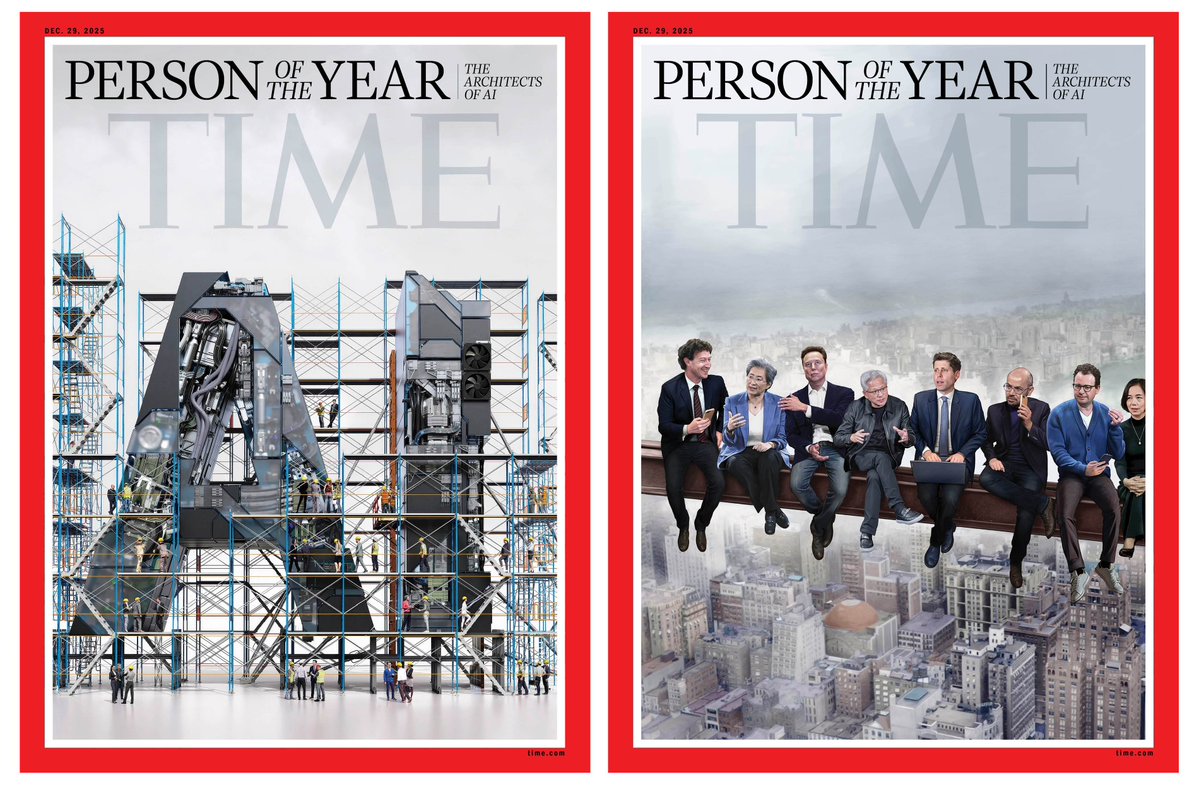
The list sparked immediate debate. All US-based leaders. No representation from China, Europe, or Australia. (We've got world-class AI research happening at CSIRO, University of Melbourne, and Sydney. Nobody made the list.)
I'm not sure these awards matter much for day-to-day business operations, but they do reflect where investment and talent are concentrating. If you're trying to recruit AI talent in Australia, you're competing with US companies paying 2-3x Australian salaries. That's the real story here.
China Closes the Gap: DeepSeek V3.2
Speaking of things Time didn't recognise, China's DeepSeek released V3.2 this week. 685 billion parameters, with DeepSeek claiming 70% lower inference costs than comparable models, matching GPT-5.2 benchmarks on several tests.
For Australian businesses with operations in Asia-Pacific, this matters. DeepSeek models run locally, don't send data to US servers, and cost significantly less for high-volume use. If you're in manufacturing, logistics, or retail with significant APAC presence, DeepSeek is worth evaluating. (I haven't tested it extensively yet, so I can't give a full recommendation. That's on my list for January.)
The geopolitical implications are obvious. AI leadership isn't a US monopoly anymore. That changes procurement decisions, data sovereignty considerations, and risk assessments for enterprise AI deployment.
What We're Watching
Next week should be interesting. Here's what I'm tracking:
- Google and Anthropic responses to GPT-5.2. They won't let OpenAI hold the benchmark lead for long. I'd expect announcements before Christmas.
- Global AI Virtual Conference (December 15-17) usually produces several significant announcements. Last year we got three major model releases during the conference.
- Australian regulatory developments. The Department of Industry has been quiet since the National AI Plan launch. That usually means they're working on implementation guidance.
- Enterprise AI agent deployments. With the Agentic AI Foundation announced, I expect several major companies to announce agent pilots before year-end.
The community temperature on AI right now sits around 8/10 for excitement, but anxiety about ethics, jobs, and regulation is climbing. That's probably healthy. We're moving fast enough that pausing to ask "should we?" alongside "can we?" isn't a bad idea.
This week's snapshot will look quaint in six months. That's just how fast things are moving. We'll keep tracking what matters for Australian businesses as the landscape keeps shifting.
Sources
- Disney-OpenAI $1B Deal - CNBC, December 11, 2025
- Trump AI Executive Order - White House, December 11, 2025
- Agentic AI Foundation Launch - Linux Foundation, December 9, 2025
- Anthropic MCP Donation - Anthropic, December 9, 2025
- GPT-5.2 Release - OpenAI, December 11, 2025
- Time Person of the Year: Architects of AI - Fortune, December 11, 2025
- SAG-AFTRA Monitoring Statement - SAG-AFTRA, December 11, 2025