

Australian businesses lost $119 million to scams in just the first four months of 2025, according to the National Anti-Scam Centre. That's not a typo. Four months. And here's what makes it terrifying: deepfakes are getting so good that CSIRO research found leading detection tools collapse to below 50% accuracy when they see deepfakes they weren't trained on. We're basically flipping coins to tell real from fake.
But there's something quietly revolutionary happening behind the scenes. While everyone's scrambling to build better deepfake detectors, a different approach is gaining serious momentum. Instead of playing whack-a-mole with fakes, what if we could verify what's real from the moment it's created?
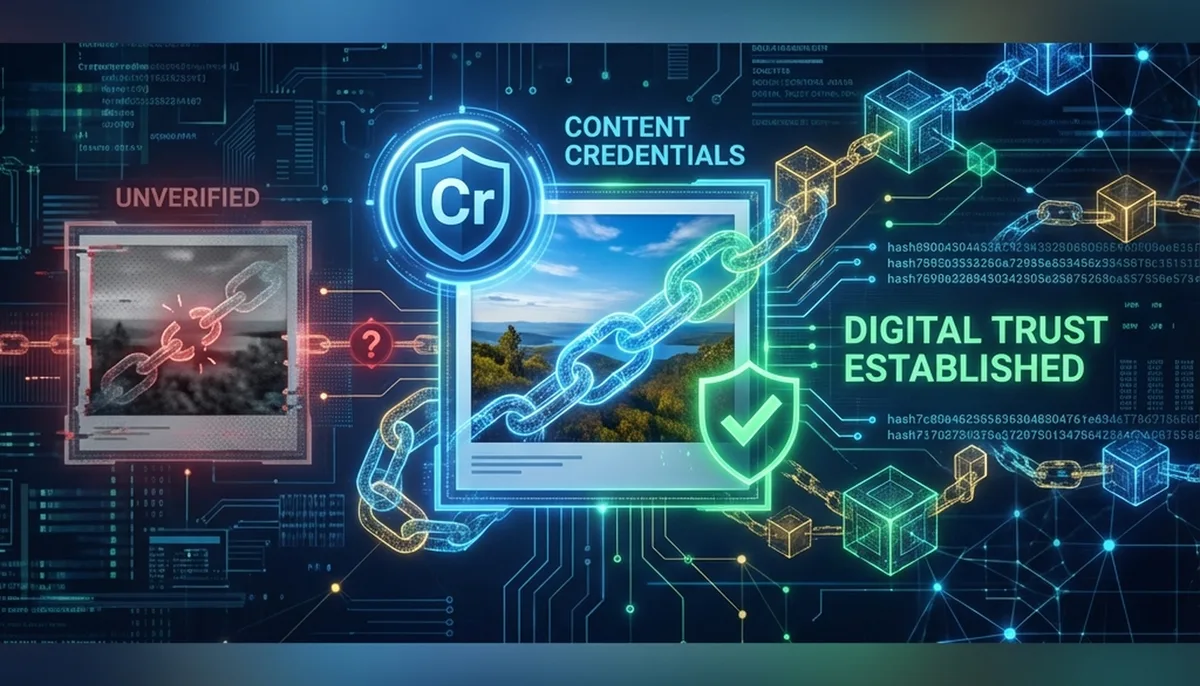
That's exactly what C2PA (Coalition for Content Provenance and Authenticity) content credentials do. Think of them as a cryptographic nutrition label for digital media. When a photo gets taken on a Sony camera or edited in Adobe Photoshop, that content credential gets embedded right into the file. It's tamper-proof, it's traceable, and it's starting to show up everywhere that matters.
From Detection to Prevention: Why This Changes Everything
Let me tell you what's broken about our current approach. When Mastercard surveyed Australian businesses, they found 20% had been targeted by deepfake scams in the past year. The estimated losses? Tens of millions of dollars. And we're trying to fight this with detection tools that can't keep up.
CSIRO's Dr. Kristen Moore put it bluntly when her team assessed 16 leading deepfake detectors: none could reliably identify real-world deepfakes. The problem isn't the tools themselves. It's that generative AI evolves faster than detection algorithms. You train a detector on today's deepfakes, and next month's models make it obsolete.
Content credentials flip this entire model on its head. Instead of asking "Is this fake?", we can now ask "Can you prove this is real?" It's a subtle shift with massive implications.
When Sony announced Camera Verify in June 2025, press photographers finally got a way to prove their images were genuine from the moment of capture. The system embeds C2PA digital signatures and Sony's proprietary 3D depth information directly into the image file. No post-processing. No trust-me verification. Just cryptographic proof.
LinkedIn rolled out content credentials with a simple "Cr" icon on AI-generated images. Click it, and you'll see exactly how that image was created, who made it, and whether AI tools were involved. Meta joined the C2PA steering committee in September 2024 and started using content credentials to label AI images across Facebook, Instagram, and Threads. Google's integrating C2PA metadata into Search, Lens, and their ad systems through the "About this image" feature.
These aren't small players experimenting. This is the infrastructure of digital media getting rebuilt.
What Australian Businesses Actually Need to Know
Right now, you're probably wondering how this affects your business. Let me make it concrete.
If you're a media company, news organisation, or publisher, content credentials give you a way to maintain credibility when trust in digital media is collapsing. The W3C published Verifiable Credentials 2.0 as an official standard in May 2025, which means the technical foundation is solid and enterprise-ready.
If you're dealing with legal evidence, insurance claims, or compliance documentation, the ability to cryptographically verify that media hasn't been tampered with becomes extraordinarily valuable. A startup called ContentSign is already helping insurance companies verify that claim photos are genuine and haven't been AI-generated or manipulated.
Brand protection is another massive use case. When deepfake fraud caused businesses an average loss of nearly $500,000 in 2024 (and $680,000 for large enterprises), being able to verify that content actually came from your company matters. Remember that UK finance director who transferred $25 million after a deepfake video call? Content credentials can't prevent social engineering, but they can verify that official company content is legitimate.
And if you're in e-commerce, projected fraud losses are climbing from $44 billion in 2024 to $107 billion by 2029. That's a 141% increase. Content credentials won't solve all of it, but they create a verification layer that makes certain types of fraud much harder to execute.
The Technical Reality (Without the Jargon)
Here's how this actually works in practice. When you create or edit content using a C2PA-compatible tool, it generates a "manifest" with information about the content's history. This includes who created it, when, what tools were used, and what edits were made. All of this gets cryptographically signed, which means tampering becomes detectable.
The manifest can be stored in three ways: embedded in the file's metadata, through invisible watermarking, or via digital fingerprinting. Even if a social media platform strips the metadata (which many still do), tools like Adobe's Content Credentials cloud can recover it by matching the image's fingerprint.
The C2PA 2.1 specification, published in May 2025, tightened security requirements significantly. It's more resistant to tampering attacks and requires stricter validation of content provenance. The specification has been fast-tracked as an ISO standard, which tells you this isn't some experimental tech. It's becoming infrastructure.
But we need to be honest about the limitations. Adoption is still early. Most internet content doesn't use C2PA yet. Security researchers have documented ways attackers can bypass some safeguards by altering metadata, removing watermarks, or mimicking digital fingerprints. It's not a silver bullet.
What it does do is shift the burden of proof. Without content credentials, everything is potentially suspicious. With them, you can start building systems that default to trusting verified content and scrutinising everything else.
Australia's Deepfake Regulations Are Coming Fast
While the technical infrastructure gets built, Australian regulators aren't sitting idle. The Criminal Code Amendment (Deepfake Sexual Material) Bill 2024 passed into law, criminalising non-consensual sexually explicit deepfakes. New South Wales went further, outlawing the creation and sharing of sexually explicit deepfakes, including audio.
Independent Senator David Pocock has introduced legislation that would give Australians legal ownership of their own face and voice. If it passes, victims could sue when their likeness gets stolen for scams or disinformation. Similar laws already exist in China, Spain, and Denmark.
Victoria and South Australia have enacted their own deepfake laws, targeting different aspects of the problem. Combined scam losses hit $2.03 billion in 2024, and reports show a 28% increase in early 2025 compared to the previous year. Regulators are clearly feeling the pressure to act.
For businesses, this creates both risk and opportunity. The risk is liability. If your organisation gets impersonated by deepfakes and you can't prove your official content is legitimate, you're in a bad position. The opportunity is that content credentials give you a proactive defence. You're not just detecting fakes after they spread. You're establishing authenticity from the start.
Implementation Timelines and What to Expect
The C2PA Trust Model timeline shows that through December 31, 2025, the existing Implementation Trust List will remain operational. After that, the new conformance programme kicks in. This means C2PA implementations will need to demonstrate they're properly built before being considered part of the trusted ecosystem.
Sony's already added content credential support to multiple camera models including the Alpha 1 II, Alpha 9 III, and Alpha 7 series. Video support rolled out in November 2025 for several models, with more coming in 2026. Adobe's integrated content credentials across Photoshop, Lightroom, Premiere Pro, and Firefly. Their free Content Authenticity web app and Chrome extension let you inspect credentials anywhere online.
The Library of Congress launched a C2PA working group in January 2025 to explore how government agencies, libraries, archives, and museums can implement content provenance. This tells you the technology is moving beyond commercial applications into institutional infrastructure.
For businesses planning implementation, the realistic timeline looks like this: early adopters and media organisations should be implementing now. Enterprise adoption will ramp through 2026 as more tools and platforms add native support. Widespread consumer awareness will probably take until 2027 or later, but that's actually fine. The infrastructure needs to be in place before mainstream adoption happens.
The Detection Problem Isn't Going Away
Let's be clear: content credentials don't eliminate the need for deepfake detection. They complement it. CSIRO's new RAIS (Rehearsal with Auxiliary-Informed Sampling) method achieves a 1.95% error rate for audio deepfakes. That's impressive, but it's still playing catch-up with generative models.
Dr. Kristen Moore's team recommends using multiple detection methods, combining audio, text, images, and metadata for better reliability. That makes sense. Content credentials verify authentic content. Detection tools identify suspicious content. You need both.
Australian businesses are responding to the threat in various ways. Around 64% mandate biometric solutions, but 51% of IT professionals identify privacy concerns as a significant challenge. Meanwhile, 80% of companies using biometrics worry about AI's ability to create synthetic identities. The technology solves one problem and creates others.
Trend Micro's Deepfake Inspector offers real-time video call analysis that runs locally on your device, preserving privacy while checking for deepfakes. Tools like TrueVault verify documents against authoritative sources and use biometric liveness checks to prevent deepfake impersonations.
But detection tools remain reactive. They analyse content after it's created. Content credentials are proactive. They establish authenticity at creation. That's why 43% of enterprises say investing in deepfake protection will be a top priority in the next 12-18 months, even though 60% don't feel prepared to combat the threat.
What This Means for Your Business in 2026
If you're a decision-maker trying to figure out what to do with this information, here's my practical advice.
First, audit your content creation and distribution processes. Where does content come from? How do you verify it's legitimate before publishing or acting on it? If you can't answer those questions confidently, you've got a problem that content credentials can help solve.
Second, look at your risk exposure. If your business depends on media authenticity (journalism, legal, insurance, e-commerce, brand protection), start testing C2PA-compatible tools now. Adobe's tools are the most mature. Sony's camera solutions work if you're producing professional photography. LinkedIn and Meta's implementations show you how social platforms are handling it.
Third, don't wait for perfect adoption before acting. The companies building content credential infrastructure today will have a massive advantage when adoption accelerates. You're not betting on whether this happens. You're betting on when.
Fourth, combine approaches. Use content credentials for your own content creation. Use detection tools for incoming content you need to verify. Train your staff to recognise deepfake red flags. Build multi-factor verification for sensitive transactions. Layer your defences.
And finally, watch the regulatory space. Australian federal and state governments are moving fast on deepfake legislation. The legal landscape in 2026 will look very different from today. Being able to demonstrate you're using best-practice verification methods could become a compliance requirement, not just a nice-to-have.
The Infrastructure of Trust Is Being Built Right Now
There's something fascinating happening beneath the surface of the deepfake crisis. While headlines focus on the latest scam or fake celebrity video, the technology industry is quietly building new trust infrastructure for the entire internet.
The C2PA steering committee includes Adobe, BBC, Google, Intel, Meta, Microsoft, OpenAI, Sony, and Truepic. When competitors collaborate at that level, it signals genuine infrastructure building, not marketing theatre. The Content Authenticity Initiative has grown to over 3,300 members.
We're watching the creation of a truth layer for digital media. It won't eliminate deepfakes. But it changes the game from "How do we detect fakes?" to "How do we prove authenticity?" That's a much stronger position to defend from.
Australian businesses have a narrow window to get ahead of this curve. The technology is mature enough to implement but early enough that adoption gives you competitive advantage. The regulatory pressure is building but not yet locked in, which means you can shape your approach proactively instead of reactively.
Content credentials aren't the complete answer to deepfakes. But they're the foundation that makes other solutions work better. And that foundation is being laid right now, whether you're paying attention or not.
Key Takeaways
Content credentials (C2PA) create cryptographic verification for digital media from the moment of creation, shifting from reactive detection to proactive authentication. Australian businesses face escalating deepfake threats, with $119 million lost in just four months of 2025 and a 28% increase in online scam losses year-over-year. Major platforms including Google, Meta, LinkedIn, Adobe, and Sony have implemented content credentials across their products through 2025. CSIRO research shows traditional deepfake detection tools collapse to below 50% accuracy when encountering unfamiliar deepfake types, making authentication infrastructure critical. Australian federal and state governments are rapidly enacting deepfake legislation, creating regulatory pressure for businesses to adopt verification methods. Practical implementation should combine content credentials for your own content, detection tools for incoming media, staff training, and multi-factor verification. The C2PA specification achieved ISO standardisation in 2025, with enterprise adoption accelerating through 2026-2027 as the trust infrastructure becomes widely available. Media organisations, insurance companies, legal firms, and e-commerce businesses face the highest risk from deepfakes and will benefit most from early adoption of content authentication.
---
Sources
- C2PA Coalition for Content Provenance and Authenticity
- Google and C2PA Increasing Transparency for Gen AI Content
- New Library of Congress C2PA Community for GLAM Organizations
- W3C Publishes Verifiable Credentials 2.0 Standard
- AI Fraud in Australia: 2025 Guide to Deepfakes
- Deepfake Statistics 2025: 25 Facts for CFOs
- CSIRO Research Reveals Major Vulnerabilities in Deepfake Detectors
- Australian Firms Combat Rising AI-Driven Deepfake Threats
- NSW Government Strengthens Protections Against Deepfakes
- Australian AI Deepfake Victims Could Soon Sue Under New Laws
- Adobe Content Credentials Overview
- Sony Launches Camera Verify Feature for News Organizations
- LinkedIn Content Credentials Implementation
- Meta Joins C2PA Steering Committee
- Google Search About This Image C2PA Integration
- Blockchain for Content Verification Use Cases
- Vbrick Announces Verified Authentic Blockchain Solution
- Content Credentials and Metadata Basics
- Brand Protection in the Age of AI and Deepfakes
- Australia's $2 Billion Scam Epidemic