


February 2026. A Context.ai employee, presumably after a long week, downloads some Roblox cheat scripts. He's not the first person to do this. He's not going to be the last. It takes maybe two minutes.
April 2026. Vercel customers start receiving breach notifications. Their environment variables, including AWS credentials and API keys, have been harvested and are now listed on BreachForums for $2 million.
That's the chain. Every step in it is real, verified, and honestly a bit hard to believe even when you're reading the official disclosure. A children's game. An AI productivity tool. A Google Workspace integration. A criminal forum listing.
The world's worst Rube Goldberg machine, except every cog cost someone their weekend. Possibly their job. Possibly their customers' data.
I'd like to say this is an unusual incident. It's not. It's a representative incident. The way most security failures actually happen now isn't a clever hack on the target company. It's a chain of small slips at companies the target has never even heard of.


That post hit 1.5 million views inside 48 hours. The Claude Mythos reference was a joke, but the underlying panic was not. (Mythos is covered in a different article: Anthropic locked their most dangerous AI in a vault. Four guys in a Discord opened it.. It's a separate incident, though the timing didn't exactly help anyone's blood pressure.)
Let me walk through exactly what happened, because the detail matters here.
The Full Attack Chain
February 2026: A Roblox cheat script on a personal laptop
Roblox cheat scripts are third-party programs that modify game behaviour. They're unauthorised, they're common, and parents who've navigated school-age kids through the Roblox ecosystem will know exactly what I'm talking about.
(My own kids have asked about "free Robux" tools approximately forty times. I've said no every time. I'm now wondering whether my vigilance on the home front is doing anything useful given everything I'm about to explain.)
The scripts are distributed across forums, Discord servers, GitHub repos, and sketchy download sites. A meaningful proportion of them contain bundled malware. Not because someone made a mistake, but because that's the business model.
In this case, the malware bundled in the script was Lumma Stealer. I want to pause on that name for a second. Lumma Stealer is exactly what it sounds like. It steals things. The naming convention here is more honest than most enterprise software I've seen.
Specifically, Lumma Stealer harvests browser-stored credentials, session tokens, saved passwords, and anything else it can reach on the infected machine. It's been active since at least 2022, it's sold as a service on Russian-language cybercrime forums, and it's become one of the most common infostealers in circulation (Bleeping Computer, 2026).
The infected employee worked for Context.ai, an AI productivity tool. Not Vercel. Context.ai.
March-April 2026: The pivot
Once Lumma Stealer had harvested credentials from the infected machine, attackers used those credentials to access Context.ai's systems. The specific account compromised was assessed as a core Context.ai infrastructure account, likely enabling privilege escalation (International Cyber Digest, April 2026).


Here's where it gets structurally interesting, and structurally terrifying. Context.ai had a Google Workspace integration with Vercel. Through that integration, attackers could reach a Vercel employee's Google Workspace account.
From a Vercel Google Workspace account, they extracted customer environment variables.

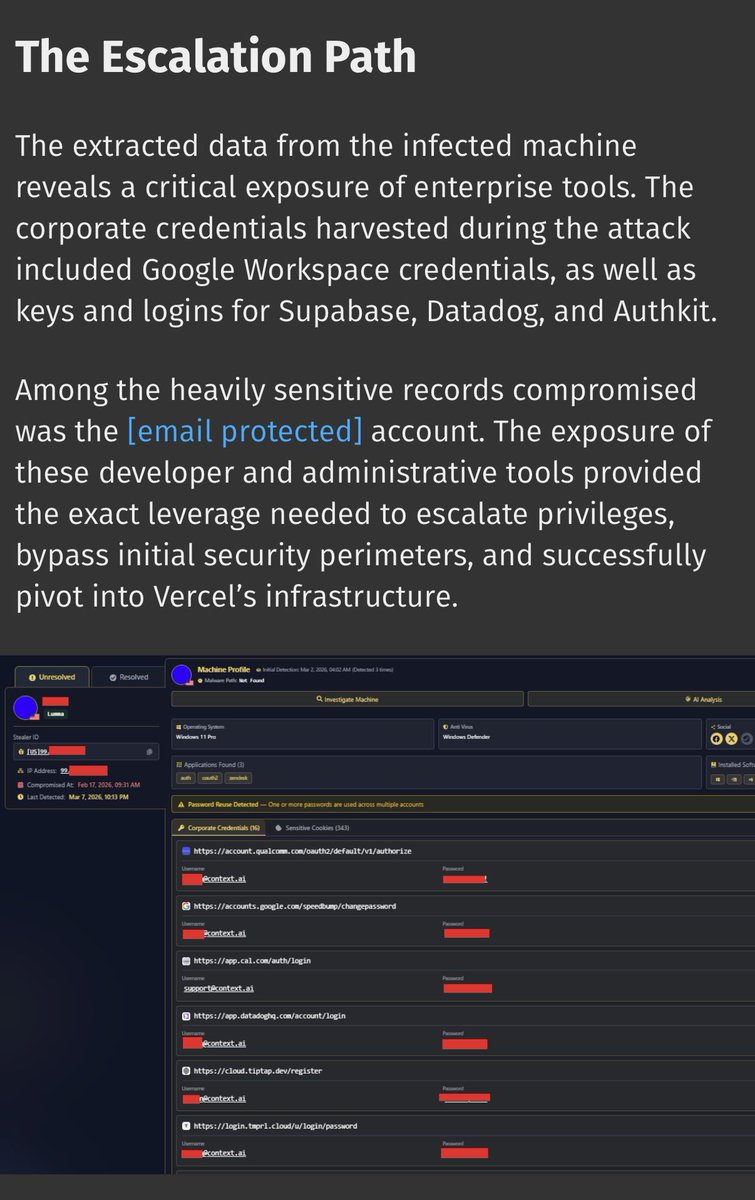
Florian Roth is one of the better DFIR and threat intelligence researchers around. His point is the correct one: the Roblox download is the detail that gets the headlines, but the actual failure was what that one infected machine could reach. Google Workspace. Supabase. Datadog. AuthKit. Vercel-related admin resources. All accessible through a chain that started with a gaming cheat.
19-20 April 2026: Disclosure and the BreachForums listing
Vercel disclosed the incident on 19-20 April. Vercel CEO Guillermo Rauch confirmed scope directly:

The stolen data, "non-sensitive environment variables" plus some AWS-adjacent credentials, appeared on BreachForums with a $2 million asking price. That phrase "non-sensitive environment variables" deserves some unpacking, and I'll get to it in a moment.
Theo's post is worth reading if you're a developer on Vercel. Sensitive env vars, those you've marked as such in the Vercel dashboard, were protected. Everything else: rotate immediately. The practical triage was simple. The reason it was necessary was not.
Each step in this chain is something a security team has been telling people not to do for ten years. Each step happened anyway. That's not unusual. That's modern supply chain reality.
Why "AI Tool Supply Chain" Is the Phrase to Remember
Your business uses Tool A. Tool A integrates with Tool B for AI features. Tool B integrates with Tool C for productivity. Tool C's employees have personal habits that nobody checks, and frankly, nobody could realistically check. The weakest personal habit at the deepest tool in the chain is now part of your security posture.
This isn't a new concept. But AI is making it worse in a specific and predictable way.
AI tools are typically given broad permissions to be useful. An AI writing assistant needs your Google Docs. An AI meeting tool needs your calendar and your inbox. An AI productivity platform needs your Slack, your Jira, your GitHub, your everything. The permissions are wide because the product only works if the permissions are wide.
AI tools are typically integrated through OAuth scopes that are wider than they need to be. Most AI tools ask for permissions like a teenager asking for the car: "I just need the keys, I'll be fine." And most businesses hand them over because the alternative is spending three hours figuring out which specific scopes the tool actually needs and explaining to a vendor why you're asking.
AI tools are also deployed faster than security review allows. The average security review cycle at an enterprise is weeks. The average time between an employee finding a new AI tool and having it connected to their work accounts is about forty-five minutes. I'm not guessing at that number. I'm describing what I've watched happen at clients.

"Your supply chain is only as secure as the worst habit of the least security-conscious employee at any vendor you've ever onboarded." Capxel got there before me. That's the thesis.
The data behind this isn't comforting. The 2026 SaaS+AI Governance report found that 91% of enterprise AI tools are unmanaged by security or IT teams. These are tools with OAuth integrations into core business systems, running on personal decisions made by individual employees, with no formal review. That's not a gap in the data. That's the actual state of play.
To be fair to the companies in that 91%: I'd be surprised if Webcoda scored much better on a cold audit. We've definitely got AI tools that someone on the team signed up for with their work email and connected to something they probably shouldn't have. I'm aware of at least three such tools right now and I've been meaning to get to them for six weeks. Turns out "meaning to get to security hygiene" and "actually doing security hygiene" are two very different calendar events.
AI Security: Defending Against Prompt Injection and Emerging Threats covers some of the adjacent risk surface here. The supply chain vector and the prompt injection vector are different entry points to the same underlying problem: AI tools have wide access and nobody's fully watching the perimeter.
What "Non-Sensitive Env Vars" Actually Means
The Vercel disclosure repeatedly used the phrase "non-sensitive environment variables." I want to say something about this.
When a BreachForums seller lists stolen environment variables, they're not selling the data. They're selling the keys.
A typical Vercel-deployed SaaS application puts a lot of things in environment variables. Stripe API keys. OpenAI and Anthropic API keys. AWS and GCP credentials. Sentry tokens. Datadog API keys. Slack webhook URLs. Notion integration tokens. Auth tokens for every third-party service the application touches.
"Non-sensitive" in this context means these weren't things like private encryption keys or password hashes. But a buyer of those env vars doesn't need your users' passwords. They need ongoing API access to your production systems. Those API keys run until you rotate them. Which means the breach doesn't end at the moment of exfiltration. It runs until every key in that stolen dump has been rotated out of every environment where it was valid.
That's a different category of problem from a data leak. It's access, not information. And access is the more expensive problem to close.
What Australian SMBs Actually Need to Do
I know this section is going to read like a security consultant made it up to sell hours. The grim part is that after this incident, it's the most genuinely applicable boring list I've ever written.
Inventory your AI tools properly. Not just the ones you pay for. The ones you got "for free" bundled with something else. The ones someone on your team installed and forgot to mention. If you've got a Google Workspace or Microsoft 365 admin panel, go and look at the third-party apps with OAuth access right now. Most businesses haven't done this since they set things up. The list will surprise you.
Rotate environment variables on critical applications every 90 days. Not because you've been breached. Because you might have been breached without knowing it, and rotation limits the window. This is pure hygiene. It's annoying and it's worth doing.
Use a secrets manager instead of environment files. Tools like Doppler, HashiCorp Vault, and AWS Secrets Manager exist specifically because putting secrets in env files and hoping for the best is not a security strategy. It's a security prayer.
Enforce MFA on every account that touches production systems. Every account. Not most accounts. Every account. This is 2026 and there are still teams with production access accounts that don't have MFA enabled. I've seen it. It's the kind of thing that's fine until it isn't.
Require corporate device policies for AI tools that touch business data. The Vercel breach started on a personal laptop. Personal devices used for work, connected to work systems, are a category of risk that device policies exist to manage. Most SMBs don't have a formal policy on this. Most should.
Demand SOC 2 Type II documentation from your AI tool vendors. Not "yes we're compliant." The actual report, dated in the last twelve months, from a named auditor. And a penetration test result while you're asking. If a vendor can't provide either, that's information.
For very small businesses, this list is a lot. Pick three: rotate your secrets, audit your third-party app permissions, and require MFA on every critical account. Do those three things and you're ahead of most of the field.
The Australian Privacy Act dimension
Under the Notifiable Data Breaches (NDB) scheme, Australian businesses have notification obligations when personal information is "likely" to have been accessed or disclosed without authorisation, and where a reasonable person would conclude that the breach is likely to result in serious harm.
Here's the part that catches people out: if your AI vendor is breached, and that breach exposes credentials that grant access to your customer data, you may have NDB obligations even though you didn't cause the breach. The question isn't "did we get breached?" It's "was personal information we're responsible for likely accessed without authorisation?" A stolen API key that grants access to your customer database is exactly that scenario.
The OAIC hasn't issued specific guidance on AI tool supply chain breaches yet. My reading is that the existing NDB framework covers this, but businesses aren't thinking about it this way. They should be.
If you're unsure whether a breach at one of your AI vendors triggers your own notification obligations, that's a real conversation with your privacy officer or legal team, not a quick admin decision.
Closing
The chain worked. It's documented. It's being sold as a playbook on the same forums where the Vercel data was listed. It will be used again, and the only real question is who gets to write the disclosure next.
I'm not going to tell my kid to stop playing Roblox. I like Roblox. It's genuinely impressive software and it's kept him occupied on Saturday mornings in a way that means I can drink my coffee while it's still hot, which is more than I can say for most things in my life.
What I am going to do is tell Webcoda to assume that any AI tool we use was installed at some point by someone who, on a quiet evening, made a small personal choice they didn't realise would matter. Not a stupid choice. Not a malicious choice. Just a human choice.
That assumption changes how we evaluate vendors. It changes what questions we ask about their employee device policies, their third-party app integrations, and whether they've ever actually read the permissions their own tools are requesting.
Most businesses haven't made that shift yet. They think of supply chain security as something that happens at the firewall or the login page. The Vercel incident is a good illustration of why that mental model doesn't hold anymore.
The Roblox detail is the part you'll remember from this article. The supply chain logic is the part that's going to matter when it's your turn to write the notification email.

Job done. Go rotate your secrets.
---
Key Takeaways
The attack chain:
- Context.ai employee downloaded Roblox cheat script containing Lumma Stealer (February 2026)
- Credentials harvested from infected personal laptop
- Attackers pivoted through Context.ai's Google Workspace integration to reach Vercel's internal systems
- Customer environment variables extracted and listed on BreachForums for $2M
The structural lesson:
- Your security posture is the sum of your vendors' security postures, including vendors you've never heard of
- AI tools with broad OAuth permissions are the highest-risk link in most modern supply chains
- "Non-sensitive" env vars aren't harmless: they contain API keys that represent ongoing access, not just historical data
Australian Privacy Act note:
- A vendor breach that exposes credentials granting access to your customer data may trigger your own Notifiable Data Breach obligations, even if you weren't the direct target
Immediate actions:
- Audit third-party app permissions in Google Workspace / Microsoft 365
- Rotate environment variables on critical applications (90-day cycle)
- Enable MFA on every account with production access
- Require SOC 2 Type II documentation from AI tool vendors
---
Sources
- TechCrunch. "App host Vercel confirms security incident, says customer data was stolen via breach at Context.ai." 20 April 2026. https://techcrunch.com/2026/04/20/app-host-verc...
- The Register. "Vercel customer data stolen via Context.ai supply chain attack." 20 April 2026. https://www.theregister.com/2026/04/20/vercel_c...
- Vercel. "Vercel April 2026 Security Incident: Knowledge Base Bulletin." April 2026. https://vercel.com/kb/bulletin/vercel-april-202...
- Guillermo Rauch (@rauchg). Vercel CEO disclosure thread. X (Twitter). 23 April 2026. https://x.com/rauchg/status/2047150411170320808
- Florian Roth (@cyb3rops). DFIR analysis: what one infected machine could reach. X (Twitter). 20 April 2026. https://x.com/cyb3rops/status/2046134007872487896
- International Cyber Digest (@IntCyberDigest). Technical breakdown of the attack chain. X (Twitter). 20 April 2026. https://x.com/IntCyberDigest/status/20463558309...
- Theo (@theo). Developer triage post on Vercel breach. X (Twitter). 19 April 2026. https://x.com/theo/status/2045883344324640817
- Capxel Security (@capxel_security). Supply chain risk commentary. X (Twitter). 20 May 2026. https://x.com/capxel_security/status/2057159765...
- Wilson Nwafor (@wilsonnwafor_). AI tools as supply chain attack vector. X (Twitter). 22 May 2026. https://x.com/wilsonnwafor_/status/205783545956...
- Bleeping Computer. Lumma Stealer malware analysis and distribution methods. 2026. https://www.bleepingcomputer.com
- Google Security Blog. "AI threats in the wild: current state of play." April 2026. https://security.googleblog.com/2026/04/ai-thre...
- Office of the Australian Information Commissioner. Notifiable Data Breaches scheme guidance. https://www.oaic.gov.au/privacy/notifiable-data...
- Shirish (@shiri_shh). First public disclosure post. X (Twitter). 19 April 2026. https://x.com/shiri_shh/status/2045883344324640817