

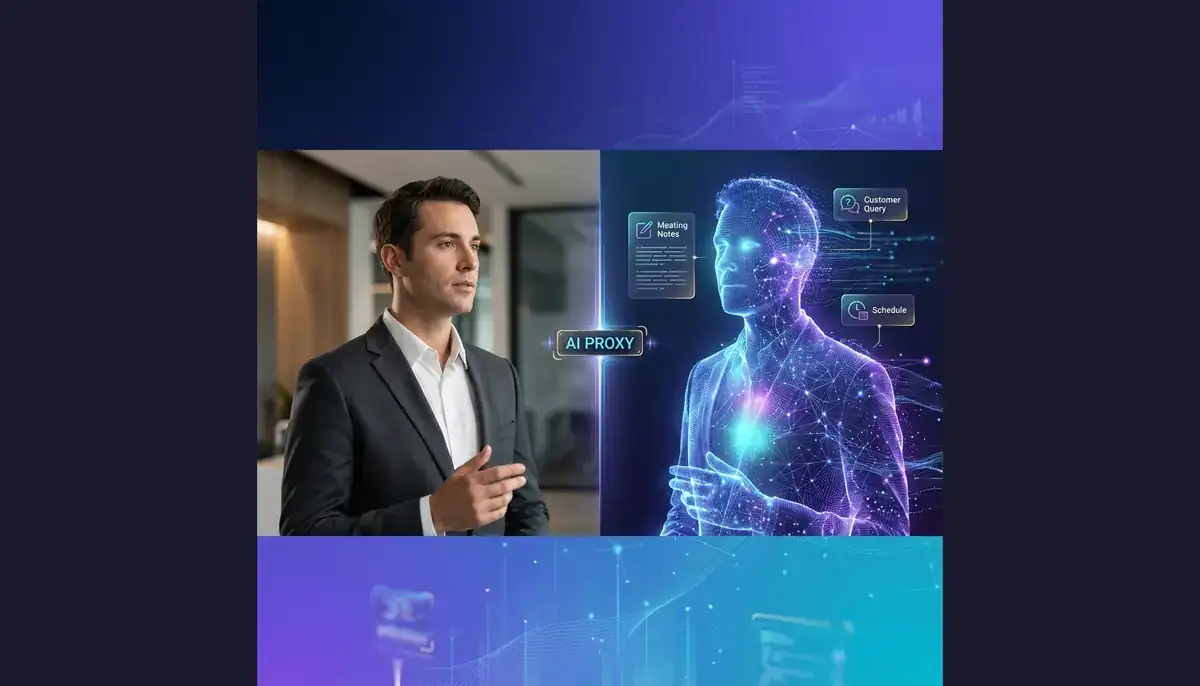
Imagine you're in two places at once. Your physical self is closing a deal in Melbourne, while your digital twin sits through a strategy meeting in Sydney. It takes notes, asks clarifying questions, and makes decisions based on how you'd respond. When you check in later, it's already briefed you on action items and flagged the decisions that need your final approval.
This isn't science fiction for 2035. It's happening right now in Australian workplaces, and the timeline's tighter than you think. Around 65% of Australian candidates already use AI for tasks like resume writing, and 92% of hiring managers rely on AI at some stage of recruitment.[^1] We're not asking if digital twins will transform how we work. We're asking how fast you'll adapt.
The opportunity here is massive. Digital twin technology is projected to explode from $10.3 billion in 2021 to $54.6 billion by 2027, representing a compound annual growth rate of 31.7%.[^2] Australian businesses that understand how to deploy AI proxies strategically will gain serious competitive advantages in productivity, customer service, and talent acquisition.
Picture this: you train an AI system on your communication style, your decision-making patterns, your expertise. Then you let it handle the routine stuff while you focus on work that actually needs you. Customer service teams are already seeing productivity gains of 14% using AI systems.[^3] But here's where it gets interesting. These aren't just chatbots following scripts anymore. They're learning how *you* specifically would respond.
Companies like Viven.ai have launched platforms where users can query colleagues' digital twins to ask questions like "what are your big action items for tomorrow" or get status updates on business relationships.[^4] Think about that for a second. You're not interrupting your senior developer for a quick update. You're asking their digital twin, trained on their actual work patterns and communication style.
The practical applications are already rolling out. If you're in customer service, technical support, or training, you've now got access to your deepest experts without bothering them for every call.[^4] Your top performer's digital twin can handle tier-one queries while they tackle complex problems that actually need human judgment.
But let's talk about what this really means for Australian businesses over the next 18 months.
The Recruitment Revolution (It's Already Here)
LinkedIn just launched Hiring Assistant in Australia, their first AI-powered recruiting agent that automates sourcing, screening, and outreach.[^5] This isn't some future beta test. It's live now, and it's changing how Australian companies compete for talent.
Here's what the numbers tell us: skills-first hiring approaches powered by AI can expand candidate pools by 7.7 times in Australia.[^5] More than 56% of Australian HR professionals say AI will push employers to focus more on skills than traditional credentials like degrees.[^5]
The efficiency gains are real. Agencies using AI for sourcing and screening typically reduce time-to-fill by four days, delivering an 8-10% improvement.[^1] Each placement then has a 1.5-3× salary ROI boost.[^1] And we're seeing 97% of HR teams already using AI somewhere in recruitment.[^1]
But here's where digital twins get interesting. Instead of just screening resumes, you could have your digital twin conduct initial interviews, asking the questions you'd ask and flagging candidates who match your hiring criteria. The AI understands your assessment style because it's trained on your past decisions.
There's a catch, though. Australian employment law hasn't caught up yet. The Parliamentary inquiry that wrapped up in February 2025 heard evidence of rising worker surveillance, excessive data collection, and unfair automated decision tools.[^6] They've called for AI in the workplace to be classified as "high risk" and subject to strict mandatory regulation.[^6]
The report makes 21 recommendations, including treating AI as high risk when used in employment areas like recruitment, hiring, remuneration, promotion, training, and termination.[^6] So if you're planning to deploy digital twins in your hiring process, you'll want legal counsel who understands what's coming down the pipeline.
Customer Service Gets Personal (And Fast)
The AI customer service market hit $13.01 billion in 2024 and will grow to $83.85 billion by 2033.[^7] Companies are seeing an average ROI of $3.50 return for every dollar invested in AI customer service, with leading organisations achieving up to 8× ROI.[^7]
But those are just chatbots, right? Sort of. The new generation goes deeper. Through innovations in natural language processing, digital twins with AI capabilities let customers converse with a personal avatar as they would with a real person.[^8] The AI collects information to support customer engagement, conversion, retention, and product development through natural "interpersonal" communication.[^8]
Here's the ROI that'll get your CFO's attention: implementing AI in customer service can reduce labour costs by up to 90% by automating routine tasks like answering FAQs and order tracking.[^7] By 2026, conversational AI is projected to reduce contact centre labour costs by $80 billion.[^7]
First response time for tickets has dropped from over six hours to less than four minutes with AI-powered support.[^7] AI has helped slash resolution times from nearly 32 hours to just 32 minutes in some cases.[^7]
But it's not just about speed. When your digital twin handles customer queries, it responds with your company's specific expertise, your brand voice, your understanding of customer pain points. Researchers from Stanford created AI versions of more than 1,000 people who can think and make decisions like their human counterparts, matching their originals' personalities, moral choices, and decision-making patterns with 85% accuracy.[^9]
That's the threshold that matters. When your digital twin crosses 85% accuracy in representing how you'd actually respond, it stops being a novelty and starts being a genuine business tool.
The Legal Minefield (Navigate Carefully)
Right, so you're excited about deploying digital twins. You should be. But you also need to understand the risks, because Australian regulators are watching this space closely.
The NSW Government introduced the Workers Compensation Legislation Amendment Bill in August 2025, which includes the first-of-its-kind duty in Australian work health and safety legislation.[^10] It requires businesses to ensure that digital work systems (including algorithms, artificial intelligence, and automation) don't create health and safety risks to workers.[^10]
And here's the thing: most employees are covered by modern awards or enterprise agreements that mandate consultation when major changes like introducing new technology are likely to have significant effects on employees.[^11] These obligations are broad enough to encompass AI and digital twins.
The privacy implications are enormous. AI models require massive datasets for training, and the data collection stage introduces the highest risk to data privacy, especially when sensitive data like healthcare information, personal finance data, and biometrics is included.[^12] Training AI for virtual assistants requires access to very sensitive data: location history, contacts, calendars, transcribed records of voice queries, online browsing and purchase histories.[^13]
So if you're building a digital twin that represents you in meetings or customer interactions, you're potentially collecting and processing data that falls under the Australian Privacy Principles in the Privacy Act 1988.[^11] You need to ensure compliance, and you need to get it right, because once personal data enters the AI lifecycle, individuals may not be able to effectively exercise their rights to correct or delete that data.[^12]
There's also the liability question. When misuse or errors occur, organisations may face legal and reputational consequences for deploying systems without oversight or proper authentication.[^14] Legal liability in AI-assisted scenarios hinges on who controlled or orchestrated the AI, what representations were made, and whether contractual systems included reasonable verification.[^14] Companies can't disclaim liability simply because an algorithm produced the error.[^14]
What's Coming in the Next 24 Months
By 2025, 50% of knowledge workers are expected to use virtual assistants, enhancing efficiency in decentralised work environments.[^15] We're already seeing daily AI usage increase by 233% in six months.[^15]
The digital twin market is projected to hit $24.48 billion in 2025 and explode to $259.32 billion by 2032, exhibiting a CAGR of 40.1%.[^2] North America currently dominates with 38.35% market share, but Asia-Pacific is the fastest growing region.[^2]
And here's what that means for Australian businesses: you've got about 18 months to figure out your digital twin strategy before your competitors do. The technology's mature enough now that early adopters will gain significant advantages in productivity, customer service, and talent acquisition.
But you can't just slap an AI onto your business processes and call it a digital twin. The successful implementations we're seeing share a few characteristics:
First, they start small. You don't deploy digital twins across your entire organisation on day one. You pick one high-value use case (customer service tier-one queries, initial candidate screening, meeting note-taking) and you test rigorously.
Second, they maintain human oversight. Even when digital twins match human decision-making with 85% accuracy, that still leaves 15% where human judgment matters. You need clear escalation paths for when the AI isn't sure.
Third, they're transparent with stakeholders. Your employees need to know when they're interacting with a digital twin versus a human. Your customers deserve that transparency too. And your legal team needs to sign off on your approach before you go live.
Key Takeaways
For Business Leaders:
- Digital twin technology will grow from $10.3 billion (2021) to $54.6 billion by 2027
- Companies are seeing $3.50 return for every $1 invested in AI customer service
- 97% of HR teams already use AI in recruitment, with 7.7× expansion in candidate pools
For HR and Recruitment:
- Skills-first AI hiring can expand your talent pool 7.7 times in Australia
- Time-to-fill reductions of 8-10% are typical with AI sourcing and screening
- Australian employment law reforms are coming: AI in recruitment will likely be classified "high risk"
For Customer Service:
- AI can reduce labour costs by up to 90% for routine tasks
- First response times dropping from 6+ hours to under 4 minutes
- Resolution times improving from 32 hours to 32 minutes with AI support
For Risk and Compliance:
- NSW's 2025 WHS reforms require ensuring AI systems don't create workplace health risks
- Privacy Act compliance is mandatory when processing employee/customer data for digital twins
- Legal liability can't be disclaimed just because "the AI did it"
Implementation Timeline:
- Now to Q2 2025: Pilot programs with single use cases (customer service, recruitment screening)
- Q3 2025 to Q1 2026: Scale successful pilots, establish governance frameworks
- 2026-2027: Competitive disadvantage if you haven't deployed strategic AI proxy capabilities
The question isn't whether digital twins will transform Australian workplaces. They already are. The question is whether you'll lead that transformation or scramble to catch up in 2027.
---
Sources
[^1]: The Recruitment Revolution: How AI is Transforming Hiring in Australia
[^2]: Digital Twin Market Size, Share & Growth Report [2025-2032]
[^3]: 27 AI Productivity Statistics You Want to Know (2025)
[^4]: Arriving Now..... The Digital Twin
[^5]: 'Skills are now the currency of hiring': LinkedIn launches AI-powered recruiting agent
[^6]: Committee calls for sweeping changes to workplace AI rules
[^7]: 30+ Customer Service Automation Statistics [2025]: Adoption, ROI, and Future Trends
[^8]: Are Personal AI Digital Twins the Future of Digital Marketing?
[^9]: Meet your AI twin: It acts just like you
[^11]: Legal Implications of AI in Australian Workplaces
[^12]: Privacy of Personal Data in the Generative AI Data Lifecycle
[^13]: Private Smarts: Can Digital Assistants Work without Prying into Our Lives?
[^14]: What Hidden Risks Do AI Agents Pose?
[^15]: 25 Surprising Statistics on AI in the Workplace (2025)
---