

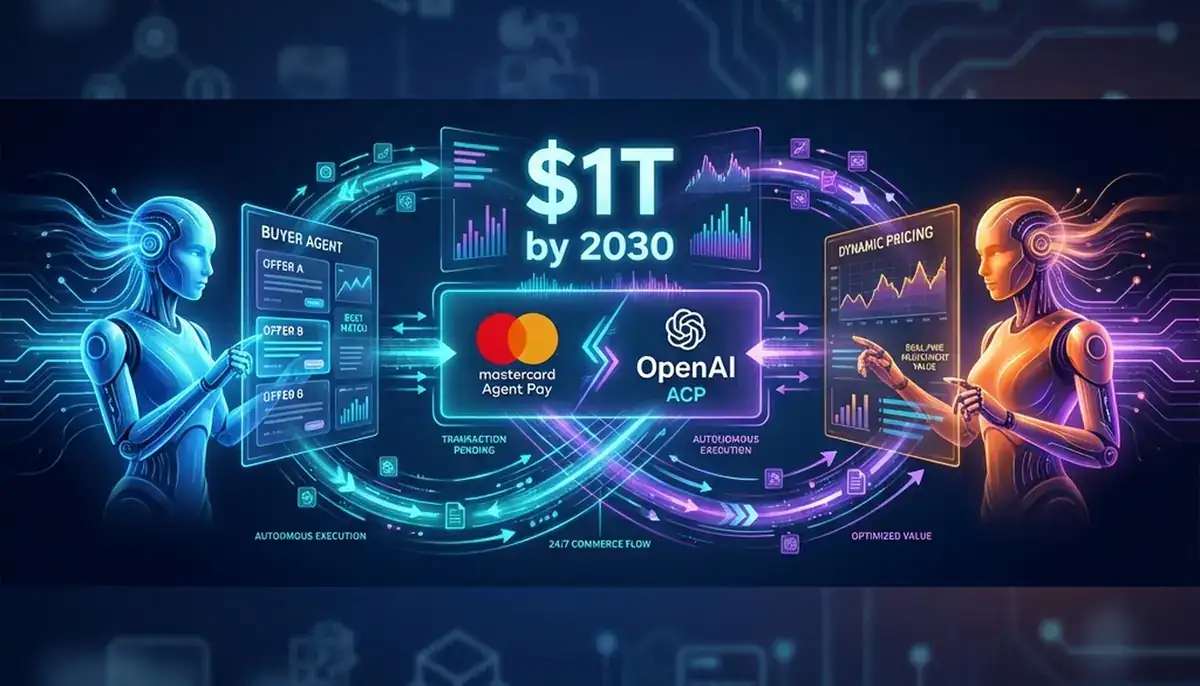
Picture this: Your company's AI purchasing agent just negotiated a better deal with your supplier's AI sales agent while you were sleeping. The price dropped 8%, delivery was expedited, and payment processed automatically. You wake up to a confirmation email, wondering if you should feel relieved or terrified.
Welcome to agent-to-agent (A2A) commerce, where AI systems buy from other AI systems without waiting for human approval. It's not science fiction anymore. By September 2025, ChatGPT enabled instant checkout for over a million Shopify merchants, and Mastercard rolled out Agent Pay to all U.S. cardholders. For Australian businesses, this shift isn't coming next decade. It's happening right now, and the companies that understand it first will dominate their markets.
The opportunity is massive. McKinsey forecasts that agentic commerce could orchestrate $1 trillion in U.S. B2C revenue by 2030, with global projections reaching $3 trillion to $5 trillion. But here's the catch: Australian businesses face unique challenges around consumer protection laws, fraud prevention, and competitive dynamics that most international forecasts overlook.
What Actually Is A2A Commerce?
Traditional e-commerce puts humans in control. You browse, compare prices, add to cart, and click buy. Agent-to-agent commerce flips this completely. AI agents act autonomously on behalf of both buyers and sellers, communicating, negotiating, and transacting without human involvement in every step.
Think of it like hiring a procurement manager who never sleeps, never gets tired, and can evaluate thousands of suppliers simultaneously. Except this "manager" is software that learns from every transaction, adapts to market conditions in real-time, and executes purchases based on predefined rules you've set.
The technical foundation relies on three emerging protocols. Google's Agent Payments Protocol (AP2) standardises how AI agents initiate and complete payments across different platforms. OpenAI's Agentic Commerce Protocol (ACP), built with Stripe, creates a common language for agent-driven purchasing inside conversational interfaces. And the Model Context Protocol (MCP) allows agents to share context, intent, and memory across different systems, so your purchasing agent remembers your preferences even when switching platforms.
Here's where it gets interesting for Australian businesses. These protocols aren't controlled by a single company. They're open standards, which means your business can implement them without vendor lock-in. But it also means your competitors can deploy AI agents just as easily.
How AI Agents Actually Negotiate and Buy
Let's get practical. When your AI purchasing agent needs office supplies, it doesn't just visit one supplier's website. It simultaneously queries dozens of suppliers' AI agents, requests quotes, evaluates terms, and negotiates discounts based on your company's purchasing history and budget constraints.
The supplier's AI agent responds with dynamic pricing, adjusted in real-time based on inventory levels, competitor pricing, and the buyer agent's negotiation parameters. AI-powered dynamic pricing systems now make 2.5 million pricing decisions daily at companies like Amazon, resulting in estimated profit increases of 25%.
But here's what most articles won't tell you: this creates an arms race. Machine-to-machine commerce requires pricing algorithms that are incredibly fast and resistant to adversarial attacks. If your supplier's AI learns that your AI always accepts offers below $X, you've just given away your negotiation advantage permanently.
The buyer agent then evaluates multiple offers based on criteria you've established (price, delivery time, supplier reliability, sustainability metrics). It can request counteroffers, bundle purchases for volume discounts, and even coordinate with other departments' agents to consolidate orders. All of this happens in seconds, not days.
Payment happens through tokenised credentials managed by systems like Mastercard's Agent Pay or Visa's Intelligent Commerce. You set spending limits, approved vendor lists, and approval thresholds. Small purchases go through automatically. Larger ones trigger human review.
The Australian Business Case: Who Benefits First?
Not every Australian business needs AI purchasing agents tomorrow. But some sectors can't afford to wait.
B2B procurement is the obvious winner. Senior procurement leaders across Australia are already turning to AI to strengthen sourcing strategies amid supply chain challenges. Companies like ABC, Macquarie University, and Ampol are piloting agentic AI for procurement. The benefits are clear: 60% faster purchasing cycles, 15-20% cost savings through better negotiation, and 24/7 operation without additional staff.
But here's where smaller businesses have an advantage. Large enterprises move slowly. They've got legacy procurement systems, complex approval chains, and risk-averse compliance teams. A mid-sized Australian manufacturer can deploy AI purchasing agents in weeks, not years. You're negotiating with the same supplier AIs as the big players, but you're faster and more adaptable.
Professional services firms should pay attention too. Accounting firms, legal practices, and consultancies spend shocking amounts of time on administrative procurement. An AI agent handling software subscriptions, office supplies, and service renewals frees up billable hours. Thoughtworks Australia notes that agentic commerce drives smarter growth by reducing friction in every interaction.
Retail and e-commerce businesses face a different equation. You're not just deploying buying agents, you need selling agents too. Salesforce reports that 43% of retailers are already piloting autonomous AI, with 53% evaluating its use. The retailers who figure out how to serve both human shoppers and AI shopping agents will capture disproportionate market share.
The Dark Side: Fraud, Manipulation, and Consumer Protection
Now for the uncomfortable truth: AI agents can be manipulated, deceived, and exploited. And the consequences are worse than traditional fraud because they scale infinitely.
Visa detected a 25% increase in malicious bot-initiated transactions over six months, with the U.S. experiencing a 40% spike. Australia's relatively small market size won't protect us. In fact, it makes us more vulnerable, because international fraud operations can test attacks here before scaling to larger markets.
The attack vectors are sophisticated. Fraudsters create fake AI agents that impersonate legitimate suppliers, offering prices just low enough to trigger automatic purchases from buyer agents. By the time the fraud is detected, money's been transferred and goods never arrive. Deloitte predicts that GenAI-driven fraud losses could exceed $40 billion by 2027 in the U.S. alone.
But there's a subtler threat: market manipulation. What happens when competing suppliers' AI agents learn to tacitly coordinate pricing without explicit collusion? Traditional competition law wasn't written for machines that can signal intent through algorithmic behaviour. The ACCC has no clear framework for prosecuting AI agents that collectively raise prices through learned behaviour rather than direct conspiracy.
Australian Consumer Law adds another layer of complexity. The ACL review found that while existing laws are technologically neutral, AI's reliance on opaque algorithms makes it nearly impossible for consumers to understand or challenge decisions that affect them. If your purchasing agent makes a bad deal, who's liable? You, the agent's developer, or the supplier whose agent misrepresented terms?
The proposed reforms suggest shifting the burden of proof onto manufacturers when AI causes harm. This makes sense for consumer protection but creates enormous uncertainty for businesses deploying AI agents. You could be liable for autonomous decisions you didn't directly make or even know about until after the fact.
Building Your A2A Strategy: Five Critical Steps
So how do Australian businesses actually implement agent-to-agent commerce without getting burned? Here's what works:
Start with controlled experiments. Don't hand your AI agent a corporate credit card and hope for the best. Begin with low-risk, high-volume purchases (office supplies, consumables, recurring services). Set tight spending limits and require human approval for anything outside narrow parameters. IBM's guide to AI agents in procurement recommends starting with supplier sourcing and risk assessment before moving to autonomous purchasing.
Demand transparency from your agents. If you can't understand why your AI made a purchasing decision, you can't trust it. Look for systems that provide decision logs, explanation interfaces, and the ability to audit every transaction. This isn't just good practice, it's likely to become a legal requirement under upcoming ACL reforms.
Build in kill switches and override mechanisms. Your agent should never have more authority than your newest procurement officer. Establish clear escalation paths, set maximum transaction values, and maintain approved vendor lists. Trace Consultants Australia emphasises that ANZ leaders need governance frameworks before deploying autonomous agents in supply chains.
Prepare for adversarial agents. Your purchasing agent will negotiate against supplier agents optimised to maximise profit. Some will test boundaries, probe for weaknesses, and exploit information asymmetries. Make sure your agent's negotiation parameters include floor prices, quality thresholds, and delivery requirements that can't be compromised even for apparent cost savings.
Stay ahead of regulatory changes. The Australian Treasury's final report on AI and Consumer Law is reshaping liability frameworks. Businesses that wait for perfect regulatory clarity will find themselves years behind competitors who are learning by doing (within reasonable risk parameters).
What Happens Next: The 2026-2027 Timeline
The adoption curve is steeper than most predictions. Salesforce's Connected Shoppers Report found that 66% of shoppers want AI agents that can secure high-demand items before they sell out, and 65% want agents that buy products when they hit target prices. Consumer demand is already here.
On the B2B side, 90% of Chief Procurement Officers are considering AI agents, with 82% identifying specific use cases. But deployment remains limited, mostly stuck in simple, rule-based tasks. The companies that master complex, autonomous agent negotiation in 2026 will establish competitive advantages that persist for years.
Payment infrastructure is accelerating adoption. Mastercard's rollout to all U.S. cardholders by late 2025, followed by global expansion, eliminates a major technical barrier. Australian businesses can now deploy purchasing agents knowing the payment rails are mature and secure.
The wild card is regulation. If the ACCC moves quickly to establish clear liability frameworks and competition guidelines, Australia could become a testing ground for global A2A commerce standards. If regulators move slowly, we'll import frameworks developed for U.S. and European markets that don't account for our consumer protection priorities.
Key Takeaways
For Business Leaders:
- A2A commerce isn't replacing e-commerce, it's adding a parallel channel where AI agents operate alongside human buyers
- McKinsey projects $3-5 trillion in global agentic commerce by 2030, with Australian businesses facing both opportunity and disruption
- First-mover advantages exist for mid-sized businesses that can deploy agents faster than enterprise competitors
For Procurement Teams:
- AI purchasing agents can reduce costs 15-20% through better negotiation and 24/7 operation
- Start with low-risk, high-volume purchases before expanding to strategic procurement
- Build governance frameworks now because regulatory liability is shifting toward businesses deploying AI
For Retail and E-Commerce:
- 43% of retailers are piloting autonomous AI, with ChatGPT already enabling instant checkout for millions of merchants
- Your business needs both buying agents (procurement) and selling agents (serving AI shoppers)
- Dynamic pricing algorithms must be fast and resistant to adversarial manipulation
For Technology and Security:
- Three key protocols enable A2A commerce: AP2 (payments), ACP (commerce), and MCP (context sharing)
- Fraud risks are escalating, with Visa detecting 25% increase in malicious bot transactions and 450% spike in dark web AI agent discussions
- Implement strong authentication, spending limits, and human oversight for high-value transactions
For Legal and Compliance:
- Australian Consumer Law is adapting to shift burden of proof onto businesses when AI causes harm
- Liability frameworks remain unclear for autonomous agent decisions
- Competition law has no clear approach to AI agents that coordinate pricing through learned behaviour
---
Sources
- McKinsey - The Agentic Commerce Opportunity
- OpenAI - Buy it in ChatGPT: Instant Checkout
- Mastercard - Agent Pay Launch
- BigCommerce - How AI Agents Are Powering A2A Commerce
- Google Cloud - Agent Payments Protocol (AP2)
- OpenAI - Agentic Commerce Protocol
- Nomtek - Dynamic Pricing E-Commerce
- Vendavo - AI-Enabled Dynamic Pricing
- Mastercard - Agentic Commerce Framework
- Visa - Agentic AI Fraud Impact
- eCommerce News Australia - AI Reshapes Procurement
- Thoughtworks Australia - Agentic Commerce
- HUMAN Security - Agentic Commerce Security
- Australian Treasury - Review of AI and Australian Consumer Law
- Anisimoff - Proposed ACL Reforms
- IBM - AI Agents in Procurement
- Trace Consultants - Transforming Supply Chains with AI Agents
- Australian Treasury - Final Report on AI and ACL
- PYMNTS - Visa, Mastercard, PayPal Fuel Agentic AI Commerce
- Ivalua - AI Agents in Procurement Guide
---