

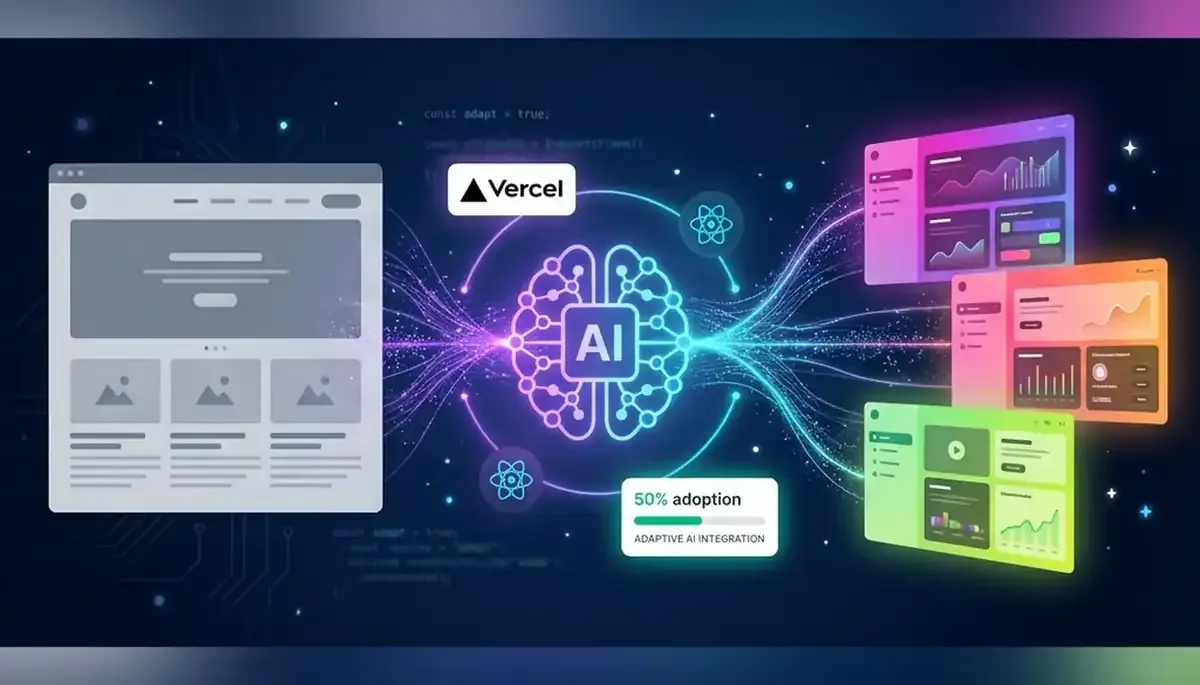
Picture this: you visit a company's website, and the interface instantly adapts to your role, your goals, and your preferred way of navigating. Not just different colours or font sizes, but an entirely different layout, different navigation patterns, different content priorities. Your colleague visits the same site five minutes later and sees something completely different because the AI recognised they're looking for different outcomes.
This isn't a glimpse into some distant future. It's happening right now, and it's called Generative UI. While Australian businesses have spent the last decade perfecting responsive design (making sites work across different screen sizes), the next frontier is here: interfaces that don't just respond to device size, they generate themselves based on who you are and what you'll need.
And here's the thing, this shift is moving faster than most business leaders realise. 50% of Australian businesses are now using AI, and those who'll understand Generative UI's potential will have a massive advantage over competitors still thinking in terms of static page templates.
What Actually Is Generative UI?
Let's cut through the jargon. Generative UI is a system where artificial intelligence dynamically creates user interfaces in real-time, customised to each visitor's context, behaviour, and needs (NN/Group, 2025). It's not just showing or hiding elements. It's actually generating new layouts, components, and interaction patterns on the fly.
Think about the evolution of web design. We started with static layouts that looked the same for everyone. Then we got responsive design, which adjusted layouts based on screen size. That was a huge leap forward. But Generative UI? It's a completely different paradigm. As Foolproof's research explains, UI design has evolved from static, fixed layouts to AI-driven, adaptive experiences that can predict user needs and evolve without manual intervention.
But traditional responsive design asks: "What device are you using?" Generative UI asks: "Who are you, what do you'll need, and how can I help you get there fastest?"
The technology that's powering this isn't theoretical anymore. Vercel's v0 platform can now generate React components with proper server architecture, complete with loading states and error boundaries, all from natural language prompts. Google's Gemini 3 builds bespoke interfaces instantly by interpreting user intent. These aren't proof-of-concepts. They're production-ready tools businesses are deploying today.
Why Australian Businesses Should Care Right Now
Here's where it gets interesting for Australian companies. We're not talking about marginal improvements. We're talking about fundamental changes to how customers interact with digital properties. And that's what'll separate market leaders from followers over the next three years.
The numbers tell a compelling story. McKinsey's 2025 survey shows that 71% of organisations now regularly use generative AI in at least one business function, up from just 33% in 2023. But here's the gap: most Australian businesses are still thinking about AI for content generation or customer service. Only 22% of large Australian enterprises have a comprehensive AI strategy, and even fewer are thinking about Generative UI.
That's the opportunity. Early adopters can create experiences that feel almost magical compared to traditional websites.
Now consider the business applications that are already working:
E-commerce Personalisation at Scale
We're not talking about "customers who bought this also bought that" recommendations. Generative UI'll completely restructure product pages, navigation, and checkout flows based on each customer's behaviour. Zalando uses generative AI to create fashion recommendations and style tips tailored to individual taste, but imagine taking that further so the entire interface adapts. High-intent buyers see streamlined, conversion-focused layouts. Browsers see inspirational, content-rich experiences.
B2B Interface Adaptation
Different stakeholders need different information. Generative UI'll show CFOs financial dashboards and ROI metrics, while technical leads see integration specs and API documentation, all from the same base platform. Gartner predicts that by 2026, 30% of new applications will employ AI to create personalised adaptive interfaces, up from less than 5% today.
Accessibility That Actually Works
This is where Generative UI gets really powerful. Instead of retrofitting accessibility features, AI'll generate interfaces that meet WCAG 2.1 AA standards automatically for users who need them, with proper keyboard navigation, screen reader support, and semantic markup built in from the start.
The Technical Reality (And Why It's Not As Hard As You Think)
Let's talk about what it actually takes to implement Generative UI. You don't need a team of AI researchers or a seven-figure budget.
Vercel's AI SDK 3.0 provides the streamUI function that lets developers call a model and have it respond with React Server Components. It's built on top of Next.js and integrates with existing React applications. The technical documentation shows developers can start implementing Generative UI with familiar tools they're already using.
Here's the simplified workflow:
- User interacts with your application
- The system sends context (user role, behaviour history, current goal) to an AI model
- The model generates appropriate UI components in real-time
- Components stream to the user progressively (they don't wait for everything to load)
- The system learns from interactions to improve future generations
The components aren't built from scratch every time. You'll create a library of reusable elements with your brand guidelines baked in. The AI then orchestrates these components into optimised layouts. As ICG's research shows, this approach maintains brand consistency while allowing for personalisation.
And cost-wise, it's not negligible but it's not prohibitive either. IBM's analysis notes that computing costs for generative AI are expected to climb 89% between 2023 and 2025. But context matters. OpenAI's GPT-4o runs at $10 per million output tokens, which is 83% cheaper than GPT-4's launch pricing. For most business applications, we're talking about dollars per day, not thousands. That's manageable for any serious digital operation.
The Challenges Nobody's Talking About
Let's be honest about the problems, because there are real ones to solve.
The Consistency Paradox
Users rely on familiar patterns. Logos go in the top left. Navigation bars work a certain way. When you constantly change the UI, you'll risk creating confusion. NN/Group's research warns that constantly changing interfaces will cause usability problems because much of users' understanding of modern web interfaces is rooted in design standards.
The solution isn't to avoid Generative UI. It's to be strategic about what you'll generate and what you keep consistent. Core navigation, branding elements, and critical user paths should remain stable. Secondary interfaces, content presentation, and feature discovery? That's where generative makes sense.
Brand Identity Risks
The challenge with AI-generated interfaces is maintaining brand consistency when the AI's trained on public data. You can end up with designs that look generic or similar to competitors.
The fix? Creating a detailed style system that constrains the AI. This means comprehensive design tokens, component libraries, and brand-specific training data. Superside's case study with D2L Brightspace demonstrates this works. They generated 110+ uniquely tailored ad variations that maintained 100% brand consistency while cutting production time by 70%.
Accessibility Gaps
Here's an uncomfortable truth: many AI-generated websites fail basic accessibility standards. A 2025 study evaluating AI-based platforms found that generated sites often have improper heading hierarchies, missing alt text, poor contrast ratios, and unlabeled interactive elements.
This isn't an inherent Generative UI problem. It's an implementation problem. WCAG 2.2 provides clear criteria for accessible AI development. Developers'll need to use proper semantic HTML, implement ARIA attributes correctly, and test with actual assistive technologies. It's doable, but it'll require discipline.
The Skills Gap
This is the big one for Australian businesses. The Reserve Bank of Australia's 2025 survey found that many firms struggle to hire the skills needed to drive AI transformation, particularly data engineers and data scientists. Only 61% of large Australian enterprises report using AI, and the business culture remains cautious.
What's Actually Coming Next
So where does this go? We're at the very beginning of a massive shift. And it's going to reshape how we think about digital experiences completely.
Right now, Generative UI's being used for specific applications: chatbot interfaces, dashboards, personalised e-commerce experiences. But the future, according to industry analysis, is moving from designing for the average user to designing for the individual.
The Timeline
Current implementations are in their infancy stage, but we've seen enough examples from Vercel, Galileo, and Coframe to know production-ready solutions are here. The challenge? Scale. That'll mean generating unique interfaces for billions of users simultaneously requires immense processing power.
The bet many companies are making is that this processing will happen locally on users' devices rather than in the cloud. That's why you're seeing such massive investment in AI-capable hardware. AWS is investing $20 billion in Australian data centre infrastructure from 2025-2029, specifically to support AI workloads.
From Responsive to Generative
The shift from responsive design to generative design mirrors the shift from desktop to mobile a decade ago. Companies that adapted early gained significant advantages. Companies that waited? They lost market share to more agile competitors.
NN/Group predicts that generative UI will force an outcome-oriented design approach where designers prioritise user goals and define constraints for AI to operate within, rather than designing discrete interface elements. That's a fundamental change in how design teams work. And it's coming whether we're ready or not.
The Economic Pressure
Here's what'll drive adoption faster than anything else: companies report 3.7x ROI for every dollar invested in generative AI. Financial services companies see 4.2x returns. When the business case is that clear, adoption accelerates. And competitors who don't move will find themselves explaining to stakeholders why they're missing out on those returns.
What Australian Businesses Should Do Now
You don't need to implement Generative UI across your entire digital presence tomorrow. But you'll want to start preparing now. Here's how.
Start with Low-Risk, High-Value Applications
Internal dashboards and tools are perfect testing grounds. Generate personalised analytics views for different team members. Create adaptive admin interfaces that adjust to user roles. These environments'll let you'll learn without customer-facing risk. And they'll demonstrate ROI quickly to internal stakeholders.
Build Your Foundation
Create a comprehensive component library with your brand standards embedded. Document your design system in a way that AI can understand. This preparation'll make Generative UI implementation dramatically easier when you're ready. And you'll get value from that component library immediately, even before implementing generative features.
Address the Skills Gap
68% of Australian companies have integrated AI technologies, but implementation quality varies wildly. You'll want to invest in training for your existing team. You'll want to partner with agencies that understand both AI and design. Don't try to build expertise from scratch. That's the expensive path, and it'll slow you down significantly.
Think About Accessibility First
WCAG compliance isn't optional, and it's harder to retrofit than build in from the start. Ensure your Generative UI implementations use proper semantic HTML, support keyboard navigation, and work with screen readers. Get this right from day one, and you'll avoid expensive remediation work later.
The companies that'll win with Generative UI aren't necessarily the ones who implement it first. They're the ones who implement it thoughtfully, with clear business objectives and proper technical foundations. Speed matters, but strategic clarity matters more.
Key Takeaways
Generative UI Fundamentals:
- AI dynamically creates personalised interfaces in real-time, not just responsive layouts
- It's production-ready now, not theoretical future technology
- 71% of organisations use generative AI in business functions, but few leverage Generative UI
- The shift from responsive to generative design mirrors the desktop-to-mobile transition
Australian Business Context:
- 50% of Australian businesses now use AI, but only 22% of large enterprises have comprehensive strategies
- Startups are outpacing large enterprises in AI adoption (81% vs 61%)
- Australian businesses adopting AI report 34% average revenue increases and 38% cost savings
- Skills gaps and cautious business culture remain significant barriers
Implementation Realities:
- Modern tools like Vercel's AI SDK 3.0 make Generative UI accessible to existing development teams
- Costs are manageable: GPT-4o runs at $10 per million tokens, typically dollars per day for business applications
- Brand consistency requires comprehensive design systems and component libraries
- Accessibility must be built in from the start using WCAG 2.2 standards
Strategic Opportunities:
- E-commerce interfaces can adapt completely based on user intent and behaviour
- B2B platforms can show different views to different stakeholder roles automatically
- Early adopters gain competitive advantages through superior user experiences
- Companies report 3.7x to 4.2x ROI on generative AI investments
Critical Challenges to Solve:
- Balancing personalisation with interface consistency and predictability
- Maintaining brand identity when AI generates unique experiences
- Ensuring accessibility compliance in dynamically generated interfaces
- Building internal skills or partnerships to implement effectively
---
Sources
- Department of Industry Science and Resources. "AI adoption in Australian businesses for 2025 Q1". 2025. https://www.industry.gov.au/news/ai-adoption-au...
- Nielsen Norman Group. "Generative UI and Outcome-Oriented Design". 2025. https://www.nngroup.com/articles/generative-ui/
- Vercel. "Introducing AI SDK 3.0 with Generative UI support". 2024. https://vercel.com/blog/ai-sdk-3-generative-ui
- Google Research. "Generative UI: A rich, custom, visual interactive user experience for any prompt". 2024. https://research.google/blog/generative-ui-a-ri...
- McKinsey. "The state of AI in 2025: Agents, innovation, and transformation". 2025. https://www.mckinsey.com/capabilities/quantumbl...
- IT Brief Australia. "Australian startups outpace big businesses in rapid AI adoption". 2025. https://itbrief.com.au/story/australian-startup...
- About Amazon Australia. "New AWS research shows one Australian business adopts AI every three minutes". 2025. https://www.aboutamazon.com.au/news/aws/new-aws...
- The Intellify. "Generative AI in E-commerce: A Complete Guide". 2024. https://theintellify.com/generative-ai-in-ecomm...
- Centizen. "Generative UI: The Future of User Interface Design". 2024. https://www.centizen.com/from-generative-ai-to-...
- A11Y Pros. "Accessible AI: Ensuring WCAG Compliance in Chatbots, Generative UIs, and Assistive Tech". 2025. https://a11ypros.com/blog/accessible-ai
- Vercel AI SDK. "AI SDK RSC: Streaming React Components". 2024. https://ai-sdk.dev/docs/ai-sdk-rsc/streaming-re...
- ICG. "Demystifying Generative UI: Shaping the Future of Design with AI". 2024. https://icg.co/demystifying-generative-ui-futur...
- IBM Think. "The hidden costs of AI: How generative models are reshaping corporate budgets". 2024. https://www.ibm.com/think/insights/ai-economics...
- Intuition Labs. "LLM API Pricing Comparison (2025): OpenAI, Gemini, Claude". 2025. https://intuitionlabs.ai/articles/llm-api-prici...
- Metanow. "How AI Is Transforming Website Design in 2025". 2025. https://www.metanow.dev/blog/digital-solutions-...
- Superside. "8 AI Design Trends in 2025 for Enterprises Shaping Creativity". 2025. https://www.superside.com/blog/enterprise-ai-de...
- ACM Digital Library. "Accessibility in the Age of Generative AI Web Based Builders". 2025. https://dl.acm.org/doi/10.1145/3757980.3757989
- AudioEye. "How WCAG Guidelines Apply to AI-Generated Content". 2024. https://www.audioeye.com/post/wcag-guidelines-a...
- Reserve Bank of Australia. "Technology Investment and AI: What Are Firms Telling Us?". November 2025. https://www.rba.gov.au/publications/bulletin/20...
- Medium. "Generative UI: The Future of Dynamic User Experiences". 2024. https://medium.com/design-bootcamp/generative-u...
- Medium. "Generative UI: The AI-Powered Future of User Interfaces". 2024. https://medium.com/@knbrahmbhatt_4883/generativ...
- Netguru. "AI Adoption Statistics in 2025". 2025. https://www.netguru.com/blog/ai-adoption-statis...
- Appinventiv. "AI in Australia: Top Business Opportunities and Implementation". 2024. https://appinventiv.com/blog/ai-in-australia/
- Foolproof. "What is Gen UI and does it matter?". 2024. https://foolproof.co.uk/journal/what-is-gen-ui-...
---