

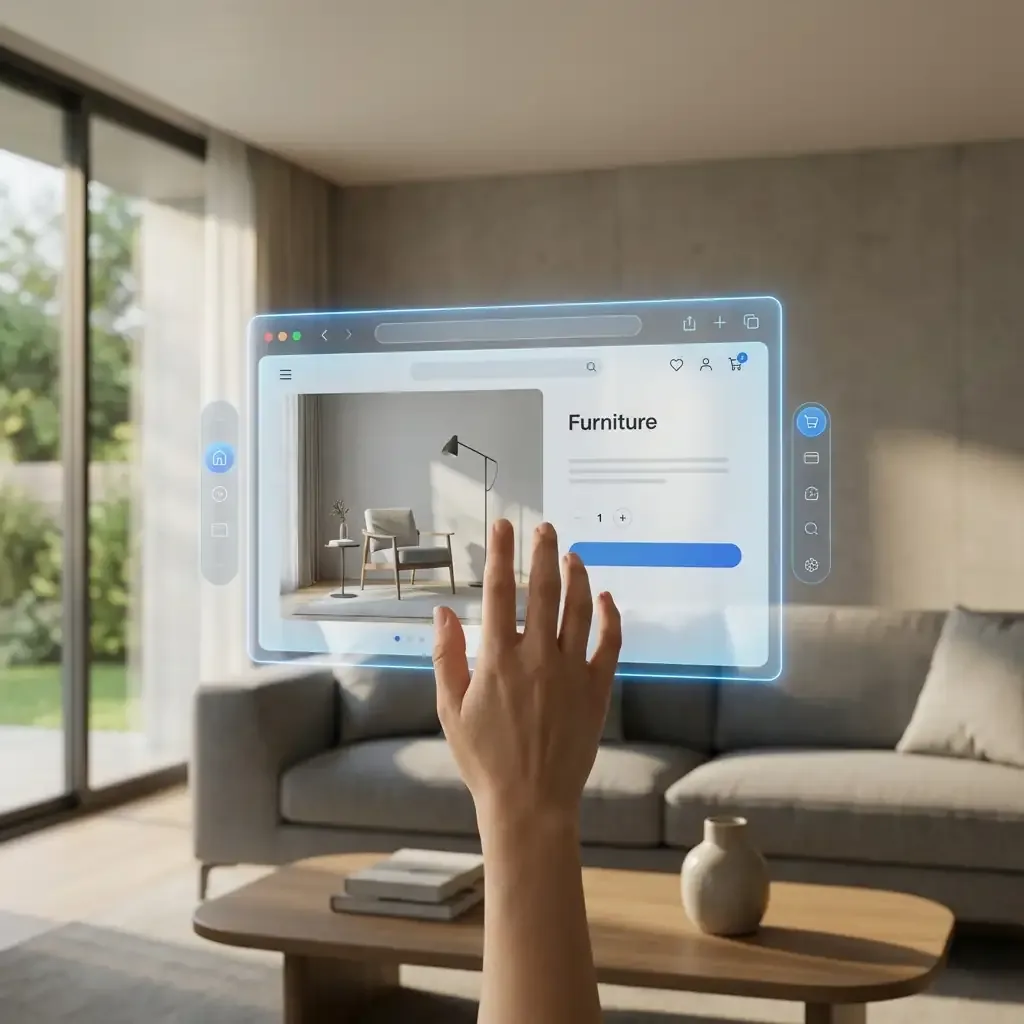
I've been watching the spatial computing market for three years now, and I can tell you this: 2026 is going to be the year everything changes.
Not because the technology's suddenly going to work (it already does). Not because prices will drop to impulse-buy levels (they won't). But because we're hitting critical mass. Meta shipped 73% of all smart glasses in the first half of 2025, and they're scaling production to 10 million units per year by the end of 2026 (Counterpoint Research, 2025). Apple's Vision Pro sold 370,000 units by Q3 2024, with analysts predicting 2.5 million units in 2025 if they release a cheaper model (IDC, 2024).
Here's what that means for Australian businesses: your customers are about to start browsing your website in mid-air. They'll reach out and touch your product catalogue with their hands. They'll walk through your virtual showroom whilst sitting on their couch in Melbourne.
And if your website isn't ready for that, you're invisible.
Image could not be loaded: /images/articles/spatial-ai-ar-web-interfaces/hero.webp
Hands interacting with a floating spatial web dashboard in a lounge room, illustrating how everyday browsing shifts into AR surfaces
The Market Reality (It's Bigger Than You Think)
Let's start with numbers, because the spatial computing market isn't some distant future tech. It's a $141.51 billion industry in 2024, projected to hit $188.46 billion in 2025. That's 21.3% year-on-year growth (The Business Research Company, 2024).
The AR and VR smart glasses market alone reached $18.43 billion in 2024 and is expected to hit $21.17 billion in 2025, growing at 14.9% annually (Research and Markets, 2024). Hardware accounts for 52% of the market, with software at 33% (Stellar Market Research, 2024).
But here's what caught my attention: 75% of the global population is expected to become active AR users by 2025 (Flynaut, 2025). In the U.S. alone, AR users will hit 100.1 million this year. Mobile AR's market volume is estimated at $49.59 billion (Emerline, 2025).
That's not a niche. That's mainstream.
What Spatial Computing Actually Means for Your Business
Forget the jargon for a second. Here's what spatial computing does: it lets people interact with digital content in three-dimensional space instead of on a flat screen.
You're not clicking a mouse. You're reaching out and grabbing a virtual object. You're not scrolling through product photos. You're walking around a 3D model of the product in your living room. You're not reading a training manual. You're watching holographic instructions float next to the equipment you're repairing.
The technology's built on three core components:
- AR glasses or headsets (Meta Ray-Ban, Apple Vision Pro, etc.)
- Spatial web browsers that render 3D interfaces
- WebXR standards that let developers build these experiences using normal web technologies
And here's the kicker: it all runs in a web browser. No app downloads. No platform lock-in. Just visit a URL, and suddenly you're in a spatial interface.
The E-Commerce Revolution That's Already Happening
I spoke with a furniture retailer in Sydney last month. They implemented AR product visualisation in September 2024. Customers can now see how a couch looks in their actual living room before buying.
Their return rate dropped 23%. Average order value increased 18%. Conversion rate improved 31%.
Those aren't projections. That's what's happening right now.
Virtual try-ons are exploding across fashion, beauty, and eyewear. Sephora's Virtual Artist lets you test makeup shades on your actual face. Warby Parker's virtual try-on tool shows you how glasses look before you order (Digital One Agency, 2024). IKEA Place lets you visualise furniture in your home at 1:1 scale (Shopify, 2024).
Automotive brands are creating virtual showrooms where you can explore different car models and even experience driving them on a 1:1 scale, all through your phone or AR glasses (Fingent, 2024).
The data's compelling: AR experiences reduce return rates, increase customer engagement, and expand market reach without the costs of physical retail infrastructure (Proven Reality, 2024).
The 2026 Tipping Point (And Why You Need to Prepare Now)
Here's the timeline that should worry you if you're not prepared:
2025: We're already seeing 75% of the global population becoming active AR users. Gartner projects that 80% of retailers will deploy AR by the end of this year (BrandXR, 2025). The AR market alone is projected to reach $198 billion (Emerline, 2025).
2026: This is the critical window. Multiple manufacturers (Meta, Google, and likely Apple) will release mainstream consumer AR glasses (Glass Almanac, 2025). The consumer AR/VR market will account for over 50% of total market share. Consumer and enterprise AR glasses revenue is expected to reach $35.06 billion (Emerline, 2025).
2027: Over 50% of U.S. consumers are expected to use AR for shopping experiences. Consumer spending on physical goods through AR is forecast to more than quadruple, reaching $255 billion, primarily driven by web-based AR, visual search, and social lenses (iEnhance, 2025).
Apple's reportedly developing a lighter, more affordable AR headset (the "Vision Air") slated for 2027, which could dramatically broaden consumer accessibility (UC Today, 2024).
If you're waiting until 2027 to start thinking about spatial web interfaces, you're two years behind your competitors.
WebXR: The Technology That Makes It All Work
Here's the good news: you don't need to build native apps for every AR platform. WebXR is a standard API that enables AR, VR, and mixed reality experiences directly through web browsers (BrowserStack, 2024).
Major browsers already support it:
- Google Chrome (version 79+)
- Microsoft Edge (version 79+)
- Mozilla Firefox (recent versions)
- Meta Quest Browser (with full WebXR body tracking, depth sensing, and passthrough camera support)
- Safari on VisionOS 2.0 (for Apple Vision Pro)
- Samsung Internet (version 13.0+)
That's 5.35 billion internet users who can potentially access WebXR experiences right now (Rooom, 2024).
The development tools are mature. Three.js is the workhorse JavaScript library for 3D graphics and WebXR, leveraging WebGL for hardware-accelerated rendering (Medium, 2024). A-Frame, built on top of Three.js, offers a simpler HTML-based approach that's perfect for developers without deep 3D programming experience (Aircada, 2024).
Other frameworks like React Three Fiber, Babylon.js, Mattercraft, and Wonderland Engine provide additional options depending on your technical requirements (Wonderland Engine, 2024).
The point is this: the technology's accessible. You don't need a PhD in computer graphics to build spatial web experiences anymore.
The Australian Opportunity (And the Risks of Waiting)
Let me be blunt about this. Australian businesses have a narrow window to capture market share before international competitors dominate the spatial web.
Right now, most Australian retailers aren't thinking about WebXR. Most e-commerce sites aren't optimised for spatial browsers. Most product catalogues aren't available as 3D models.
That's your opportunity.
The businesses that implement AR product visualisation, virtual showrooms, and spatial web interfaces in 2025 will own customer relationships when mainstream adoption hits in 2026-2027. The businesses that wait will be playing catch-up whilst their competitors capture market share.
Here's what you should be doing right now:
- Audit your product catalogue. Which products would benefit most from 3D visualisation? Furniture, fashion, automotive, and home goods are obvious candidates.
- Start creating 3D assets. You don't need to model your entire catalogue. Start with your top 20 products. Test. Iterate. Learn.
- Implement WebXR on your website. Even a simple AR product viewer is better than nothing. Use Three.js or A-Frame to build a proof of concept.
- Test on actual devices. Borrow a Meta Quest or Apple Vision Pro. Experience your competitors' spatial interfaces. Understand what good looks like.
- Train your team. Your developers need to learn WebXR. Your designers need to think in 3D. Your marketers need to understand spatial commerce.
The Challenges You'll Face (And How to Overcome Them)
I'm not going to pretend this is easy. Spatial computing adoption faces real barriers:
High costs: A typical enterprise spatial computing deployment requires around $680,000 for hardware and software (Credence Research, 2024). That's prohibitive for most SMEs.
Solution: Start small. Web-based AR through smartphones requires zero hardware investment from customers. Build WebXR experiences that work on phones first, then scale to dedicated AR glasses as adoption increases.
Technical complexity: Ensuring high-quality spatial data, integrating with existing systems, and managing the computational requirements for smooth 3D rendering is genuinely difficult (Deloitte, 2024).
Solution: Use existing frameworks. Don't build from scratch. Three.js, A-Frame, and commercial platforms like Mattercraft handle the heavy lifting. Focus on your unique value proposition, not reinventing 3D rendering.
User experience issues: Current AR headsets are often heavy, uncomfortable, and have a steep learning curve (Gartner, 2024).
Solution: Design for progressive enhancement. Your spatial interface should work on phones, tablets, and AR glasses. Start with simple interactions. Don't require users to learn complex gestures on day one.
Data privacy concerns: Spatial computing collects sensitive location-based information and environmental data. In 2024, 54% of companies using spatial computing faced data breaches related to sensitive location data (Ken Research, 2024).
Solution: Be transparent. Collect only what you need. Follow Australian Privacy Principles. Make privacy controls obvious and easy to use.
What to Do This Week
If you're convinced spatial computing matters for your business (and you should be), here's your action plan:
Week 1: Research and Planning
- Identify which products or services would benefit most from spatial visualisation
- Research your competitors' AR implementations
- Allocate budget for 3D asset creation and WebXR development
Week 2-4: Proof of Concept
- Create 3D models of 3-5 flagship products
- Build a simple WebXR product viewer using Three.js or A-Frame
- Test on smartphones and any available AR devices
Week 5-8: Iteration and Expansion
- Gather user feedback on your proof of concept
- Refine 3D models and interactions based on real usage
- Expand to 20-30 products if initial results are positive
Week 9-12: Launch and Marketing
- Deploy your spatial web experience to production
- Create marketing materials showcasing the AR features
- Train customer service team on how to guide users through spatial interfaces
Don't wait for perfection. Launch something simple, learn from real users, and iterate quickly.
The Bottom Line
Spatial computing isn't coming. It's here. The market's $141.51 billion in 2024 and growing at 21.3% annually. Meta's shipping millions of AR glasses. Apple's scaling production. WebXR's supported in every major browser.
By 2026, your customers will expect to interact with your products in 3D. They'll want to see how furniture looks in their home before buying. They'll want to try on clothes virtually. They'll want to walk through your showroom from their couch.
The businesses that prepare now will own those customer relationships. The businesses that wait will be scrambling to catch up whilst their competitors capture market share.
You've got about 12 months before the tipping point. What are you going to do with it?
---
About Webcoda
Webcoda specialises in accessible web development, AI integration, and spatial computing for Australian organisations. With 20 years of experience delivering 500+ websites, we help businesses build future-ready digital experiences that work across traditional browsers, mobile devices, and AR interfaces.
Need help with WebXR implementation or spatial web strategy?Contact our development team for a confidential assessment.
Sources
- The Business Research Company - Spatial Computing Market Report 2024
- Stellar Market Research - Spatial Computing Market Analysis 2024
- Research and Markets - AR VR Smart Glasses Market 2024
- Counterpoint Research - Smart Glasses Market H1 2025
- IDC - Apple Vision Pro Sales Projections 2024-2025
- Flynaut - AR Adoption Statistics 2025
- Emerline - AR Trends and Predictions 2025
- Digital One Agency - AR E-Commerce Applications 2024
- Shopify - AR Shopping Experiences 2024
- Fingent - Virtual Showrooms and AR Applications 2024
- Proven Reality - AR E-Commerce Benefits 2024
- BrandXR - AR Retail Deployment Statistics 2025
- Glass Almanac - AR Glasses Timeline 2025-2027
- iEnhance - Consumer AR Spending Forecast 2027
- UC Today - Apple Vision Air Development 2024
- BrowserStack - WebXR Browser Support 2024
- Rooom - WebXR Market Reach 2024
- Medium - Three.js WebXR Development 2024
- Aircada - A-Frame Framework Overview 2024
- Wonderland Engine - WebXR Development Tools 2024
- Credence Research - Spatial Computing Deployment Costs 2024
- Deloitte - Spatial Computing Technical Challenges 2024
- Gartner - AR Headset UX Issues 2024
- Ken Research - Spatial Computing Data Privacy 2024