

Your customer service call went badly. You hung up frustrated, maybe even slammed the phone down a bit. The representative apologised, sure, but something felt different about how quickly they escalated to a manager. You didn't ask for one. They just... knew.
That's not intuition anymore. That's emotion AI at work.
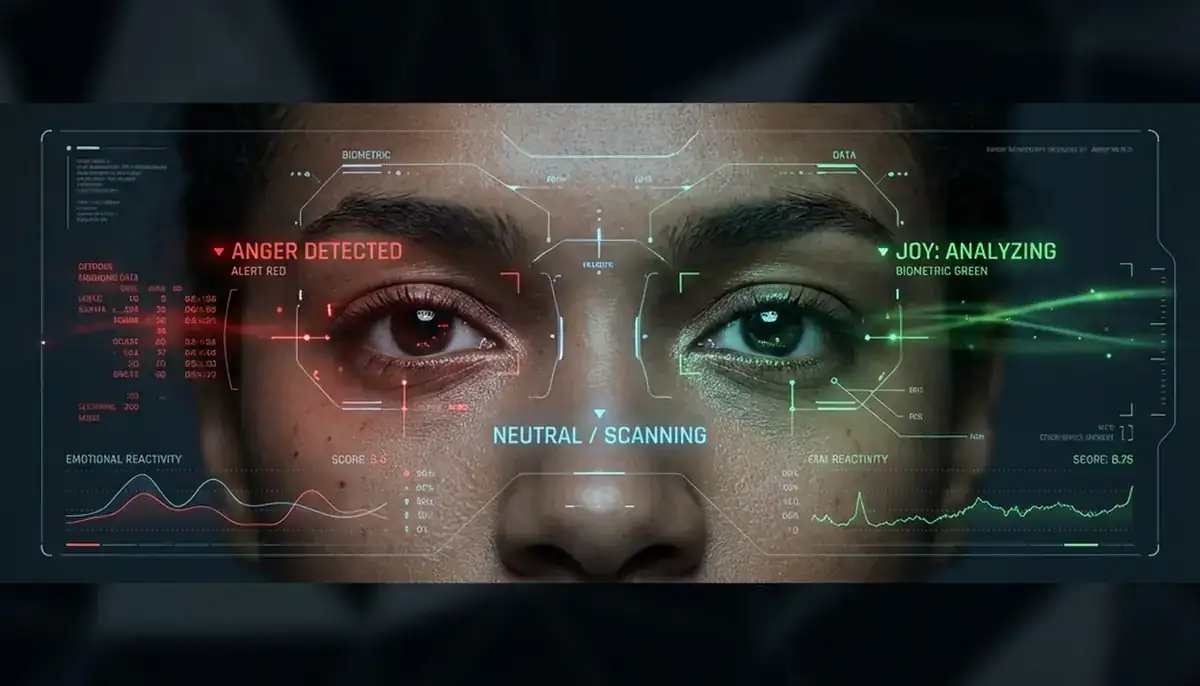
Affective computing (the technical term for emotion AI) analyses your facial expressions, voice tone, and even how you type to figure out exactly what you're feeling. It's already processing over 1.8 million job applications at Unilever, routing angry callers to experienced support staff at contact centres worldwide, and helping mental health professionals track patient progress between sessions. The global market hit USD 96.19 billion in 2025 and researchers project it'll reach USD 283.42 billion by 2030.
But here's the uncomfortable bit. This technology doesn't just recognise that you're angry or frustrated or delighted. It creates a permanent record of your emotional state at a specific moment in time. And unlike your password, which you can change if it's compromised, you can't change how you look when you're stressed or how your voice sounds when you're anxious.
Australian businesses are already making decisions about this technology. The question isn't whether emotion AI is coming to your website or contact centre. It's whether you'll deploy it ethically, or whether you'll wait for the Privacy Commissioner to tell you what you did wrong.
How Emotion AI Actually Works (And Why That Matters)
Let's clear something up first. Emotion AI isn't mind-reading. It's pattern recognition powered by machine learning algorithms that analyse observable behaviours across three main channels.
Facial expression recognition maps your face to identify micro-expressions associated with specific emotions. The software tracks changes in your eyebrows, mouth corners, eye openings, and dozens of other facial muscle movements. Research shows this technology achieves around 70% accuracy in controlled settings, though that drops significantly with poor lighting, camera angles, or when people from different cultural backgrounds express emotions differently.
Voice tone analysis examines pitch, rhythm, speaking speed, and vocal stress patterns. A 2025 study on negative speech emotion recognition using LSTM-based models achieved 88.94% accuracy for detecting sadness, anger, fear, or disgust. But there's a catch. Listeners frequently misclassify certain emotions. Happy gets confused with surprise. Fear gets mistaken for sadness. What sounds like anger to the algorithm might just be how someone speaks when they're passionate about a topic.
Keystroke dynamics tracks your typing patterns, including how long you hold keys down, the intervals between keystrokes, and how often you make corrections. Research demonstrates that emotional states affect keystroke duration and latency. When you're stressed, you type differently. When you're calm, your rhythm changes. A dataset called EmoSurv records these patterns across five emotional states: anger, happiness, calmness, sadness, and neutral.
The technology combines these inputs through what researchers call multimodal emotional AI. By fusing data from text, voice tone, facial expressions, and physiological signals, these systems achieve higher accuracy than single-channel approaches. That's especially useful in complex scenarios where emotional expression varies across different channels.
The Business Case (It's Not Just About Being Nice)
Australian businesses aren't adopting emotion AI because it's trendy. They're doing it because the ROI projections are compelling.
Average ROI for AI customer service implementations reaches 312% within 18 months, according to recent industry analysis. Companies report improvements of 35% in customer satisfaction, 45% reduction in response times, and 67% decrease in routine support tickets. Some organisations achieve returns ranging from $1.41 to $8.00 per dollar invested, with structured measurement frameworks delivering 40-60% higher returns than intuitive assessments.
But you can't just flip a switch. AI systems require 90-120 days to reach optimal performance through training data accumulation and workflow optimisation. Companies expecting immediate 500-800% ROI often abandon implementations before the system proves itself. Setting realistic targets of 200-300% ROI in year one, growing to 400-600% in subsequent years, prevents premature shutdowns.
Here's where emotion AI specifically adds value. Contact centres can identify irate customers from the start of a call and route them to experienced operators who know how to de-escalate. Retail websites can detect when a user's getting frustrated with navigation and trigger proactive help. Gaming companies test new releases by monitoring players' emotional responses in real-time, fixing problems before launch.
Unilever uses emotion AI to process recruitment at scale. The company evaluates sociability, cognitive ability, and emotional traits through natural language processing and body language analysis during video interviews. They've reported a 75% reduction in hiring time while increasing diversity in their candidate pool. Though not everyone's convinced that's working as intended.
Where This Gets Ethically Messy (And Legally Risky)
Let's talk about what happened at Bunnings.
The Australian hardware chain deployed facial recognition technology in stores. The Office of the Australian Information Commissioner investigated and found the company breached the Privacy Act. The OAIC published guidance focusing on four key privacy concepts: necessity/proportionality, consent/transparency, accuracy/bias, and governance.
That guidance matters because more than a quarter of Australians feel facial recognition technology is one of the biggest privacy risks they face today. Only 3% think it's fair and reasonable for retailers to require biometric information when accessing services.
The problem isn't just about collection. It's about what happens next. Emotion AI creates what researchers call "sensitive information" under Australian privacy law. You can't collect sensitive information without consent unless an exception applies. And consent can't be implied just because you told someone you're planning to collect it. The Privacy Act requires voluntary, informed, current, specific, and unambiguous consent.
But how do you give meaningful consent to technology you don't understand? If a customer doesn't grasp how an emotion AI system will analyse their facial expressions or voice patterns, their ability to provide informed consent decreases significantly. The OAIC notes this creates serious transparency challenges in AI contexts.
Then there's the accuracy problem. Emotion recognition models are poorly prepared to work with cultural and demographic diversity. Studies show accuracy of emotion classification differs greatly among different demographic groups. Research demonstrates that individuals tend to display racial bias when attributing emotions to others. This bias consists of misperceiving facial expressions due to racial prejudice, such as associating ambiguous aggressive expressions more strongly with certain racial groups.
When Unilever first deployed its emotion AI recruitment system, the company faced backlash after the tool was found to favour early-career candidates, inadvertently sidelining experienced professionals. Candidates complained about opacity in the AI's decision-making process. Unilever responded with a campaign clarifying how algorithms function, but the damage to trust was already done. The company that provided the video analysis technology, HireVue, eventually stopped using AI in its hiring software following an external audit.
The Privacy Commissioner Is Watching
Australia's privacy landscape shifted significantly in 2025. The OAIC launched a new digital ID regulatory strategy in March, mapping how it intends to encourage people and businesses to shift toward safer ID verification methods while respecting privacy.
Facial recognition became a regulatory priority. The Commissioner investigated 7-Eleven for using facial recognition in customer survey tablets, collecting tens of thousands of faces. The OAIC ordered Clearview AI, a facial recognition software company, to stop collecting information on Australians and delete any information already collected after determining the company breached the Privacy Act by collecting sensitive information without consent and by unfair means.
The Australian government is reforming the Privacy Act with specific attention to biometric technologies. Proposed changes include redefining personal information to cover inferred information and updating categories of sensitive information. There's growing support for dedicated facial recognition legislation modelled on risk assessment approaches that balance innovation with protection.
A new statutory tort for serious invasions of privacy commenced on 10 June 2025. This operates as a standalone cause of action, meaning individuals now have a direct legal avenue to seek redress for serious privacy breaches, independent of the existing Privacy Act framework.
If you're planning to deploy emotion AI in your business, you're operating in an environment where regulators are actively scrutinising these technologies and Australians are increasingly sceptical about biometric data collection.
What Australian Businesses Need to Consider
So you're weighing whether to implement emotion AI in your customer service operations or on your website. Here's what you need to think through before you commit.
Start with necessity. Do you actually need emotion detection, or would simpler analytics solve your problem? The OAIC's guidance emphasises necessity and proportionality. If you can achieve your business goals without collecting biometric data, that's the safer path legally and ethically.
Get proper consent. Don't bury emotion AI in your terms of service. If you're analysing facial expressions or voice patterns, tell customers explicitly and get clear consent. Make it voluntary. Let people opt out without losing access to your core service. That's not just good practice, it's what the Privacy Act will likely require as reforms progress.
Audit for bias. Research shows emotion recognition systems perform differently across demographic groups. Test your chosen system with diverse populations before deployment. Monitor for discriminatory outcomes. A 2024 review of transformer-based multimodal emotion recognition architectures found that varied datasets improve accuracy and fairness. If your vendor can't demonstrate bias testing, find a different vendor.
Implement strong governance. Someone in your organisation needs to be accountable for how emotion AI operates, what data it collects, how long you retain it, and who has access. Document your decision-making. You'll need that documentation if the Privacy Commissioner comes asking questions.
Plan for transparency. Customers will ask how your emotion detection works. Your support team needs clear, non-technical explanations. "We use AI to improve customer experience" won't cut it. Be specific about what you're analysing and why.
Set realistic timelines. Remember that 90-120 day optimisation period. Budget for initial lower performance while the system learns. Train your staff on how to interpret and respond to emotion AI insights. Research shows human agents resistant to AI collaboration reduce automation rates and ROI by 40-60%. Position AI as agent augmentation, not replacement.
Consider cultural context. Emotional expressions vary significantly across cultures. What looks like anger in one context might signal concentration in another. If you serve diverse Australian communities, your emotion AI needs to account for that variability, or it'll generate false insights that damage customer relationships.
The 2027 Question
By 2027, affective computing is projected to reach USD 32 billion in valuation globally. North America leads with a 38.7% market share, but Asia Pacific (with China at the forefront) is the fastest-growing region. Australian businesses will face increasing competitive pressure to adopt these technologies as international competitors gain advantages in customer understanding and service personalisation.
The technology will get better. Accuracy will improve. Multimodal systems will become more sophisticated at detecting genuine emotional states rather than misinterpreting cultural communication styles or individual quirks. But better technology doesn't resolve the fundamental ethical tensions.
We're headed toward a future where your website knows you're frustrated before you've finished typing your complaint. Where your customer service call gets routed based on vocal stress patterns you didn't know you were broadcasting. Where your job interview performance includes an emotional profile you never see.
Some of that future looks genuinely helpful. Mental health professionals using emotion AI to track patient progress between sessions can provide better care. Contact centres routing distressed customers to specially trained staff can prevent escalation. Gaming companies that understand player frustration can build better experiences.
But some of it looks dystopian. Employers making hiring decisions based on algorithmic interpretations of your facial expressions during video interviews. Retailers tracking your emotional responses as you browse. Insurance companies, banks, or government services using emotion detection in ways you never consented to.
The technology is here. The business case is proven. The market is growing at 24.13% annually. Australian businesses will adopt emotion AI whether privacy advocates like it or not.
The only question that matters is whether we'll do it ethically, with genuine consent and robust protections, or whether we'll repeat the mistakes of every other surveillance technology that promised convenience and delivered exploitation.
Your move.
Key Takeaways
Market Growth
- Global affective computing market reached USD 96.19 billion in 2025, projected to hit USD 283.42 billion by 2030
- North America leads with 38.7% market share, Asia Pacific growing fastest
- Average ROI of 312% within 18 months for AI customer service implementations
Technology Capabilities
- Facial expression recognition achieves ~70% accuracy, but drops with lighting, angles, and cultural differences
- Voice tone analysis reaches 88.94% accuracy for detecting negative emotions
- Keystroke dynamics reveals emotional state through typing patterns and rhythm changes
- Multimodal systems combining multiple inputs achieve highest accuracy rates
Business Applications
- Contact centres route distressed callers to experienced operators
- Retail websites detect user frustration and trigger proactive assistance
- Recruitment processes analyse emotional traits during video interviews
- Gaming companies test releases by monitoring real-time player emotional responses
- Healthcare providers track patient mental health progress through voice and facial analysis
Accuracy and Bias Challenges
- Emotion recognition models perform poorly with cultural and demographic diversity
- Systems misclassify emotions (happy confused with surprise, fear with sadness)
- Racial bias in emotion attribution affects algorithmic accuracy
- Unilever's recruitment AI initially favoured early-career candidates, sidelining experienced professionals
- HireVue discontinued AI emotion analysis in hiring following external audit
Australian Privacy Landscape
- Biometric information classified as "sensitive information" under Privacy Act 1988
- OAIC determined Bunnings breached Privacy Act using facial recognition in stores
- New statutory tort for serious privacy invasions commenced 10 June 2025
- 27% of Australians see facial recognition as major privacy risk, only 3% find it reasonable
- Privacy Act reforms propose updated definitions covering inferred and biometric information
Consent Requirements
- Voluntary, informed, current, specific, and unambiguous consent required
- Cannot be implied through notification alone
- Transparency challenges make meaningful consent difficult in AI contexts
- Customers must understand how systems analyse expressions and voice patterns
Implementation Considerations
- AI systems require 90-120 days to reach optimal performance
- Realistic ROI targets: 200-300% year one, growing to 400-600% in subsequent years
- Companies expecting immediate 500-800% returns often abandon before optimisation
- Strong governance and accountability mechanisms essential
- Bias testing across diverse populations mandatory before deployment
- Staff training crucial (resistance reduces ROI by 40-60%)
Regulatory Priorities
- Facial recognition now OAIC regulatory priority for 2025
- March 2025 digital ID regulatory strategy emphasises safer verification methods
- Clearview AI ordered to stop collecting Australian data and delete existing information
- Growing support for dedicated facial recognition legislation with risk assessment approach
- Regulators actively scrutinising biometric technologies across retail, recruitment, and security
Ethical Concerns
- Permanent record of emotional states at specific moments
- Risk of manipulation through emotional profiling
- Algorithmic bias perpetuating discrimination
- Lack of transparency in decision-making processes
- Cultural variations in emotional expression not adequately addressed
- Privacy concerns about intimate emotional data collection and retention
---
Sources
- Affective Computing Market Size & Share - MarketsandMarkets
- What is Affective Computing / Emotion AI in 2025 - AIMultiple
- Top 30 Affective Computing Applications - AIMultiple
- 17 Best Emotion Detection Software Reviewed in 2025 - The CX Lead
- Facial Emotion Recognition Complete Guide - Visage Technologies
- Understanding Facial Expression Recognition - iMotions
- Guidance on Privacy and AI Products - OAIC
- The Price of Emotion: Privacy, Manipulation, and Bias in Emotional AI - ABA Business Law Today
- OAIC Dual AI Guidelines Set New Standards - Future of Privacy Forum
- Keystroke Dynamics as Behavioral Biometrics - Fleksy
- EmoSurv: Keystroke Dynamics Dataset with Emotion Labels - IEEE DataPort
- Real-time Speech Emotion Recognition Using Deep Learning - Springer
- Speech Emotion Recognition in Mental Health - JMIR Mental Health
- Unilever's Practice on AI-based Recruitment - ResearchGate
- Is AI Recruiting (Un)ethical? A Human Rights Perspective - PMC
- How AI Is Changing the ROI of Customer Service - Harvard Business Review
- AI Emotion Detection for Customer Service Guide - Dialzara
- Measuring AI Chatbot ROI: Case Studies - Dialzara
- Five Generations of Facial Recognition Usage and Australian Privacy Law - Oxford Academic
- Australian Privacy Watchdog Regulatory Strategy Prioritizing Biometrics - Biometric Update
- Ethical Considerations in Emotion Recognition Research - MDPI
- Ethical Considerations in Emotion Recognition Technologies - Springer
- Affective Computing Market Forecasts 2025 to 2030 - Research and Markets
- Emotion AI Statistics By Market Size and Analysis 2025 - ElectroIQ
- Developing Negative Speech Emotion Recognition Model - Journal of Big Data
---