

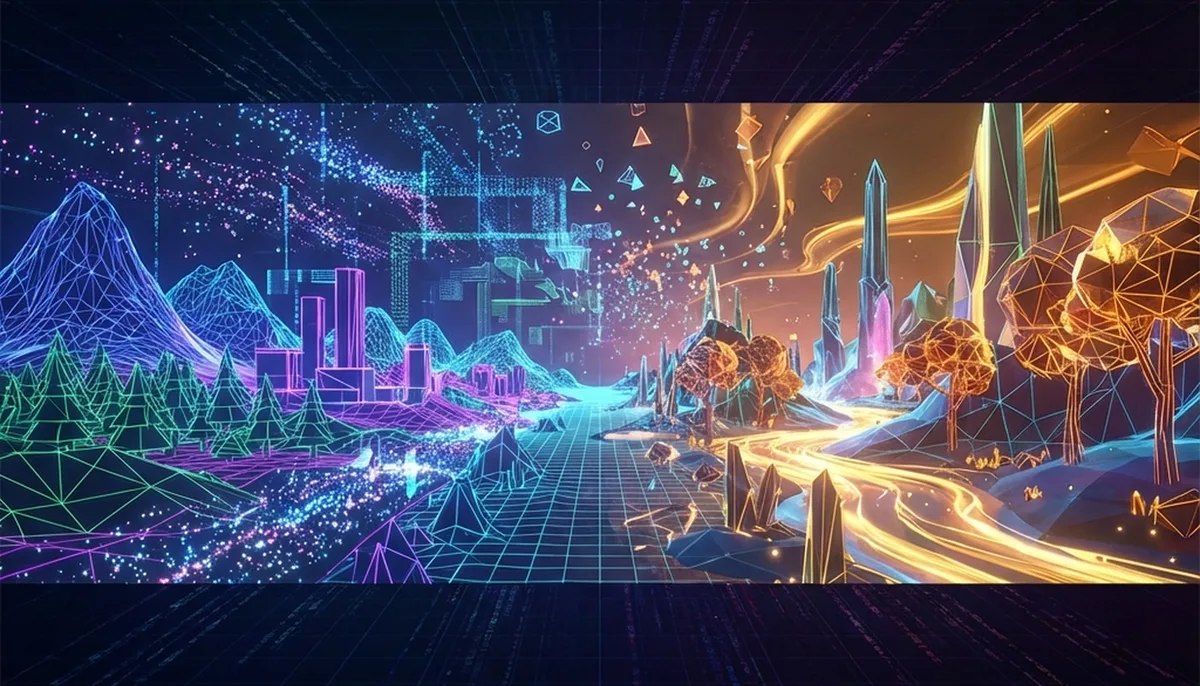
Picture this: You're exploring a virtual training facility that didn't exist five minutes ago. The layout's unique, the hazards are realistic, and every detail adapts to your skill level. This isn't science fiction. It's happening right now in Australian businesses using AI-powered procedural generation.
The numbers tell a compelling story. Companies switching to virtual training environments save between 30-70% on training costs[^1]. But here's what's really interesting: VR learners are completing training four times faster than traditional classroom methods[^2]. That's not just incremental improvement, it's a complete transformation of how we think about employee development.
And this technology isn't limited to gaming anymore. The virtual training and simulation market jumped from $464.62 billion in 2024 to $542.2 billion in 2025, growing at a staggering 16.7% annually[^3]. Australian businesses are taking notice because the ROI is impossible to ignore.
What's Actually Happening Right Now
Let's talk about what procedural generation really means for business. Meta's WorldGen can generate complete, interactive 3D worlds from a single text prompt in about five minutes[^4]. Think about that. What used to require teams of 3D artists working for weeks now happens faster than your coffee break.
The shift from static content to dynamic, AI-generated environments is reshaping multiple industries. Gaming companies are leading the charge, but training, product visualisation, and virtual collaboration are close behind.
Google's 2025 research found that 90% of game developers are already using AI in their workflows[^5]. That's not early adoption anymore. That's the new baseline. In Australia specifically, 81% of game studios predict income growth or stability for 2025, with 61% planning to hire more staff[^6]. The local gaming market alone is valued at $2.5 billion and expected to grow at 7.6% annually through 2033[^7].
But gaming is just the start. The real revolution is happening in enterprise applications. Companies like IKEA, Zalando, and American Eagle report 94% higher conversion rates using AI-generated 3D product visualisations[^8]. That's the kind of ROI that gets boardroom attention.
The Technical Reality Behind the Magic
Here's where it gets technically interesting. Researchers at AMD recently created a procedural generation system that produces 35.6 GB worth of realistic trees, leaves, and bushes from just 52 KB of data[^9]. That's not a typo. The compression ratio is almost incomprehensible.
The secret? GPU mesh shaders and work graphs that generate geometry in real time. On an AMD Radeon RX 7900 XTX, researchers augmented a scene with 79,710 instances in just 3.74 milliseconds[^10]. For context, that's faster than you can blink.
This isn't purely academic research either. Unity and Unreal Engine are integrating these capabilities directly into their platforms, making them accessible to developers without specialized expertise. Unity eliminated its controversial Runtime Fee in January 2025 and now offers free access for developers with revenue under $200,000[^11].
The barriers to entry are dropping fast. What used to require massive computing power now runs on consumer-grade hardware. Cloud platforms and edge computing push AI processing closer to users, minimising latency and delivering near-instant results[^12].
Business Applications That Actually Work
Training and simulation deliver the most immediate ROI. Boeing reported a 90% increase in first-time training quality using VR/AR technology[^13]. H&R Block saw a 50% decrease in dissatisfied customers and a 9.9% reduction in customer handling times after implementing VR training[^14].
The military simulation and virtual training market reached $17.6 billion in 2024 and is projected to hit $25.47 billion by 2032[^15]. About 33% of that growth comes from demand for synthetic training environments and AI-based simulation systems[^16].
Here's something interesting for Australian businesses: VR-trained employees retain up to 75% of knowledge compared to just 10% with traditional methods[^17]. That means fewer repeated training sessions and better long-term outcomes. The maths is straightforward: better retention equals lower ongoing training costs.
Product visualisation is another area showing remarkable results. Real-time 3D generation lets customers interact with products before purchase. E-commerce platforms now generate unique product descriptions, images, and virtual try-on experiences for each user[^18]. The technology adapts to individual preferences, creating personalised shopping experiences at scale.
Virtual collaboration tools are evolving too. Companies can now generate meeting spaces, product mockups, and design environments on demand. No more waiting for 3D artists to create every asset manually.
The Indie Developer Advantage
Small businesses and solo developers are having their moment. As developer Maarten Brouwer points out, "While big developers can afford to build specialised level design tools, this often isn't feasible for indies, so procedural generation can be an interesting option as an alternative to time-consuming manually crafted levels"[^19].
The playing field's levelling. Indie developers are using procedural generation to compete with larger studios, creating unique games on smaller budgets[^20]. In 2025, advances in AI-driven systems and procedural generation allow indie teams to achieve mainstream polish while maintaining experimental gameplay[^21].
Tools like Promethean AI and Ludo use machine learning to design level layouts and item behaviours autonomously[^22]. These systems reduce design time significantly, letting small teams focus on creativity instead of repetitive asset creation.
But it's not all smooth sailing. Procedural systems can generate poorly structured content if not properly balanced. Random generation sometimes produces repetitive results. Testing and debugging randomly-generated content remains challenging[^23].
Here's my honest take: if your business isn't at least experimenting with procedural generation by end of 2026, you're going to spend 2027 playing catch-up. The window for early-adopter advantage is closing faster than most people realise.
Real Limitations You Should Know About
Let's be honest about the challenges. AI-generated 3D models often lack the precision of manually crafted assets[^24]. Texture quality remains inconsistent, especially for objects requiring nuanced material representation[^25]. According to 2025 testing, roughly 1 in 10 generations are client-ready without rework[^26]. Lower than most people expect when they see the impressive demos.
The consistency problem is significant. AI struggles to produce identical results across multiple perspectives[^27]. That's a major issue for businesses with strict brand guidelines. I learned this the hard way recommending AI-generated product shots to a client with strict brand guidelines. The AI couldn't maintain their exact Pantone colours across generations. We ended up needing human artists for quality control anyway. Now I'm much more careful about where I suggest these tools. Companies invest millions in precise logos, colours, and materials that AI can't consistently replicate[^28].
Data scarcity holds back progress too. Autodesk's Bernini trained on 10 million 3D shapes, which sounds impressive until you compare it to GPT-4's 10 trillion words[^29]. 3D AI needs substantially more training data to reach human-level quality.
Post-processing requirements add unexpected costs. AI-generated models typically need manual cleanup and refinement[^30]. Experienced artists can use these tools effectively for background props and low-detail elements, but hero assets, complex geometry, and characters still require human expertise[^31].
Scene complexity with multiple interacting objects remains a challenge. While AI handles individual objects reasonably well, creating realistic environments with proper physical interactions requires significant manual intervention[^32].
What's Coming Next
The trajectory is clear. The AI-powered digital content creation market will hit $45.2 billion by 2031, growing at 29.4% annually[^33]. Even if those projections are off by 30%, the direction is undeniable. By late 2026, predictions suggest creators will control scenes in real time, adjusting camera movements and lighting as AI updates footage instantly[^34].
Real-time applications are exploding. Gaming already generates dynamic environments as players explore. Customer service chatbots craft responses with human-like nuance in milliseconds[^35]. The next step is bringing that responsiveness to enterprise applications.
Edge computing and 5G/6G networks are pushing AI processing to end users, eliminating latency[^36]. That means synthetic environments can adapt instantly to user actions without perceptible delay.
Machine learning algorithms are optimising rendering processes, enabling more complex VR experiences on consumer hardware[^37]. What required server farms two years ago now runs on laptops.
The synthetic data generation market exceeded $310.5 million in 2024 and is projected to grow at 35.2% annually through 2034[^38]. Businesses need this data to train AI models, enhance analytics, and meet privacy regulations without exposing sensitive information.
Key Takeaways
Here's what Australian businesses need to know:
Cost reduction is real: Companies save 30-70% switching to virtual training. VR training costs less than half of classroom training per employee at scale[^39].
Speed matters: VR trains employees five times faster than classrooms[^40]. That's reduced time away from productive work and faster onboarding for new hires.
Retention drives ROI: 75% knowledge retention versus 10% for traditional methods[^41] means training investments deliver lasting value.
Technology is accessible: Unity Personal is free for developers under $200,000 revenue[^42]. Modern game engines integrate AI tools that handle time-consuming tasks automatically[^43].
Quality varies: Roughly 1 in 10 AI generations are production-ready without manual refinement[^44]. This is where expectations crash into reality. Budget for human oversight and cleanup.
Market growth is accelerating: Virtual training market grew 16.7% in 2025[^45]. Early adopters gain competitive advantage.
Look, I've been in digital for 20 years, and this is the fastest I've ever seen the landscape shift. If you're feeling overwhelmed by the pace of change, that's just pattern recognition working correctly. The best any of us can do is experiment, measure, and adapt.
The choice isn't whether to adopt these technologies but when and how. Australian businesses embracing procedural generation now are building capabilities that'll define their competitive position for years.
The worlds we're generating today look primitive compared to what's coming. But they're already good enough to deliver measurable business value. And honestly? That's the only metric that matters.
---
Sources
[^1]: VR Training ROI Analysis: How to Measure for Your Business
[^2]: VR Training ROI Analysis: How to Measure for Your Business
[^3]: Global Virtual Training And Simulation Market Report 2025-2029
[^4]: WorldGen: Meta reveals generative AI for interactive 3D worlds
[^5]: 90% of Games Developers Already Using AI in Workflows, Google Cloud Research
[^6]: Australian video game development industry generates $339.1 million
[^7]: Australia Gaming Market Size, Growth & Forecast 2033
[^8]: 2025 Trends in AI 3D Modeling
[^9]: Graphics researchers create GPU procedural algorithm for 35.6 GB trees from 52 kB
[^10]: Real-Time Procedural Generation with GPU Work Graphs
[^11]: Best Game Development Software in 2025
[^12]: What is the future of AI content generation in 2025?
[^13]: Immersive Learning ROI: The Cost Effectiveness of XR Training
[^14]: VR Training ROI Analysis: How to Measure for Your Business
[^15]: Military Simulation and Virtual Training Market to Reach USD 25.47 Bn by 2032
[^16]: Military Simulation and Virtual Training Market Size
[^17]: The Business Case for Immersive Safety Training: ROI and Cost Savings
[^18]: How AI Is Transforming Digital Content Creation in 2025
[^19]: How procedural generation is being used to develop exciting new games
[^20]: The Evolution of Procedural Generation: Endless Worlds in 2025 Gaming
[^21]: Why Small Indie Teams Are Winning Big With Gamers in 2025
[^22]: AI and the Evolution of Game Worlds: Procedural Generation 2025
[^23]: Procedural Generation in Mobile Games: A 2025 Design Guide
[^24]: Beyond the render button: The 3D content generated by AI in 2025
[^25]: Say It, See It: A Systematic Evaluation on Speech-Based 3D Content Generation
[^26]: Is AI Ready for High-Quality 3D Assets in 2025?
[^27]: The current state of generative AI in 3D
[^28]: Beyond the render button: The 3D content generated by AI in 2025
[^29]: Complete Breakdown on Gen AI for 3D. Are 3D artists in danger?
[^30]: Generative AI's Reality Check: What It Means for 3D Artists in 2025
[^31]: Is AI Ready for High-Quality 3D Assets in 2025?
[^32]: Challenges and Opportunities in 3D Content Generation
[^33]: How AI Is Transforming Digital Content Creation in 2025
[^34]: How AI translation and creation tools are transforming digital content in 2026
[^35]: What is the future of AI content generation in 2025?
[^36]: What is the future of AI content generation in 2025?
[^37]: The Future of Content Creation: How AI Will Transform Creative Industries by 2025
[^38]: Synthetic Data Generation Market Size, Growth Analysis 2034
[^39]: VR Training ROI Analysis: How to Measure for Your Business
[^40]: VR Training ROI Analysis: How to Measure for Your Business
[^41]: The Business Case for Immersive Safety Training: ROI and Cost Savings
[^42]: Best Game Development Software in 2025
[^43]: Best Game Development Software in 2025
[^44]: Is AI Ready for High-Quality 3D Assets in 2025?
[^45]: Global Virtual Training And Simulation Market Report 2025-2029
---