


Here's the uncomfortable truth about AI in 2025: your team is probably using it every day, they're probably more productive because of it, and you probably can't point to a single dollar of extra profit.
I've watched this pattern unfold with three different clients over the past 18 months. Enthusiastic pilot projects. Promising demos. Genuine excitement from stakeholders. Then, six months later, a quiet admission that nothing's actually changed at the bottom line. (One CFO told me he couldn't find any of their AI investment in the P&L. That stung.)
Here's the paradox that should worry every executive: 78% of organisations now use AI in at least one business function, with productivity growth quadrupling in AI-exposed industries according to PwC. Yet 80% of companies report no material earnings contribution from their GenAI investments. The technology works. The business case doesn't.
Image could not be loaded: /images/articles/genai-paradox-chaos-vs-success.png
Most AI projects end up in the chaos pile. Here's why.
If you're an executive who's signed off on AI initiatives and can't articulate their financial impact, you're not alone. You're just part of a very expensive pattern.
The Awkward Truth About AI Adoption
Let's start with what we know. GenAI adoption is real and accelerating. McKinsey's 2025 research found that 78% of organisations are using AI in at least one business function, up from 55% just two years ago. Gartner reports that only 48% of AI pilots reach production, taking an average of 8 months to get there.
But here's where it gets interesting. BCG's September 2025 research found that 60% of companies generate no material value from AI despite significant investment. Only 5% are generating value at scale. The gap between AI leaders and laggards is widening, not closing.
The gap between adoption and value isn't small. It's a chasm. And it's burning through budgets at an alarming rate.
MIT Media Lab's 2025 analysis delivered an even more sobering verdict: 95% of enterprise GenAI pilots fail to deliver measurable business impact or revenue acceleration within expected timeframes. (Worth noting: this study used strict success criteria, measuring P&L impact within 6 months.) Despite investments ranging between $30 billion and $40 billion globally, the vast majority of organisations are getting zero return.
This isn't primarily a technology problem. RAND Corporation's 2024 research found that AI projects fail at twice the rate of other IT initiatives, with leadership misalignment and poor stakeholder communication consistently among the top causes.
The Five Failure Patterns
When you analyse enough failed AI projects, five patterns emerge consistently. I've seen each of these kill promising initiatives.
1. Data Quality Delusion
Most executives don't realise their data isn't ready until they're six months into an AI project. Gartner's CDO survey identified data quality and readiness as the top obstacle, cited by 43% of respondents. The prediction is stark: organisations will abandon a significant portion of AI projects that aren't supported by AI-ready data.
The problem isn't lack of data. It's that AI-ready data has vastly different requirements from traditional data management. Gartner estimates that bad data costs organisations an average of $12.9 million annually. McKinsey's 2023 research found that 70% of AI project failures link directly to data problems, not algorithmic shortcomings.
2. Unclear Value Proposition
Here's a diagnostic question I ask every client: "If this AI project succeeds perfectly, what specific financial metric improves, and by how much?" If you can't answer with a number, you're heading for failure.
BCG's 2025 research found that the top 5% of AI performers generate 3x the value of average adopters. They're not hoping for impact. They're planning for it, with defined metrics.
3. Governance Gaps
McKinsey's research identified tracking well-defined KPIs as the single most important factor for AI success. Yet most organisations launch pilots without establishing measurement frameworks first. They're trying to define success metrics after implementation begins, which is like deciding where you're sailing after you've left port.
4. Pilot Purgatory Syndrome
Gartner predicts that at least 30% of GenAI projects will be abandoned after proof-of-concept by end of 2025. The reasons? Poor data quality, inadequate risk controls, escalating costs, or unclear business value.
Automation consultant Noah Epstein put it bluntly:

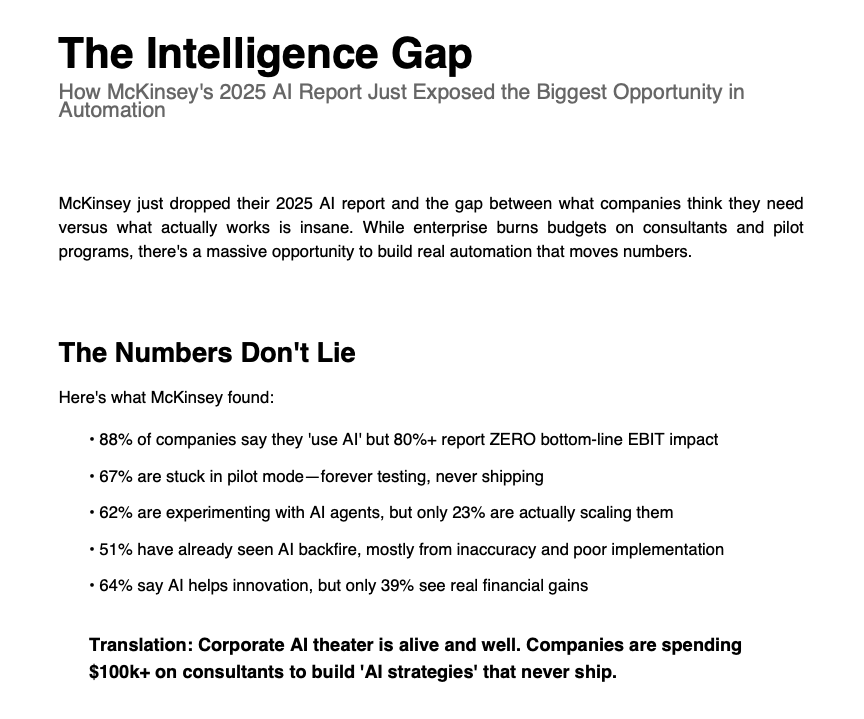
Here's what happens: a pilot costs $50,000 to $200,000. It works well enough to generate excitement. Then someone calculates the cost to scale it across the organisation. Building custom models from scratch can run up to $20 million upfront, with recurring costs per user in the tens of thousands annually. Even implementing document search with RAG can cost up to $1 million upfront.
Executives see those numbers and freeze. Projects that should scale to production stay locked in endless pilot phases. (I call it "proof-of-concept purgatory". One client has been running the same pilot for 14 months.)
5. The People Problem
BCG's 2025 research found that AI leaders follow a consistent pattern in resource allocation: 10% on algorithms, 20% on technology and data, and 70% on people and processes.
Most organisations flip this ratio. They invest heavily in technology and treat people and processes as afterthoughts. The consequences can be brutal:

That's the reality when you prioritise algorithms over people. Gartner's global CDO survey identified the top obstacles: data quality and readiness (43%), lack of technical maturity (43%), and shortage of skills and data literacy (35%).
What Successful Projects Do Differently
The 20% of organisations creating real value aren't necessarily smarter or luckier. From what I've seen, the common thread is discipline.
They Redesign Workflows First
McKinsey found that AI high performers are nearly three times as likely to fundamentally redesign individual workflows. Half intend to use AI to transform their businesses, not just automate existing processes.
This is the difference between adding AI to broken processes and reimagining how work gets done. One of our clients in healthcare redesigned their patient intake workflow before implementing AI. The result wasn't just faster processing. It was 40% fewer errors and dramatically improved patient satisfaction.
They Define Success Upfront
Successful organisations establish measurement frameworks before deployment. McKinsey's 2024 study found that leading companies already attribute more than 10% of their EBIT to GenAI deployments. They didn't discover this impact. They planned for it.
The measurement approach includes both quantitative metrics (revenue impact, cost reduction, efficiency gains) and qualitative factors (employee satisfaction, customer experience improvements, strategic capability development).
They Prioritise Strategic Impact
BCG's 2025 analysis shows that leading companies allocate more than 80% of their AI investments to reshaping key functions and inventing new offerings, rather than smaller-scale productivity initiatives.
Companies that moved early into GenAI adoption report $3.70 in value for every dollar invested, with top performers achieving $10.30 returns per dollar according to IDC research.
Here's what this means for the paradox: some of that 80% seeing "no impact" aren't failing. They're just early. Most organisations achieve satisfactory ROI within 2-4 years, much longer than typical 7-12 month technology payback periods. The problem isn't always that AI doesn't work. Sometimes it's that expectations don't match reality.
They Focus on Measurable Productivity
Federal Reserve research found that self-reported time savings from GenAI translate to a 1.1% increase in aggregate productivity. Workers are 33% more productive in each hour they use GenAI. OECD studies found productivity gains ranging from 5% to over 25% in customer support, software development, and consulting roles.
But here's what matters: these gains are measured, not assumed. MIT Sloan research found that when AI is used within its capability boundaries, worker performance improves by nearly 40%. When used outside those boundaries, performance drops by 19 percentage points.
Successful organisations know the difference.
A Framework for Actual ROI
After watching enough projects succeed and fail, I've developed a diagnostic framework that helps separate viable initiatives from expensive distractions.
Assessment Phase: The Four Questions
- Data Readiness: Can we access, trust, and integrate the data this project needs? (Data quality is the top obstacle cited by CDOs in AI projects.)
- Value Clarity: What specific financial metric improves, by how much, and by when?
- Workflow Impact: Are we redesigning the process or just automating existing inefficiency?
- Capability Boundaries: Do we understand where this AI helps and where it hurts performance?
If you can't answer all four with specifics, you're not ready to proceed.
Cost Categories: The Full Picture
Visible costs: Model development, infrastructure, licensing, integration
Hidden costs: Data preparation, workflow redesign, change management, ongoing monitoring, risk mitigation
Gartner's analysis shows that hidden costs often exceed visible ones by 2-3x. Budget accordingly.
Benefit Categories: Beyond Productivity
Direct benefits: Cost reduction, revenue increase, efficiency gains
Indirect benefits: Improved decision quality, enhanced customer experience, competitive positioning, strategic capability building
McKinsey found that in 2024, strategy and corporate finance showed the highest revenue increase at 70% of respondents, while supply chain reported 67%. The benefits are real, but they're not universal.
Timeline Expectations: The Reality Check
Most successful AI projects achieve satisfactory ROI within 2-4 years. If you're expecting 12-month payback, you're setting yourself up for disappointment and premature abandonment.
Key Takeaways
Diagnostic Questions to Ask Right Now:
- Can you articulate the specific financial impact of your AI initiatives in dollars and timeframes?
- Have you allocated 70% of your AI budget to people and processes, not just technology?
- Do you have AI-ready data, or are you assuming your existing data will work?
- Are you redesigning workflows or just automating existing processes?
- Have you defined success metrics before deployment, not after?
Implementation Priorities for the Next Quarter:
- Audit your data readiness before launching new AI projects. Data quality is the top obstacle cited by 43% of CDOs. Don't be caught unprepared.
- Establish measurement frameworks before deployment. Track well-defined KPIs from day one. This is the single most important success factor according to McKinsey.
- Redesign workflows around AI capabilities, don't just overlay AI on broken processes. High performers are 3x more likely to fundamentally redesign workflows.
- Reallocate budgets to 70% people and processes, 20% technology and data, 10% algorithms. This is what successful AI leaders do.
- Set realistic expectations for 2-4 year ROI timelines, not 12-month payback periods. Then plan accordingly.
The GenAI paradox isn't permanent. But escaping it requires honest assessment of where you are, clear definition of where you're going, and disciplined execution of what actually drives value. Most organisations haven't done this work yet. The ones that have are already pulling away from the pack.
If you're not seeing bottom-line impact from your AI investments, the question isn't whether the technology works. It's whether you're doing the hard work that makes it work for you.
---
Sources
- McKinsey: The State of AI in 2025
- PwC: AI Linked to Fourfold Increase in Productivity Growth (2025)
- BCG: Are You Generating Value from AI - The Widening Gap (September 2025)
- Gartner: 30% of GenAI Projects Will Be Abandoned (July 2024)
- Fortune: MIT Report - 95% of Generative AI Pilots Failing (August 2025)
- RAND Corporation: Root Causes of AI Project Failure (2024)
- McKinsey: Gen AI's ROI (2024)
- Integrate.io: Data Transformation Challenge Statistics (2025)
- St. Louis Fed: The Impact of Generative AI on Work Productivity (2025)
- OECD: Unlocking Productivity with Generative AI (2025)
- MIT Sloan: How Generative AI Can Boost Highly Skilled Workers' Productivity (2024)
- The Quarterly Journal of Economics: Generative AI at Work (2025)
- IDC Research: AI ROI Study (2024)
- Noah Epstein (@NoahEpstein_) on AI Pilot Purgatory (November 2025)
- @giyu_codes on AI Project Failures and Layoffs (August 2025)