

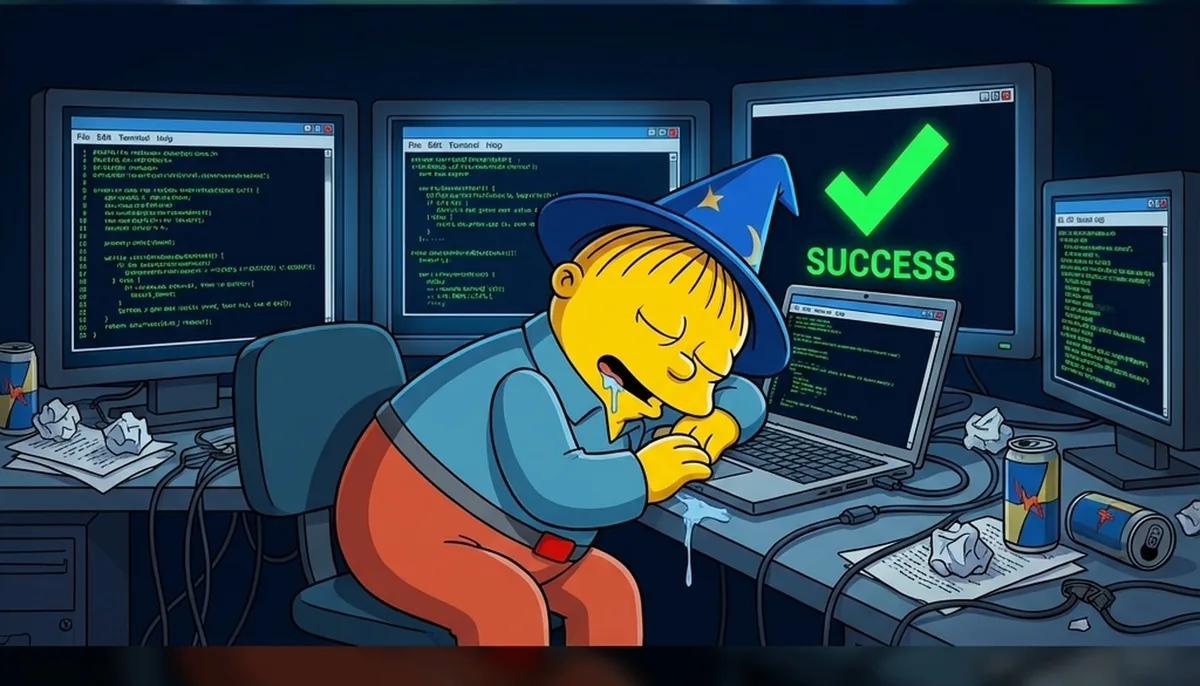
I thought it was a joke when I first heard the name.
Ralph Wiggum technique? Like the Simpsons kid who says "I'm helping!" while being completely oblivious? That's what we're calling serious development methodology now?
Then I watched Geoffrey Huntley's demo. He'd left Claude Code running overnight with a single prompt: build a programming language using Gen Z slang. Three months later, he had a working compiler. LLVM compilation. Editor support. The whole thing. That's when I stopped laughing and started paying attention.
The Accidental Discovery
Geoffrey Huntley, an Australian developer known for pushing LLMs into uncomfortable territory, introduced the technique in mid-2025. His original description was almost disappointingly simple: "Ralph is a Bash loop" (Geoffrey Huntley, 2025).
That's it. A while loop that feeds the same prompt to Claude over and over until the task is done.

But here's where it gets interesting. Each iteration isn't starting fresh. Claude sees the modified files from the previous run. It reads its own git commits. It reviews what it built, notices what's broken, and fixes it. The loop creates a self-correcting feedback system that can run for hours, even days, without human intervention.
The naming makes more sense now. Ralph Wiggum's childlike persistence ("I'm helping!") becomes a metaphor for AI that just keeps trying, learning from each failure, until it eventually gets there.
Why This Works (When It Works)
Huntley's core philosophy sounds counterintuitive: "Better to fail predictably than succeed unpredictably."
Traditional AI coding workflows focus on crafting the perfect prompt, getting Claude to produce pristine code on the first attempt. The Ralph Wiggum approach inverts this entirely. Instead of perfection, you optimise for iteration. Instead of clever prompts, you write clear completion criteria.
Matt Pocock, the TypeScript educator with a massive developer following, put it this way:

His earlier comparison was even more pointed: "How it started: Swarms, multi-agent orchestrators, complex frameworks. How it's going: Ralph Wiggum" (Matt Pocock, January 2026).
There's something almost embarrassing about how simple it is. We've been building elaborate agent architectures, and the solution turns out to be a bash loop and persistence.
How It Actually Works
The Ralph Wiggum plugin uses Claude Code's Stop hook feature to intercept exit attempts. Here's the flow:
- You initiate with
/ralph-wiggum:ralph-loop "your task" --max-iterations 50 - Claude works on the task
- When Claude thinks it's done and tries to exit, the Stop hook blocks it
- The plugin re-feeds the original prompt
- Claude reads the modified files and git history from the previous iteration
- Process repeats until your completion criteria are met or iterations run out
The key insight: each loop iteration has full context of what came before. Claude isn't restarting. It's reviewing and improving.
Here's what the commands look like in practice:
# First, add the official Anthropic plugin marketplace (one-time setup) /plugin marketplace add anthropics/claude-plugins-official # Install the Ralph Wiggum plugin /plugin install ralph-wiggum # Start a basic loop (note: commands are namespaced with the plugin name) /ralph-wiggum:ralph-loop "Add comprehensive tests to all exported functions" --max-iterations 20 # With completion promise (loop ends when Claude outputs this exact string) /ralph-wiggum:ralph-loop "Refactor to TypeScript until all type errors resolved" --max-iterations 50 --completion-promise "ALL_TYPES_RESOLVED" # Cancel an active loop /ralph-wiggum:cancel-ralphThe --max-iterations flag isn't optional. It's your circuit breaker. Without it, you're one ambiguous requirement away from burning through your entire API budget.
The Results Are Genuinely Impressive
I'm not prone to hype, but the case studies here are hard to ignore.
The Cursed Language
Huntley ran a three-month continuous loop with a prompt to create a programming language using Gen Z slang. The result was "Cursed," a functional language with LLVM compilation where slay means func and yeet means import. It has editor support. It compiles. It works (Cursed Language, GitHub).
Three months of autonomous iteration produced a working compiler. I don't know whether to be impressed or concerned.
The $50K Contract
Perhaps the most eye-catching: a $50,000 contract reportedly completed for $297 in API tokens. I haven't been able to independently verify this one, but even if it's exaggerated, the economics are compelling.
When Ralph Wiggum Shines
The technique works best for tasks with three characteristics:
Clear Completion Criteria
If you can define "done" in precise, measurable terms, Ralph loops excel. "All tests passing" works. "Make the code better" doesn't.
Arvid Kahl described it well: "The loop continues to experiment and look at prior work to ultimately get you there" (Arvid Kahl, January 2026). But it only works if "there" is a specific destination.
Mechanical, Repetitive Operations
- Large refactors (class components to functional)
- Framework migrations (Jest to Vitest, moment to date-fns)
- Dependency upgrades across many files
- Adding types to an untyped codebase
- Batch documentation generation
- Test coverage expansion
Automatic Verification
The best Ralph tasks have built-in success signals. Tests pass. Types resolve. Linters approve. The loop can verify its own work without human judgment.
When It Falls Apart
I'd be doing you a disservice if I didn't emphasise the failure modes.
Ambiguous Requirements
If Claude can't objectively determine whether it's succeeded, the loop will either run forever (burning tokens) or stop prematurely (declaring false victory). This isn't a Claude problem. It's a prompt problem. You need to be brutally specific.
Subjective Quality
"Make the architecture cleaner" is not a Ralph task. Neither is "improve performance" without specific metrics. The technique has no taste. It can't evaluate aesthetic or architectural quality.
Security-Sensitive Code
I'll be blunt: do not use Ralph loops for authentication, payment processing, or data handling without extensive human review afterwards. Autonomous code generation and security do not mix well. The loop might produce working code that's also vulnerable. You won't know until you look.
Context Dilution
Yoav Tzfati raised a valid concern: without context resets, irrelevant information accumulates across iterations (Yoav Tzfati, January 2026). If early iterations go down wrong paths, that baggage carries forward.
The Cost Reality
Let's talk money, because this is where developers get burned.
A 50-iteration loop on a large codebase can easily cost $50-100+ in API credits. That's not theoretical. That's what happens when each iteration processes thousands of lines of context.
The success stories come from well-optimised workflows:
- Clear, achievable goals
- Conservative iteration limits
- Tasks that converge quickly
- Smaller context windows
The horror stories come from the opposite:
- Vague requirements that never resolve
- No iteration limits
- Tasks that keep "almost" working
- Massive codebases in context
Practical Cost Management:
# Start conservative (assumes plugin is already installed) /ralph-wiggum:ralph-loop "Add JSDoc to utils/" --max-iterations 10 # Only increase after observing behaviour /ralph-wiggum:ralph-loop "Add JSDoc to utils/" --max-iterations 25 # Never start with max-iterations > 50 unless you've tested the taskWes Winder's enthusiasm ("opus 4.5 with ralph wiggum and playwright is agi") captures the upside (Wes Winder, January 2026). But AGI it isn't. It's a powerful tool with a fast-spinning cost meter.
The Ecosystem Beyond the Official Plugin
The community hasn't been idle.
frankbria/ralph-claude-code (463 GitHub stars) adds intelligent exit detection, rate limiting, and dashboard monitoring. If you're worried about runaway costs, this fork addresses it (GitHub).
ralph-orchestrator (253 stars) goes further with multi-AI support, error recovery, and spending limits (GitHub).
AwesomeClaude maintains a directory of templates, prompt patterns, and community implementations (awesomeclaude.ai).
The Universal Principle: Beyond Claude Code
Here's what I find most interesting. The Ralph Wiggum technique isn't really about Claude Code. It's about a philosophy: iteration beats perfection when you have clear goals and automatic verification.
That principle applies everywhere.
Cursor
Cursor's Background Agent and Composer can be set up for similar loops. You won't get the elegant Stop hook mechanism, but you can achieve the effect with bash scripts that re-trigger Composer after each completion. Some developers are using tmux sessions with watch commands to approximate Ralph behaviour.
Codex CLI
OpenAI's Codex CLI supports --dangerously-auto-approve for autonomous operation. Wrap it in a bash while loop with exit conditions based on test results, and you've got the same pattern:
while ! npm test; do codex "Fix failing tests" --dangerously-auto-approve doneCrude, but effective for the right tasks.
Aider
Aider's watch mode and auto-commit features support continuous operation. Configure it to watch for file changes and auto-commit passing tests, then trigger it in a loop. The ergonomics are different, but the philosophy is identical.
The Common Thread
Every AI coding tool can be wrapped in persistence. The specific implementation matters less than the insight: let the AI iterate toward a goal rather than expecting perfection on the first prompt.
If you're ready to implement this on your specific tool stack, we've written a complete technical guide with copy-paste scripts for every major platform.

Ralph Wiggum Loops: The Cross-Platform Implementation Guide
The Ralph Wiggum technique works beyond Claude Code. Here's exactly how to implement autonomous coding loops on Cursor, Copilot, OpenAI Codex, Aider...
Read full articleThe Opus 4.5 Evolution
There's an interesting development here. Matt Pocock noted that "Ralph Wiggum + Opus 4.5 is really, really good" (Matt Pocock, January 2026). But Opus 4.5 is also making the technique less necessary for many tasks.
I wrote about Opus 4.5's improved capabilities in my earlier analysis. The short version: context management has improved dramatically. Claude is better at following plans across long sessions. Tasks that used to require 20 iterations might now complete in 5.
This doesn't make Ralph obsolete. It changes when you reach for it. Complex, multi-hour batch operations still benefit from the loop structure. But simpler refactors might not need it anymore.
The technique is evolving from "necessary workaround" to "power tool for specific scenarios." That's healthy progress.
Getting Started Tomorrow
If you want to try this yourself, here's my recommended path:
Day 1: Install and Observe
# Add the marketplace (one-time setup) /plugin marketplace add anthropics/claude-plugins-official # Install the plugin /plugin install ralph-wiggum # Try a simple loop /ralph-wiggum:ralph-loop "Add a single test for the most critical function" --max-iterations 5Watch what happens. Don't intervene. See how Claude iterates.
Day 2: Small Mechanical Task
Pick something boring and well-defined. Adding type annotations to one file. Converting callbacks to promises in one module. Set max-iterations to 10.
Day 3: Overnight Run
Once you trust the pattern, try an overnight task. Something that would take you half a day of tedious work. Migration, documentation, test expansion.
Set a spending alert on your API dashboard first.
Key Takeaways
For Individual Developers:
- Ralph Wiggum works best for tasks you could do yourself but don't want to
- Clear completion criteria matter more than clever prompts
- Start with max-iterations 10-15, increase only after observing behaviour
- The technique isn't magic. It's persistence plus self-correction.
For Team Leads:
- Consider Ralph loops for batch operations that block sprints
- Establish guidelines for which tasks are appropriate
- Review autonomous code before merging, especially security-sensitive areas
- Track API costs carefully during adoption
For CTOs Evaluating AI Tools:
- The overnight success stories are real but not universal
- ROI depends heavily on task selection and prompt quality
- The technique works across tools, not just Claude Code
- Expect the pattern to become standard in AI-assisted development
The Philosophy:
Geoffrey Huntley's "Ralph is a Bash loop" sounds like a joke. It's actually wisdom. The most powerful automation isn't the cleverest. It's the one that keeps trying until it works.
Sometimes the best code is written while you sleep.
---
Sources
- Geoffrey Huntley. "Ralph Wiggum Software Development Technique". 2025. https://ghuntley.com/ralph/
- Geoffrey Huntley (X/Twitter). "meet ralph wiggum". 6 January 2026. https://x.com/GeoffreyHuntley/status/2008428845...
- Matt Pocock (X/Twitter). "My Ralph Wiggum breakdown went viral". 5 January 2026. https://x.com/mattpocockuk/status/2008200878633...
- Matt Pocock (X/Twitter). "Ralph Wiggum approach lets you ship while you sleep". 4 January 2026. https://x.com/mattpocockuk/status/2007924876548...
- Wes Winder (X/Twitter). "opus 4.5 with ralph wiggum and playwright is agi". 5 January 2026. https://x.com/weswinder/status/2008051871743918410
- Arvid Kahl (X/Twitter). "The loop continues to experiment". 5 January 2026. https://x.com/arvidkahl/status/2008202699372626091
- Yoav Tzfati (X/Twitter). Context window limitations discussion. 6 January 2026. https://x.com/yoavtzfati/status/200836207238046...
- Anthropic. "Claude Plugins Official Marketplace". GitHub. https://github.com/anthropics/claude-plugins-of...
- Anthropic. "Ralph Wiggum Plugin README". GitHub. https://github.com/anthropics/claude-code/blob/...
- frankbria. "ralph-claude-code". GitHub. https://github.com/frankbria/ralph-claude-code
- mikeyobrien. "ralph-orchestrator". GitHub. https://github.com/mikeyobrien/ralph-orchestrator
- Geoffrey Huntley. "Cursed Programming Language". GitHub. https://github.com/ghuntley/cursed
- The Decoder. "Ralph Wiggum Autonomous Loops". January 2026. https://the-decoder.com/ralph-wiggum-claude-code/
- DEV Community. "The Ralph Wiggum Approach". January 2026. https://dev.to/sivarampg/the-ralph-wiggum-appro...
- paddo.dev. "Ralph Wiggum: Autonomous Loops for Claude Code". https://paddo.dev/blog/ralph-wiggum-autonomous-...
---